


Utah’s capital city has a new vision for how it plans to add more greenery to the fast-growing Granary District, while slowly chipping away at a grand vision for an unofficial “green loop.”
Salt Lake City unveiled a new concept for the “500 West Corridor Improvement and Connectivity Plan” on Thursday, which essentially merges nature and active transportation needs alongside 500 West, from 600 South to 900 South.

It’s similar to what’s already available along the road from 600 South to nearly North Temple, including at The Gateway. Project officials believe it will offer better sidewalks, bicycle infrastructure and other “long-term needs of the street” for a former industrial area that’s become much more residential over the past decade.
“Missing sidewalks, inadequate storm drains and failing asphalt are the reality on 500 West today. With dozens of local businesses here and nearly 3,000 housing units that have been completed, are under construction or are in the pipeline, we can’t afford to delay these improvements any longer,” said Blake Thomas, Salt Lake City’s senior advisor on real estate and capital projects.

The project has been on the city’s radar for years, as part of the Green Loop that Salt Lake City Mayor Erin Mendenhall pitched in 2023. The project called for a linear parkway surrounding downtown, which could add green space to a part of the city lacking it while also improving the biking and pedestrian experience and creating “safe, comfortable and attractive corridors,” the mayor said.
However, the city backpedaled on that earlier this year, effectively focusing on individual projects within the scope of the original vision rather than building a system all at once.

“This is iterative, block-by-block, major one-off projects,” Thomas told KSL in January, adding that the city will view every block differently, but with the same overall goal of how it can improve downtown connectivity.
Salt Lake City recently allocated new funds to help pay for construction documents for a “Civic Center” on the east end of the Green Loop. The project also could receive $3.1 million from a parks bond that Salt Lake County plans to add to the November ballot.

The “500 West Corridor Improvement and Connectivity Plan” focuses on the southwest end of the original plan.
The design released on Thursday shows more trees for shade alongside the three-block stretch of 900 South, which seeks to lessen impacts of the urban heat island effect in the area. It also aims to improve street and utility infrastructure, such as stormwater and flood management, as well as parking and access for buildings located in the area.
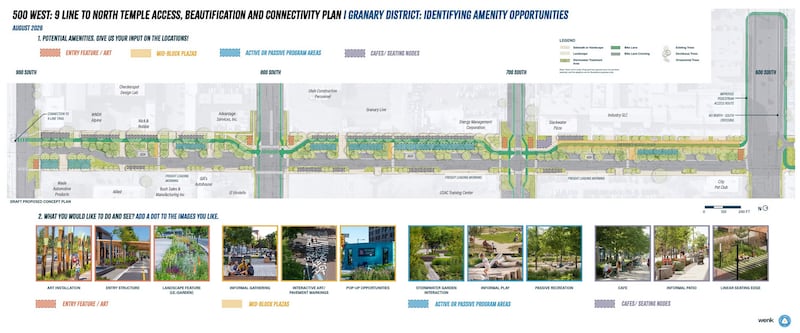
It calls for increased transportation safety for people walking, biking, driving and taking transit, as well. This includes improved bicycle and pedestrian connections at 600 South and 900 South, where it connects up with the 9-Line Trail that serves as the southern boundary of the green loop.
Better walking and biking connections are also planned for people seeking to reach the Folsom Trail, North Temple, downtown and surrounding neighborhoods, city officials said.

The concept plan, they said, was drafted in coordination with property owners and businesses within the area, but it’s not the end of the process.
Salt Lake City recently launched a new online survey about the concept, seeking to gather community feedback on it. City officials say the survey will help shape what types of amenities are included in the area, such as seating, gathering areas, recreation and art.
It remains open through the end of Sept. 12. Information collected from it will be used to revise the concept for a final plan, which could be completed by the end of this year, per city documents.
