


One of the most exciting archaeological digs ever undertaken in Utah may be part of the reconstruction of a downtown Salt Lake park.
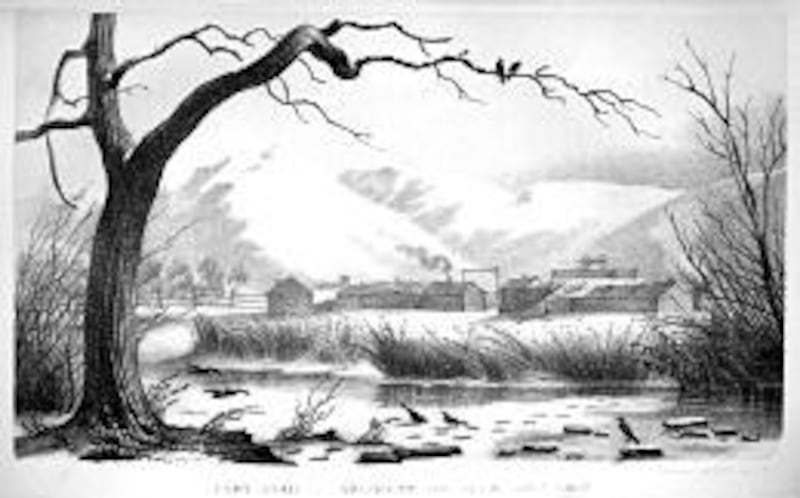
In July 1847, when the Mormon pioneers arrived in the Valley of the Great Salt Lake, they took precautions in case native tribes turned out to be hostile. They quickly built a fort. It never served as a defensive outpost, and instead became the center for the agriculture that sustained the city.
A description of the fort was penned by Capt. Howard Stansbury of the U.S. Army Corps of Topographical Engineers, who headed an 1849 federal survey of the Valley of the Great Salt Lake. The survey made valuable scientific discoveries, especially concerning the Great Salt Lake, zoology and botany.
In his report, printed by the government in 1853, Stansbury described the settlement of what was then called Great Salt Lake City:
"In a short time after the arrival of the pioneer company, ground was surveyed and laid out into streets and squares for a large city; a fort or enclosure was erected, of houses made of logs and sun-dried brick, opening into a large square, the entrance to which was defended by gates, and formed a tolerably secure fortification against Indian attacks."
Stansbury noted that in October 1847, another 3,000 to 4,000 pioneers arrived, "and the fort was necessarily enlarged for their accommodation.
"Agricultural labours were now resumed with renewed spirit; ploughing and planting continued throughout the whole winter and until the July following, by which time a line of fence had been constructed, enclosing upward of 6,000 acres of land, laid down in crops, besides a large tract of pasture land."
The location of the fort apparently was today's Pioneer Park in downtown Salt Lake City.
Skip ahead 156 years. Pioneer Park is a hangout for homeless people and panhandlers. From time to time violence erupts there, including stabbings. Heroin needles sometimes show up. Nearby businesses would like the site to become much, much nicer.
Mayor Rocky Anderson has been supporting plans for a redesigned Pioneer Park.
According to a Nov. 4 Deseret Morning News article, Design Workshop, a Park City firm, has drawn up plans for "history rooms" at the park's four corners, a dog run, Bocci courts, an interactive playground, concessions, a "great lawn" where children would play, a pathway for horse-drawn carriages and pathways for skating and biking.
If any of this is to happen, an archaeological survey would be required.
"The idea of doing something in Pioneer Park has come up several times in recent years," Kevin Jones, the state archaeologist, said Sunday.
"I really don't know the extent to which the subsurface in that area has been disturbed by the construction of the park and by sewer and utility lines cut through there, and so forth. It could be relatively disturbed."
The record of ancient and pioneer life may have been badly damaged or obliterated.
"It is right near the heart of a big city," he said. "There has been a lot going on in that area for over 150 years."
Still, much may await the trowel and brush of the archaeologist.
"There is potential for there to be significant historic and archaeological deposits in the park," Jones said.
A hint of that came in 1986, when a construction crew started work on the foundation of an apartment complex in Block 49, just east of Pioneer Park. Human bones and the deteriorated wood of early coffins were uncovered. Unknown to contractors, they were digging up Utah's first pioneer cemetery.
Archaeologists from Brigham Young University and dozens of volunteers stepped in to excavate the remains. Altogether, 34 skeletons were uncovered.
Excavators recovered the remains of pioneers who died in the 1840s and 1850s, and the bones of a young Fremont Indian woman who may have died centuries earlier, plus Fremont pithouses.
The site was important to two cultures because of the presence of City Creek's fresh water supply.
If development is to occur at Pioneer Park, workers should not uncover the past haphazardly, according to Jones.
"We know and revere that place as one of the first stopping places of the pioneers when they got here to the valley," he said.
"I think the first thing to do would be to do background research," documenting what may have occurred there. If the ground is to be disturbed, "then definitely some archaeological testing would be prudent."
Jones emphasized that should happen well in advance of any construction, not after heavy equipment is brought in.
Utahns should feel assured that the project would be carried out under careful supervision. "It would be only a block from my office," Jones said, "so it would be easy to go over and check on things."
E-MAIL: bau@desnews.com