

Salt Lake Mayor Rocky Anderson won a second term Tuesday in a healthy victory over challenger Frank Pignanelli as up and down the state citizens in 237 cities and towns went to the polls.
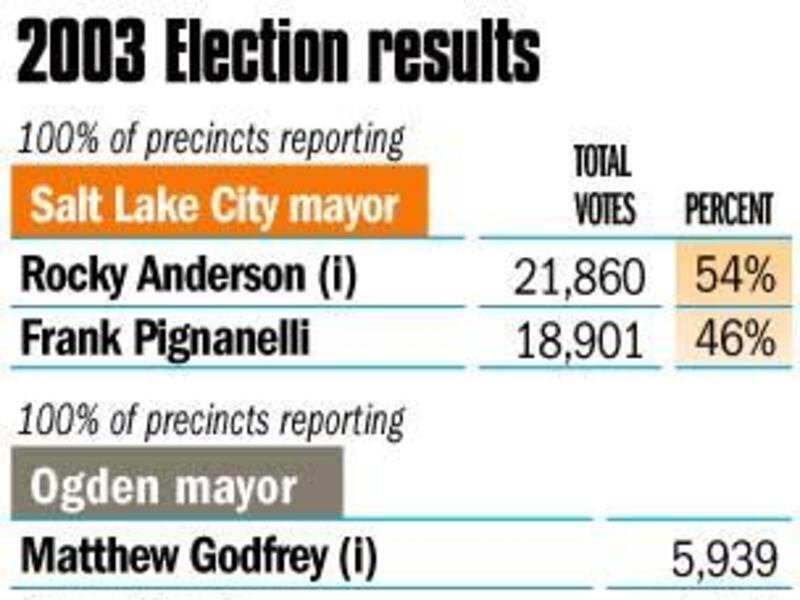
Final but unofficial tallies showed Anderson with 54 percent of the vote to Pignanelli's 46 percent — a larger victory than weekend newspaper polls indicated was coming.
Cold, snowy weather along the Wasatch Front gave way to clear skies but frigid temperatures as tens of thousands of voters picked their local government leaders and cast ballots on propositions and referendums.
There was a surprise win in Provo's council race. Steve Turley, who billed himself as "Mr. Nobody" during the campaign, beat incumbent Stan Lockhart.
Also, incumbent Mark Hathaway lost to Cynthia Dayton. Midge Johnson, also a newcomer, beat longtime city government gadfly Melanie McCoard for the District. No. 3 seat.
Shari Holweg, a former councilwoman, also lost a bid for elected office. Holweg attempted to force a postponement of the election through a lawsuit. Her suit, which was curtly dismissed three times by Provo judges, claimed Provo violated state election laws.
In southern Utah, LaVerkin residents voted down a referendum that would have banned the U.N. flag from city property, stopped the United Nations from stationing any personnel in the city and prohibited the international organization from taxing city residents. Councilman Al Snow, who got the referendum on the ballot but was dumped in last month's primary, said, "You can't blame me. I tried" to keep the United Nations out of LaVerkin.
In Ogden, first-term Mayor Matthew Godfrey easily defeated Councilman Jesse Garcia in the mayor's race, even though the state Democratic Party tried to turn out the vote for Garcia, a Democrat, in the nonpartisan contest.
And in Holladay, one of the state's newest cities, voters picked Dennis Webb over Bob Neslen to be their new part-time mayor.
All three Salt Lake City Council members seeking re-election won: Dave Buhler, Nancy Saxton and Val Blair Turner. The 48 percent voter turnout in Salt Lake City is considered fair but not outstanding, and perhaps could have been driven down by the poor weather.
The Salt Lake mayor's ballot-counting was close from the get-go after polls closed at 8 p.m. But as the night wore on, Anderson's lead widened.
Anderson said his victory Tuesday, while closer than his 1999 60 percent-40 percent win, still means most city residents are happy with how he's managed any number of difficult city issues. He promised to work hard over the next four years, continuing current programs and adopting new ones where needed.
Anderson won the Oct. 7 primary, topping second-place finisher Pignanelli by 15 percentage points. But as citizens paid more attention — as many of the votes that went to Republican Molonai Hola, eliminated in the primary, went to Pignanelli, the former state lawmaker-turned-lobbyist gained on Anderson.
A poll published last weekend by the Deseret Morning News and KSL-TV showed Pignanelli had closed to within 2 percentage points of Anderson, while a Salt Lake Tribune poll had Pignanelli slightly ahead.
All depended on who got out their supporters Tuesday. And that turned out to be the mayor.
Unfortunately for Pignanelli, said Deseret Morning News/KSL-TV pollster Dan Jones, many of the Hola supporters — especially Republicans who are also LDS — stayed home Tuesday. And most of the citizens who passed up the primary but voted Tuesday cast ballots for Anderson, a Brigham Young University exit poll showed.
Anderson said Tuesday night that a number of his supporters, perhaps shocked into action over the weekend by the close polls, didn't fail him on Election Day. They volunteered in get-out-the-vote efforts the past four days and even more went to the ballot box after seeing Anderson in danger of losing, he said.
Anderson said the close victory "perhaps showed that some (Salt Lakers) were angry" at him "for some of the tough decisions" he's made.
But displeasure sometimes comes with "real leadership," Anderson said, adding that's what he's provided over the past four years.
Will Anderson become a kinder, gentler mayor in his second term?
"I think I can do a better job communicating and do a better job building relationships with City Council members and state lawmakers," said Anderson. "And we have to bridge whatever divides there may be in this community."
He certainly turned that way during this year's re-election effort, which did not see Pignanelli, the former Democratic leader in the Utah House, slamming Anderson like some believed he should. To show a different side, Anderson ran soft and fuzzy TV ads, like the one showing former-Olympic-boss, now-Massachusetts Gov. Mitt Romney, an LDS Republican, endorsing the mayor.
Pignanelli said," I offered another way to run the city. But the mayor has been re-elected and now we all need to support him." As he gave his concession speech, he and his wife, D'Arcy, holding their twin sons, their daughter, Christiana, 7, cried softly clutching her mother's hand.
But Pignanelli said they'd fought the good fight. "We offered some solutions" to city problems, he said, and he hopes Anderson and the City Council will consider at least some of them. "The way the city does business needs to change," Pignanelli said.
Jones, who conducted exit polls throughout the day Tuesday for KSL-TV, said, "The Republicans didn't turn out — and neither did many of the (LDS) voters." As previously reported in the Deseret Morning News, while Anderson was keeping his non-LDS, non-Republican base, Pignanelli's challenge was to turn out voters who may not normally support someone like him — a Democratic Catholic.
Jones said that 43 percent of those who voted Tuesday told his surveyors that they were "very or somewhat liberal." "Only 30 percent of the conservatives voted. Nowhere else in Utah elections do you see that split," Jones said. In most Utah contests, conservative voters far outnumber liberals.
Only 28 percent of those surveyed told Jones they were Republicans. But Republicans make up more than a third of city voters.
About 45 percent of city residents are LDS, Jones said. Across the state, LDS Church members make up a greater percentage of voters than they do in the population because they go to the polls more loyally than do voters who aren't LDS. But Tuesday only 45 percent of the city voters told Jones they were LDS. "And many of those Mormons were Democrats, and Democrats voted heavily for Anderson. So, the Republican/Mormon vote didn't turn out," Jones said.
And that likely cost Pignanelli the race, he concludes.
Anderson said, "Some of the (LDS) divisiveness has been around for a long time," before the Main Street Plaza controversy. "But as we showed how inclusive we can be in city government— some saw that as (anti-Mormon) — and it is not at all that. I didn't roll over and convey the (free-speech) easement initially (to the LDS Church, which had purchased the Main Street Plaza from the city for $8.1 million). I kept (former Mayor Deedee) Corradini's commitment (of a free-speech easement), and a lot saw that as I wasn't friendly to the LDS Church. Not true."
The mayor's race was the most expensive in city history. Anderson raised and spent more than $700,000, while Pignanelli's campaign could top $400,000. Neither candidate agreed to the city's voluntary campaign limit of $375,000, which now seems outdated.
Neither Anderson nor Pignanelli wanted to talk about future campaigns, having just finished this tough one. But Anderson said earlier this year that he could see himself as mayor 10 years from now. "But it's way too early to think about a third term," Anderson said Tuesday night.
Pignanelli told the Deseret Morning News this summer that should he lose this race he'd likely not be a candidate for some time, as his young children grow. But after they are older, he could run for another office, he said, "Politics always being such a large part of my and D'Arcy's life."
Salt Lakers also approved five of six property tax bonds to pay for nearly $45 million of improvements. The increases mean the property taxes next year will go up about $30 on a $175,000 house, when bond payments and operational costs of the new facilities are figured in.
Hogle Zoo will get $10.2 million to renovate the elephant and big cat enclosures; the old main branch of the Salt Lake City Library will also get $10.2 million to remodel the facility into "The Leonardo," a science and art interactive museum; $5.4 million will be spent preserving open space; $15.3 million will build a large soccer/outdoor sports complex somewhere on the city's west side; and Tracy Aviary will receive $1.1 million to build various new bird exhibits.
But two new library branches won't be built for $5.4 million, Proposition 3 losing by a narrow margin.
E-MAIL: bbjr@desnews.com