

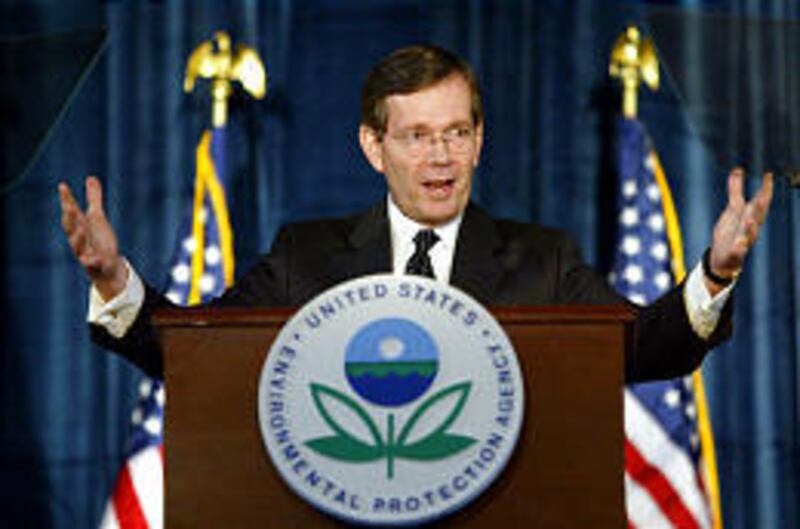
WASHINGTON — Mike Leavitt sounded a clarion call Tuesday for his Environmental Protection Agency to replace any old command-and-control philosophy with collaboration — to produce more quickly, with new partners, solutions that are better.
"Collaboration is not code for compromise. It is the pursuit of what's possible checked only by the realities of what is workable," the former Utah governor said.
That came during Leavitt's first address to all EPA staff since he was sworn in as EPA administrator three weeks ago. He spoke to about 1,000 employees at EPA headquarters — carried by TV to all staff nationally — to outline his guiding principles, and to hint at portions of an upcoming plan to improve national air quality.
Many of his themes are familiar to Utahns, especially his renewed call for "enlibra" — a word he coined from Latin roots to mean "toward balance" — in EPA work.
"Balance is the key," he said. "Real environmental problem-solving takes place in the productive center, not at the emotional extremes where we hear the loudest voices."
And with that enlibra philosophy, he said, "I believe EPA needs to be in the standards business, not the prescriptions business" and should seek "national standards, (but) neighborhood solutions" with flexibility on how best to reach goals.
Leavitt said, "I am convinced that formalized collaboration is the next great leap in environmental productivity, and EPA can lead the way."
He said he wants the EPA to bring new collaboration networks together to address the stickiest of environmental problems.
"We can help connect players," he said. "We can assist in getting them started. We can provide resources. And sometimes we can do something as simple as just get out of the way."
"Collaboration does not eliminate litigation, but it can minimize it. Collaboration doesn't take away from hard decisions, but it improves acceptance."
Leavitt said a key part of that enlibra approach — and a key to improving air quality — is for Congress to pass President Bush's "Clear Skies" proposal. It would tighten national limits on pollutants, but allow polluters to sell or swap pollution "credits," giving market incentives to find innovative ways to reduce emissions.
"The cap-and-trade approach shows us again and again that people do more and they do it faster when they have an incentive to do what's in the public interest," Leavitt said.
Leavitt said passing Clear Skies is part of a "500-day plan" he is developing to address air quality. He plans to release it soon — with similar plans on other tough issues to follow.
"I enjoy problem-solving. I like to select a group of long-term goals. Then I rely on a 500-day plan to create a timetable of short-term actions that will move us toward the achievement of the longer-term goal," Leavitt said.
He said other portions of the upcoming air quality plan will include working to address mercury emissions from power plants, placing controls on off-road diesel engine emissions, and working to ensure compliance with ozone and particulate standards.
"We will continue to protect. We will continue to safeguard. May we do it faster, may we do it better, may we collaborate more that we have ever done before," Leavitt told EPA staff. "More, better, faster, newer: That's the tune you will hear from this administrator."
E-mail: lee@desnews.com