

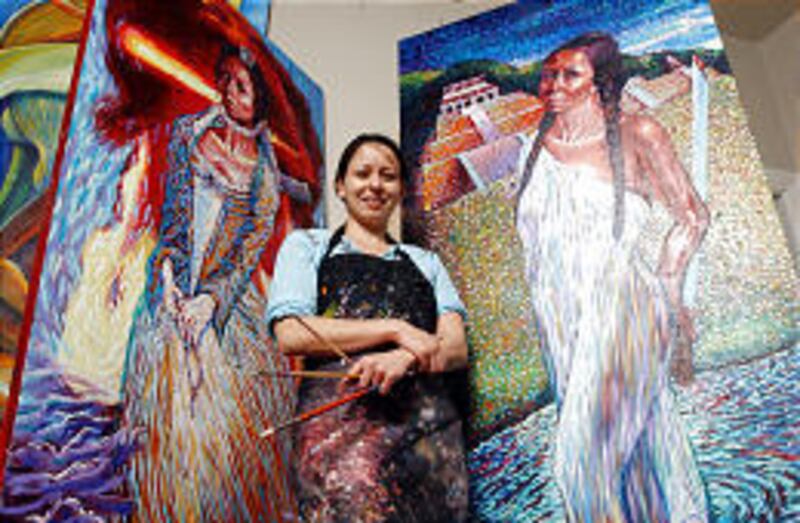
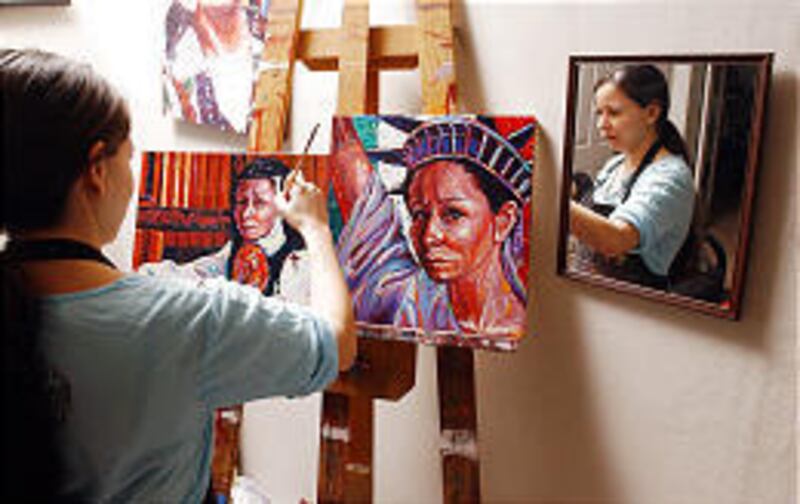
The house on 600 West in Salt Lake City is old and pretty, with a tiny sidewalk leading to an arched entry. Inside, in the living room, a mirror hangs next to an easel. Here, in the space of two months, Ruby Chacon has turned out more than a dozen paintings for a show that opens Monday at the University of Utah.
The exhibit is part of the university's Women's Week celebration, titled "Women in Leadership Shaping the Future."
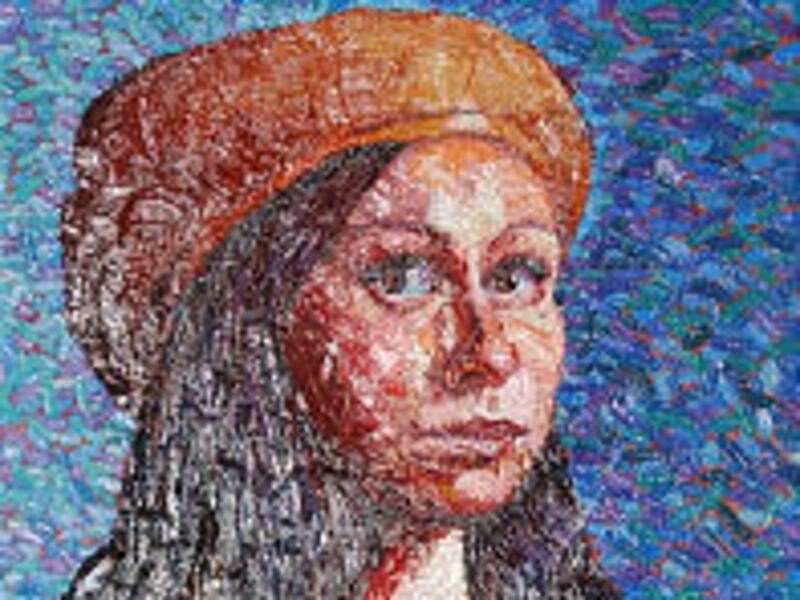
Chacon used herself as a model for each work. Together, the paintings describe the women who shaped her future. Chacon paints Aztec and Mayan women, Mexican women after the Spanish conquest, nuns and rebels. There is also a portrait of a woman with Chacon's face wearing the crown of the Statue of Liberty.
Each is painting is titled "Self As . . . "
There's a "Self As a Spaniard," a "Self As Mestiza," a "Self As Chicana Brown Beret."
Chacon relied on the mirror to begin each painting, but as she worked, she no longer needed to look at her own face. With each portrait, there came a point where art and imagination took over.
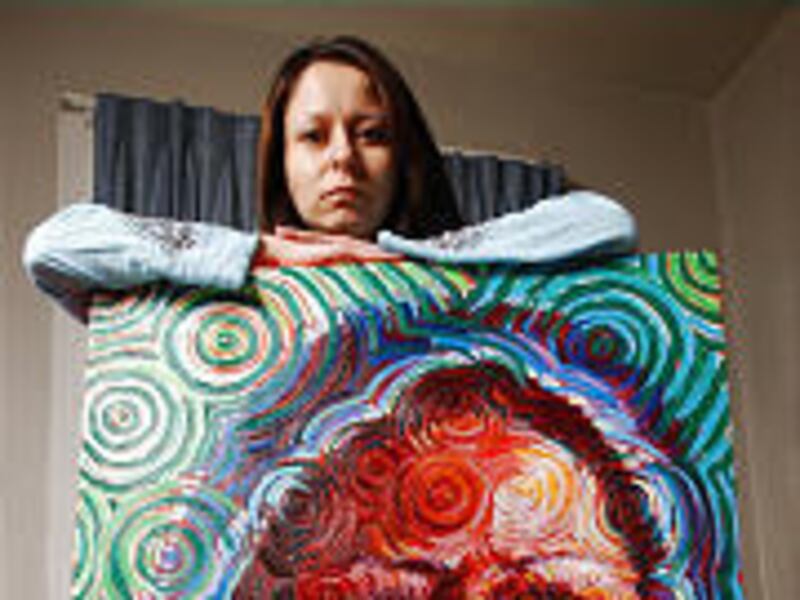
One portrait is painted in swirling, circular strokes. Another is in chunks of color that look like they were put on with a knife. Some of the portraits are small; others are huge, larger than life.
Growing up in Utah, "I never saw role models that fit my identity," Chacon says. But while these paintings are about her heritage, they are also about the human struggle, which is universal.
Chacon graduated from the University of Utah with a degree in fine arts in 1998. She had no choice about what to major in, she said. There was nothing she loved as much as painting. But it is one thing to study painting and something else entirely to decide to make your living at it. She might not have considered a career in art were it not for her nieces. And her nephew, too, of course.
Chacon's nephew, Orlando Chacon, died in 1996 at the age of 3. His mother's boyfriend was convicted of shaking him to death. At the time, the newspapers told the story just that simply. Also, at least one reporter got some facts wrong, said Chacon. But, she added, that is to be expected. An outsider's view of her family's life is always going to be "a little bit tainted."
It is only natural to think your own ways are best, she says. My mother is a better cook than your mother is. My father is stronger than yours.
Not long after her nephew's death, Chacon found herself sitting next to her nieces at a candlelight vigil. It was the YWCA's Week Without Violence, and her nephew's name was going to be read as one of the victims, one name in a long list of those who had died that year. As she sat with the girls, Chacon was startled to see that her nieces knew a lot of the names on the list.
What was their world like, she wondered. Did they see beauty in their history, or did they see a people who were expendable, born to die young? "Did they think we were here for tragedy, or is there something more?"
Chacon and her husband had a child of their own by that time. Her concern for the children set her off on an odyssey. She wanted to paint the stories of her family.
She felt obligated to, actually. "I was the only one in my family who had graduated from high school and college. I am the one who has been given the opportunity, so I need to do something with it."
Chacon was descended from people of New Mexico, who had lived there since the state was part of Mexico. She began her task by visiting her Grandfather Chacon in Monticello, Utah. She talked to him, then came home and painted him. Later, she visited the towns and villages of her ancestors, places he told her about. She had known her grandfather was a sheepherder, but she discovered he was also a poet. She came back to paint her grandfather again and again.
Chacon's sense of humor is keen, yet gentle. She laughs as she describes their portrait sessions. Her grandfather was hard of hearing. She'd ask him a question and he'd answer something else and tell a story that had nothing to do with the project at hand. But they were getting to know each other. "I was validating him. He was validating me and giving me a place. We did that for each other."
When she wasn't traveling or painting, Chacon worked at temp jobs. She was a receptionist, a ticket-taker, a telemarketer. Gradually, she became known for her art. Now she can make a living at it.
There are pros and cons to being able to earn money through art, she said. "The reward is being able to do what you love." On the other hand, "The hobby you love becomes a job."
When she was invited to do a show for Women's Week, Chacon thought of painting the portraits of mothers, mothers of today's leaders. She talked about the concept with people at the U. She talked with friends. "Nobody really liked that idea," she said. So she came up with another idea and didn't tell anyone about it, for fear of killing it with talk.
Chacon already knew Mexican folklore. She was raised on the story of La Llorona, "the weeper." La Llorona is a mythical monster who roams the world crying and looking for her lost children. In some versions of the story, she has killed her children. In other versions, they have drowned. She is used as a caution: Don't be out too late or La Llorona will snatch you to replace her own lost child.
Two of the largest paintings in Chacon's new exhibit are of a Mayan woman and a Spanish woman at the time of the conquest. The Mayan figure is La Malinche, "the betrayer." She was a real woman, but the legends around her are a version of the La Llorona story. In Chacon's painting, she holds a bloody knife behind her back. She has killed her children because Cortez is their father, and they were destined to be taken to Spain to be raised. She knew that someday they would return to oppress their own people.
The Spanish woman belonged to the conquering race. She was wealthy and protected, but Chacon did not want to paint her like a princess. A cloud of red boils behind her head. Chacon is showing that she is no better, no less bloodied, than the Mayan woman.
As you stare at these two dramatic figures, you do not notice right away that they have the same face. Instead, when you look at them, or at any of Chacon's paintings, you see first that they are women who appear both mysterious and strong.
If you go . . .
What: Ruby Chacon art exhibit: "Women Shaping My Future"
When: Monday through March 27
Where: Olpin Union Gallery, University of Utah
Hours: Daily 9 a.m.-9 p.m. (closed March 14 and 21; open at 10 a.m. on March 20)
Cost: Free
Phone: 581-5888
E-mail: susan@desnews.com