

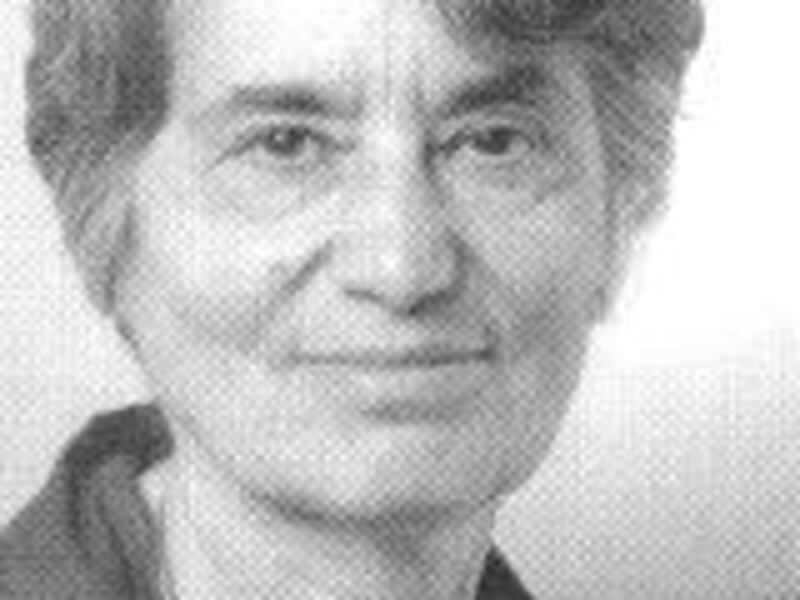
Holocaust survivor Ruth Kluger is a grandmother who likes to read mystery books. She's also a professor emerita of German literature at the University of California at Irvine.
However, when she travels to Germany, "None of this is important."
"When I go to Germany, it's quite obvious that everybody registers I'm Jewish," Kluger said. That's a contrast from the United States, where "you sort of blend in."
Kluger, a scholar of postwar German literature, will deliver a lecture on modern German perceptions of Jews on Tuesday as part of the University of Utah and Jewish Federation of Utah's weeklong Days of Remembrance.
"On the one hand they want to make up for it, they want to atone in some way," she said. "There are also feelings of resentment that you cannot be proud of your grandfather.
"It's unhealthy not looking at Jews in a sort of normal way, as a minority that exists in your country or as a people who are just people," she said.
This year marks the 20th year that the U. has set aside a week to remember the millions of victims of the Nazi-perpetrated genocide during World War II. The week coincides with the national Holocaust Remembrance Day on April 18, or Yom Hashoah in Hebrew.
Students will wear yellow stars, in memory of those forced to wear the "Star of David" as a form of ostracism in Nazi Germany. Events include lectures by Kluger and Charles Sydnor, historian and expert witness in several Nazi deportation and denaturalization trials. Films on the Holocaust will be shown at the Olpin Union Theater. On Friday, Gov. Olene Walker will deliver a proclamation at the Utah Capitol.
"I think that particularly in the humanities, we have to do everything that we can to keep these memories alive," said Harris Lenowitz, professor of Hebrew at the U.
"We have been privileged to have the witness of survivors for many, many years now. There's quite substantial literature, quite a substantial library of photo archives. . . . Projects like that, and like what we're doing here, are the key to keeping awareness of what happened there fresh and uncontorted."
Sydnor, who wrote the book "Soldiers of Destruction," will deliver a keynote address on Reinhard Heydrich, who he says was Hitler's "CEO" of the Holocaust.
"He is the key perpetrator from the standpoint of accepting the responsibility for executing the orders for genocide," Sydnor said. "He had to figure out how to do it, he had to organize it.
"The thing that is most chilling about Heydrich is how methodical, businesslike and coldly detached he was from the human enormity of what he was doing. He looked at it like a business. It was just another job."
Sydnor, president and CEO of the Commonwealth Public Broadcasting Corp. in Richmond, Va., said there have been several attempts at mass genocide since the Holocaust.
"I think the over-arching question is, how did this holocaust happen, and why," he said. "I'm not sure that we'll ever know all the reasons why, and I hope we'll all understand that genocide . . . is not something civilization is likely to survive again."
Kluger was 16 years old when she came to the United States with her mother. In 1988, she went back to Germany for two years on an exchange program, and there decided to write her autobiographical memoir, "Still Alive: A Holocaust Girlhood Remembered."
"I'm no wiser than anyone else," said Kluger, who was a young teenager when she, her mother and an adopted sister managed to escape from a "death march" between concentration camps. The three disguised themselves as German refugees and waited for Allied soldiers.
Kluger said the war in Iraq has made her somewhat pessimistic that anything has been learned from the genocide that claimed the lives of most of her family.
"At the same time one hopes the next generation will do a better job," she said.
E-mail: dbulkeley@desnews.com