

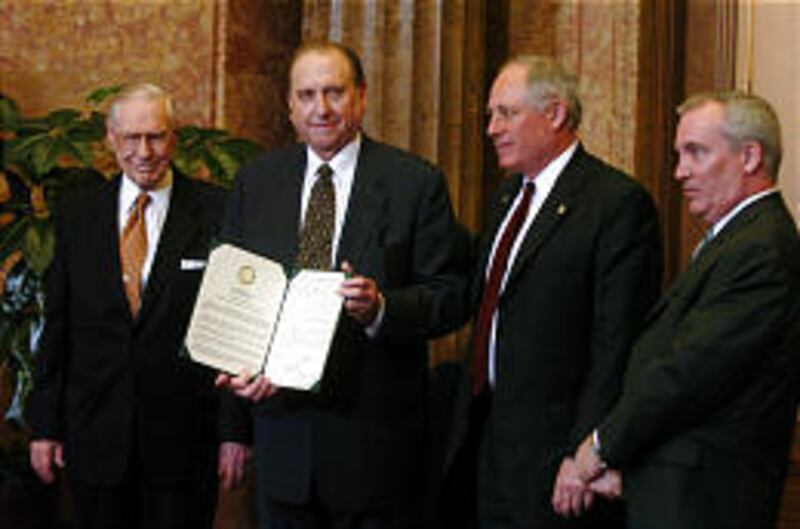
Seeking to send a message about the dangers of intolerance and religious bigotry, Illinois state government officials expressed their regrets in person Wednesday to top leaders of The Church of Jesus Christ of Latter-day Saints nearly 160 years after persecution eventually drove some 20,000 early Latter-day Saints from their homes beginning in 1846.
Illinois Lt. Gov. Patrick Quinn said the assassination of LDS Church founder Joseph Smith and his brother, Hyrum, in 1844, and the subsequent mobbings, property destruction and terrorizing of early Latter-day Saints in Nauvoo, Ill., is "a chapter in the history of Illinois that we are not proud of."
Respect for the religious beliefs of all people and tolerance for those who are different is "a fundamental part of American democracy. It's what we're fighting the war against terrorism over," he said.
"There was a day in February 1846 on Parley's Street (in Nauvoo) where people who were practicing their faith, people of good faith, were asked to leave the state and asked to move to another place. It wasn't right. We acknowledge it was wrong and express our regrets and look forward to the future."
Quinn said it is "important to come here to Salt Lake City to tell you that the people of Illinois are a warm and generous group of citizens. . . . We believe in religious freedom as a fundamental part of the Illinois and the U.S. constitutions."
Many Americans had forebears who came to the U.S. seeking freedom from religious persecution and the chance to practice their faith, he said, adding, "Those values need to be protected today in the 21st century as they should have been protected back then."
Rep. Daniel J. Burke, of the Illinois House of Representatives, expressed "sincere regret and commiseration for the horrific events" that occurred in driving early Latter-day Saints from Illinois. He said his office and other government officials have been "literally overwhelmed by the number of communications we've received" from Latter-day Saints since word of House Resolution 793's unanimous passage expressing "regret" for 19th century persecution broke last week.
"Hundreds of members of the church from all over the globe" have expressed their thanks for the gesture, he said. "Through these communications, we've learned how important this is to your community." Burke read the two-page resolution aloud to reporters before presenting a leather-bound copy of it to President Thomas S. Monson, first counselor in the church's First Presidency.
President Monson thanked him for "your kind words and this gracious gesture. We're grateful to you and the good people of Illinois," he said, adding the move "says much about kindness, compassion and feeling."
Church President Gordon B. Hinckley was originally scheduled to accept the resolution but was unable to attend following his wife's death on Tuesday afternoon. "President Hinckley asked me to extend his heartfelt appreciation to all of you. He very much wanted to be part of this unique, historic moment," President Monson said.
There was no concern expressed by church leaders about the change of wording in the resolution from "apology" to "regrets" after some Illinois lawmakers worried the wording was too strong.
President Monson acknowledged the legislative work of Rep. Burke and Rep. Jack Franks, along with discussions by Illinois Appellate Court Justice Anne Burke and her husband, Chicago Alderman Edward Burke, regarding the preparation and passage of the resolution. It was drafted after Ed Burke heard the Nauvoo story from Gov. Olene Walker's husband, Myron, during a visit to Deer Valley last year. Burke enlisted help from his brother, Rep. Dan Burke.
The resulting resolution detailed the history of the church in Nauvoo and expressed regret for "the expulsion of the community of Latter-day Saints, a people of faith and hard work" in addition to seeking "pardon and forgiveness." It also acknowledged that "biases and prejudices of a less enlightened age in the history of the State of Illinois caused . . . hardship and trauma" for LDS Church members "by the distrust, violence and inhospitable actions of a dark time in our past."
Though early Latter-day Saints did suffer through "perilous times," those days are "long gone and far behind us," President Monson said. Today the church "is woven into the everyday fabric of life in Illinois, with 51,000 church members" who call the state home and hundreds of thousands who return to Nauvoo each year in something of a "reverse trek" pilgrimage honoring their ancestors.
The resolution and visit by Illinois officials are "a marvelous expression of respect," said President James E. Faust, second counselor in the First Presidency. "Faith and belief is what powered the growth and success of Nauvoo, and that same belief powers the church today."
Just as both the Salt Lake Temple and the reconstructed Nauvoo Temple stand as monuments to the sacrifice of early Latter-day Saints, the resolution is "yet another monument" to their faith and perseverance that will "long live in the hearts of this people," he said.
"At a time when religious differences too often lead to confrontation and even violence, we view this resolution as an affirmation that Nauvoo is yet again a place of peace and that Latter-day Saints will always have a home in Illinois."
Both Quinn and Burke encouraged Latter-day Saints to visit their state. Quinn said he recently learned of a "new air route" being established from Salt Lake City to Burlington, Iowa, which would make it more convenient for visitors traveling to Nauvoo. Burlington is just across the Mississippi River from Nauvoo, a tiny town of 1,500, which hosts about 350,000 visitors annually.
E-mail: carrie@desnews.com