

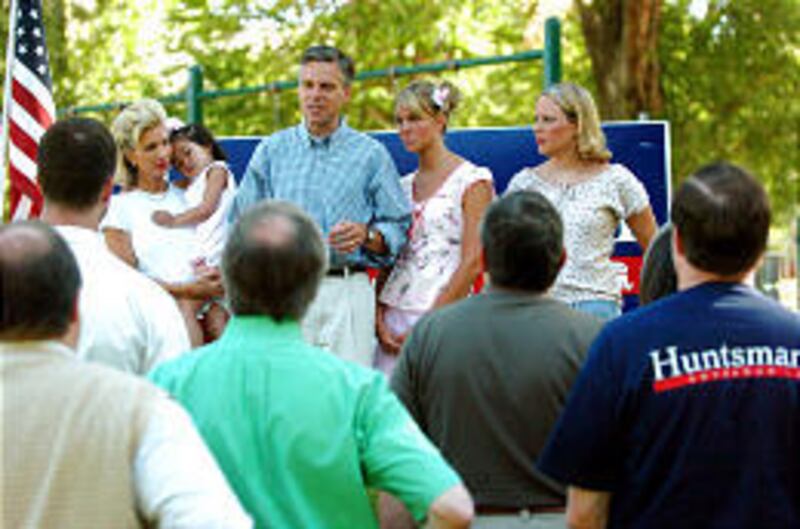
Jon Huntsman Jr. remembers vividly the moment two years ago when, during a rare weekend getaway to West Virginia, his wife, Mary Kaye, and his six children sat him down for dinner and a family meeting.
"It was all planned in advance. They told me they wanted their dad back and they wanted to go home to Utah," Huntsman recalled. "It was an 'intervention.' "
After two years as a U.S. trade ambassador criss-crossing the globe, Huntsman, now 44, was already feeling the gnaw of mounting regret that he had missed important family events. When terrorists crashed a jet into the Pentagon near his Virginia home, Huntsman was stuck in Vietnam, unable to allay his family's fears. He couldn't even call them.
The intervention hit him hard, and it "reminded me how important family is," he said. "And I listened to them."
Huntsman also listened to his children when, after the decision was reached to return to Utah, he said the children were the ones who came up with the idea he run for Utah governor.
Despite news reports he was a probable candidate before he returned to Utah, Huntsman insists he had never considered that prospect before and that he initially dismissed the idea. But the more he thought about it, the more he was intrigued.
"I can do it with my family," he said. "I can work 24 hours a day as long as it is with my family."
Polls show Huntsman is the front-runner in the race for the GOP nomination. As the eldest son of billionaire Jon Huntsman Sr., he's certainly got the name recognition, deep financial pockets and an inherited drive to succeed.
But those are also factors that, in the minds of some voters, work against him. They see the younger Huntsman as a "silver-spoon" prodigy, someone who has succeeded in life because his father paved, if not paid, the way.
Jon Jr. bristles at that characterization, but he acknowledges the perception is there. "The stereotype doesn't come up as often as I thought it would," he said.
Up side, down side
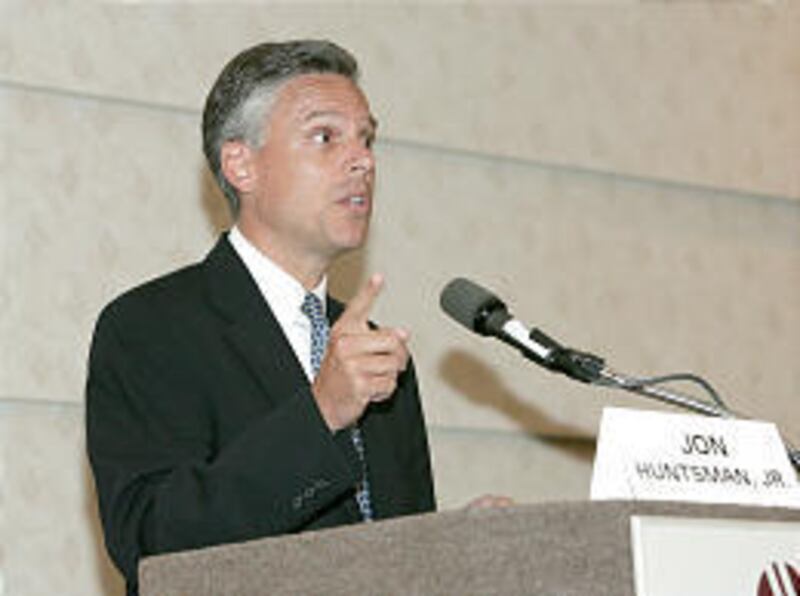
Still, it comes up enough that Huntsman typically starts his speeches to would-be voters with a preamble asking them to "suspend your stereotypes and get to know me and my family as people." He then lays out his ambitious agenda for Utah's future, all marinated with an infectious optimism.
"There aren't too many left in the room thinking I am consistent with the stereotype they had coming in," he said. "That is something that can't change until they have had a chance to meet me and talk to me."
One GOP consultant, who worked on a rival campaign before last month's GOP convention, said Huntsman never dispelled the "silver spoon" image, "but he made enough humor about it that people accepted it. People came to accept it is who he is, he was born that way and there's nothing he can do about it."
The Huntsman family name, he added, has both an up side and a down side. There are a lot of people who revere the Huntsmans for all the positive things they have done. The negative is that many people resent the wealth and privilege that comes with it, and they will say his father is "just buying him another job."
"For good and bad, the fact is he wouldn't be in the position he is today if his name was Jon Smith and his dad was the postmaster of Bluffdale," he said.
Huntsman doesn't shy away from his family name, and he recalls fondly his childhood traipsing along with his father trying to sell eggs to grocery stores. And he remembers the worry when the family mortgaged their house to buy the family's first container plant and the next two years when it looked like they would lose everything.
Connections pay off
The transformation of the Huntsman company into an international petrochemical giant left the eldest son in disbelief.
"The silver-spoon thing is a recent phenomenon, something that came as a result of those successful years in the 1990s," he said, adding those who try to paint him as a spoiled rich kid who has had everything handed to him have a warped sense of history.
Jon Huntsman Jr. has held a job ever since he was a teenager. He met his future wife while working as a dishwasher at Marie Callendar's; Mary Kaye was working the salad bar.
Even as a millionaire now, he said he has never embraced the trappings of wealth, pointing out that he doesn't own a second car or a second house, and the "one luxury" he indulged himself — a Harley Davidson Road King — sits unused in the basement parking of the Huntsman corporate offices.
To clarify the point, however, Huntsman's wife owns a car, and so do two of his children. And he doesn't need a second home when the elder Huntsman owns vacation retreats in Deer Valley and Hawaii that his children use whenever they want. Huntsman has even used the Deer Valley "castle," as it is often referred to, for campaign events.
So have the Huntsman name, money and political connections had anything to do with the opportunities Jon Jr. has had over the years?
"And tell me something else that isn't absolutely obvious," Huntsman said during a November 2002 interview with the Deseret Morning News.
'A policy wonk'
But Huntsman today is quick to point out that he has built his own name and reputation in Washington, D.C., independent of his family name and money.
He is, for example, a trusted foreign policy expert who has developed his own network of Washington insiders who have helped further his career. He rattles off current Washington officials like Paul Wolfowitz and Richard Armitage as close friends.
It was that network, along with the fact he speaks fluent Mandarin Chinese (learned on an LDS mission), that propelled him to the youngest U.S. ambassadorship in more than 100 years when he was sent to Singapore by the first Bush administration, he said.
Huntsman cut his teeth in politics — he prefers to call it public service — as an intern to U.S. Sen. Orrin Hatch, R-Utah, and later as a low-level assistant to President Ronald Reagan, coordinating the logistics of presidential travel. When the first George Bush was elected president, he found himself working on trade issues with various commissions and later as a deputy assistant secretary of Commerce for east Asia and the Pacific.
He met influential people and cultivated his own network of up-and-coming Republican friends, he said. During the Clinton administration, that network, Huntsman included, began writing papers on foreign policy for a variety of Washington, D.C., conservative think tanks.
"I love public policy," he said. "Secretly, I am a policy wonk. I love the minutiae of policy, getting different people with different opinions and hammering out a position."
That love of policy led him to formulate his campaign positions without the assistance of aides who specialize in various state issues. His campaign manager, Jason Chaffetz, said Huntsman interviews everybody he can about an issue and writes his thoughts in a growing catalog of notebooks that become the official policy of the campaign.
The one exception was his economic plan, where he brought together a team of experts. Former U.S. Sen. Jake Garn and businessman Larry Miller also advise him once or twice a month on general campaign strategy.
"There are no policy wonks behind the scenes," Chaffetz said. "He is the policy wonk."
That process has led to some initial doubts. When Huntsman was named chairman of Envision Utah, a fellow board member says Huntsman was a fish out of water. He knew nothing about growth planning and open space and the other complex issues facing the coalition.
"But he jumped in and studied everything we were doing, and he became a great leader," he said. "His learning curve was very, very short."
The process of immersing himself in an issue is something Huntsman said is rooted in his days in Washington. After George W. Bush won election in 2000, the network of Republican foreign policy experts rose to prominence in the new Bush White House. Huntsman, who was an adviser to the Bush campaign, was chosen as U.S. trade ambassador responsible for all trade issues in Asia and Africa.
It was a heady time that included meetings with the National Security Council and with foreign heads of state.
Family: front and center
The hardest part about running for governor, Huntsman said, has been purging his mind of things like trade tariffs and favored-nation status. "I now sit down with ranchers and talk about land issues," he said.
Huntsman has thrown himself into the gubernatorial campaign, calling himself a "monochromatically focused individual," a trait he says is "maybe a Huntsman mental illness."
"Whatever I have done, I focus on it singularly, energetically and passionately," he said.
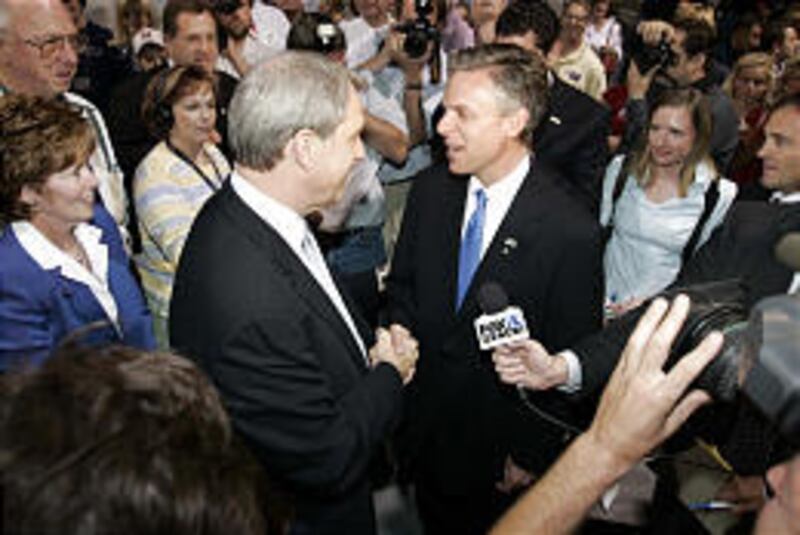
Chaffetz says Huntsman has lost 20 to 25 pounds during the campaign because he has been too focused on speaking rather than eating at all the rubber-chicken affairs.
The focus on becoming Utah's next governor has come with a personal cost. The 32-year veteran of motorcycle riding hasn't even bothered to register his Harley, let alone saddle up and ride. And there hasn't been much time for the avid rock and jazz aficionado to go to concerts or converse with friends on the role of rock 'n' roll and jazz in American history.
"They are unique expressions of who we are as Americans," he says.
And there hasn't been as much time as he would like for his much-beloved "dinking" — a term he coined for adventurous trips with his kids to the greasiest of greasy-spoon diners. But there have been a few dinks along the campaign trail, along with what he calls a treasure trove of delicious ethnic joints ignored by most mainstream Utahns.
The children also join the campaign volunteers for door-to-door campaigning, and his wife makes speeches and glad-hands would-be voters.
"I guarantee his family will be front and center of his administration," said Mary Kaye. "He looks at the job through the eyes of his six children."
E-mail: spang@desnews.com