

BOZEMAN, Mont. — Robert Young had no idea when he first met Katherine Red Feather on a South Dakota Indian reservation how much his life was going to change.
Young, at the time a successful clothing entrepreneur living a comfortable life in Bellevue, Wash., had come to the Pine Ridge Indian Reservation, prompted by a newspaper article he'd read about older residents on reservations dying during the winter because of inadequate housing.
Shocked that such a thing could happen, he decided to "adopt" one elderly reservation resident. He came away from his first meeting with Red Feather, whose whole family lived in a tiny trailer, knowing he couldn't sit by and do nothing: He was going to build her a house.
"I had some friends who were builders so I said, 'Let's go down and build one house. We'll take two weeks,' " Young said. "Fortunately I found a bunch of other people foolish enough to say, 'Gosh, let's try this out.' "
It was 1995. Young's crew returned to the reservation and built a home for Red Feather. Still struck by the plight of so many others on the reservation, Young founded the Red Feather Development Group that same year, a nonprofit named after his adopted grandmother. Two years later, he sold his clothing business, left the corporate world, and now devotes all his time to coming up with innovative ways to ease what he says is a housing crisis on reservations.
"I didn't want to walk away from it after seeing it but didn't have any illusions that we were gonna build homes for everybody in Indian country," Young said recently from the group's office in Bozeman. "It's an enormous problem."
The group estimates that over 300,000 of the 2.5 million residents of Indian reservations are either homeless or live in substandard and often dangerous houses.
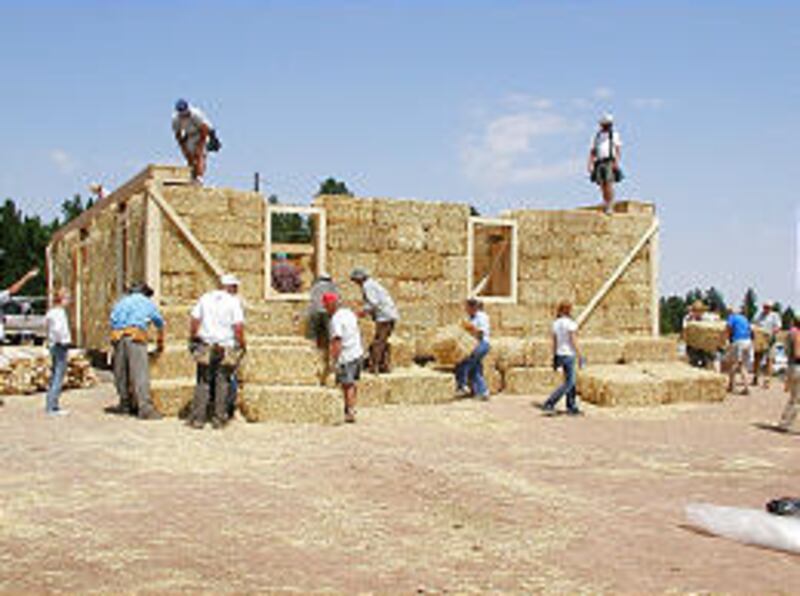
The group has adopted a unique approach to addressing the housing shortages. Red Feather specializes in the design and construction of homes and buildings made mostly of straw bales, an inexpensive and energy-efficient building material that provides high insulation value. The straw bales form the walls, which are then covered in stucco.
Volunteers do much of the building work alongside the new homeowners, who put in a certain number of hours of "sweat equity" to be eligible for one of the homes.
Red Feather also helps them secure a mortgage, something that has frequently proved elusive to potential Indian homeowners, and to purchase or lease land, which can be difficult due to complicated land ownership on reservations.
Martha Bear Quiver lives in one of Red Feather's homes near Busby on the Northern Cheyenne Indian Reservation in Montana. She struggled to no avail for 20 years before finally securing a home loan, she said.
"I was trying, and first I was too young and then I didn't make enough money, and when you hear stuff like that it kind of makes you want to give up, and I did give up for a while, but I wanted to have my own house," she said.
Red Feather is a small group, with just three regular staff members and an architect, Nathaniel Corum, whose position is funded through a Rose Fellowship. In the nine years the group has been around, it has built four straw bale homes and rehabilitated 13 other dilapidated houses on reservations.
The group also has constructed other straw bale buildings, including a study hall for students in Crow Agency, Mont., a literacy center and community center on the Northern Cheyenne reservation in Montana, and the Environmental Research Center at the Turtle Mountain Community College in Belcourt, N.D., where work began in July.
The group's work has won praise and recognition. Young received a $50,000 Volvo for Life Award in 2003, money he donated directly to the Red Feather group, and an Oprah Winfrey "Use Your Life" Award in 2002.
Corum's work at Red Feather has been featured in the premier trade magazine in his field, Architecture Magazine, as part of a piece on "public-service" architecture. He published a how-to book of straw bale construction, called "Building One House" and is working on a second edition to be published by Princeton Architectural Press in 2005.
Corum said he was drawn to the group because he believes solving housing problems helps people maintain their culture.
"Bottom line is, a family or community cannot sustain itself without housing, without shelter," he said.
The group's next major project goes beyond building single homes. Young is working with a Northern Cheyenne tribal councilman to build a series of new homes and possibly other buildings in tiny Busby. The plan is to build one to two houses a year over a five- to seven-year period, teaching tribal members the skills for building straw houses as they go.
"That's one of the most necessary parts, is 'How do you bring jobs and how do you empower tribal members?' If we have a longer commitment we can engage tribal members in that kind of thought," he said. "If it leads to some really proactive tribal members saying 'This is something we can do, this is unintimidating, it's a way that we can house our own, involve everybody in making a community,' if we start to hear thought like that, we definitely want to facilitate that."
One need only drive to the Northern Cheyenne reservation to see why it is a Red Feather priority. The median household income is $14,417 and unemployment ranges from 65 percent to 78 percent, according to the Northern Cheyenne Social Preservation Project. Young said the waiting list for housing nears 1,000 families. The homes that do exist often are in poor shape and host multiple families.
"In the inner city, especially in Seattle or Chicago or New York, when you're down and out you have avenues you can go down," Young said. "There's all sorts of programs and shelters and food. There's a lot of assistance. There's safety nets. And I didn't see that existing within reservation boundaries. I didn't see the safety nets."
Red Feather tries to incorporate each family's sense of tribal culture into the design of the buildings and homes, Corum said. That means, for example, facing the front door to the east.
Including families in the planning creates a crucial tie between the family and their new home, Corum said, one that is often lacking for reservation residents.
"When they actually become involved in the community design process, my belief is that they will have emotional and even spiritual ties to the building," Corum said.