

PROVO — Saving the mural is a must.
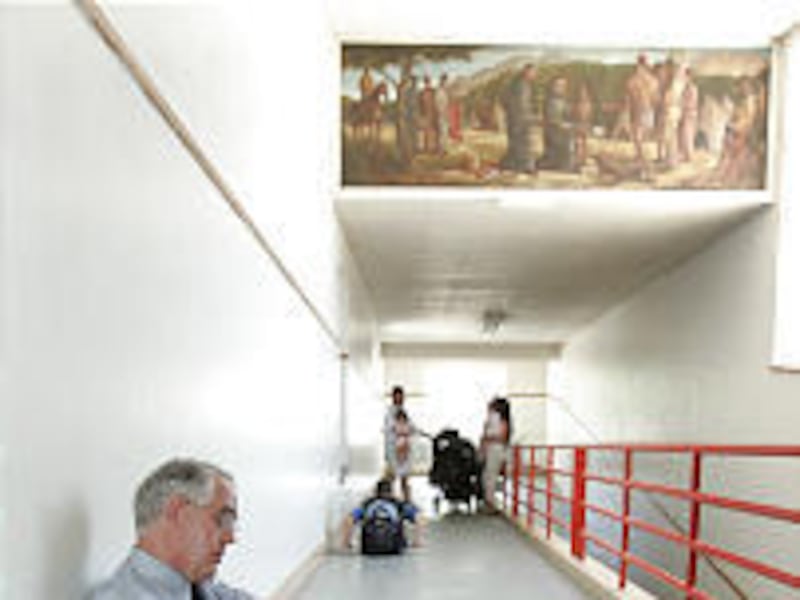
Painted on a wall in 1952 at Joaquin Elementary — where students, alumni, faculty and staff said their final goodbyes to the school on Friday — is a picture of Fathers Silvestre Velez de Escalante and Francisco Atanasio Dominguez with a 14-year-old American Indian boy in 1776.
Local lore has it that the boy, who was devoted to the priests, was integral to the friendly meeting between Escalante and Dominguez and the Laguna Indians near Utah Lake.
The priests named the boy Joaquin.
The school is named after the boy — and for 67 years, students who have walked through its doors were taught about Joaquin.
Now, parents and staff wonder how to preserve the mural when the building, built in 1937, is torn down and the land on which the school stands put up for sale.
So why is it closing? A Provo School District study determined that it would cost too much to remodel the school and bring it up to seismic standards. Plus, district officials planned to downsize the number of middle schools from three to two; and school boundaries changed.
One of the middle schools, Farrer, will be remodeled over the summer to become Farrer Elementary, where Joaquin's Principal Don Dowdle will become principal.
"There's always been a feeling of family at Joaquin, and the teachers and students and parents working together, and you know, helping kids feel good about themselves and succeeding," said Dowdle, who has worked at the school about 15 years.
"Joaquin has probably had a greater population diversity than most schools in Provo."
The population at Joaquin reflected the changing face of Provo.
Consider: This year, almost 80 percent of the students qualified for free or reduced-price lunch. About two-thirds of students leave the school to go to another school or moved into Joaquin's boundaries sometime during the school year. Sixty-five percent of students speak languages at home other than English.
"You can only imagine how difficult that would be for an adult. How frustrating that is for a child to go to four, five schools. Everybody's using a different math book; you might be ahead or behind," Dowdle said.
"At the time it was opened in 1938, this was the popular (neighborhood) or extreme," of Provo's population boundaries, Dowdle said.
"Most of the houses in the neighborhood were single-family dwellings. There were a lot of BYU professors who lived in the area with their families. Over the years it gradually changed. Two or three homes (would be) torn down and they'd put up apartments for (BYU) students."
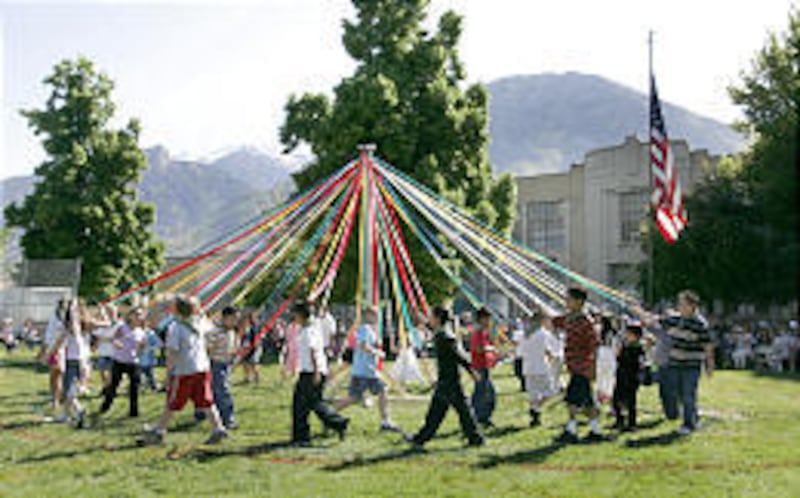
Friday's goodbye was tearful. Students participated in the last day tradition of a dance festival. This year, however, the classes danced through the decades of Joaquin's existence. They wore poodle skirts, white T-shirts and rolled-up blue jeans. They did the Hustle and Electric Slide.
And students said goodbye to each other. Only about 45 percent of Joaquin students will attend the new Farrer Elementary; most of the students will attend schools closer to their neighborhoods.
"We're excited they get to go to a new school, but we're sad. They're our friends. My son has been (with) one of the girls in his class since kindergarten," said PTA president Celeste Kennard.
With other parents, Kennard put together a scrapbook to record the school's history. They went through records and found old yearbooks, photos of the floats the school used to enter in Fourth of July parade and newspaper articles.
"It has been years that they have threatened to close Joaquin," she said.
"The school used to look completely different. And they found records that said there used to be 750 kids that used to go to Joaquin," she said. On Friday, there were about 420 students.
"We have eight portable (trailers) now. I know the building was completely different. The downstairs was remodeled completely. It's mostly storage now, and they only use one little part of it for the music room and teachers lounge," Kennard said. "And it used to be the lunchroom until it was condemned by the fire marshal because you couldn't have all the kids down there because they couldn't escape."
Over the past week, alumni drifted through the school and looked at displays on the walls showcasing the school's history.
Charles Callis, 49, has spent plenty of time in his son's fourth grade classroom, which was his fifth grade classroom when he attended Joaquin in the 1960s.
He remembers racing Matchbox cars. "We used to race them on the ramps and in the hallways," he said. "It was kind of a standard thing during recess during lunchtime before and after school."
He and his son are sad to see the school close. Callis wishes the school's name would be transferred to another school. He's proud of the name's Hispanic roots and American Indian connection.
"One thing I'm very sad about is the name 'Joaquin' is disappearing, for a couple of reasons," he said. "The story behind Joaquin is so appropriate for (students) that age."
E-mail: lhancock@desnews.com