




PROVO — One thing everyone can agree upon about Jon Steven Young: He is a driven man, propelled all his life to achieve and perform. It is something in his circuitry, part of his DNA.
This week, Steve Young will be in Canton, Ohio, where the NFL will induct him into the Pro Football Hall of Fame. It's one more step in a most remarkable career built one step at a time.
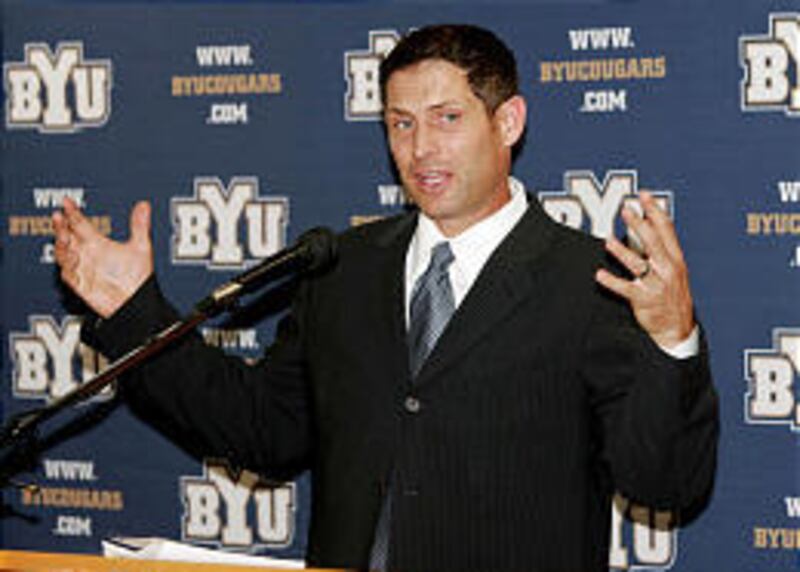
"I don't know what to really expect," Young, 43, said Saturday, when he was honored at BYU and met with fans. "They say it's pretty overwhelming. I just hope I'm not writing my speech on the way to the ceremony."
Young is currently a TV analyst and the chief officer in a business that buys other multimillion-dollar businesses. He's got a family. He's a middle-aged man. But the stories that have laced his life en route to Canton are anything but routine. He's proven over and over again, in every level of competition, that challenges are hurdles to be taken one by one, and quitters rarely triumph in life.
Today, Young's NFL records that still stand a decade past his days on the field include highest passer rating for a season, highest passer rating for a career, highest pass percentage for a career and the most touchdown passes ever thrown in a Super Bowl (six).
It's been a long time since Young told his mom he didn't want to go to Scout camp because he'd get homesick. It's been more than two decades since he told his father, Grit, he wanted to quit BYU's football team because the view from eighth string was practically insurmountable.
It's been decades since, as a sophomore at Greenwich High School in Connecticut, the guys he grew up with were known as the sophomore "lousy bunch." By Young's senior year, he'd helped lead those guys to the state finals.
Perhaps that's where it all began.
Young earned the starting job at Greenwich High in his junior year, when coach Mike Ornato replaced injured starter Bill Barber with the curly haired athlete. In a scrimmage against New Cannan High, on Young's first play, he dropped back to pass and dropped the football in the grass. Young picked it up, surveyed oncoming tacklers, found a hole and zig-zagged his way 70 yards for a touchdown.
That move, that athleticism, became a Steve Young trademark.
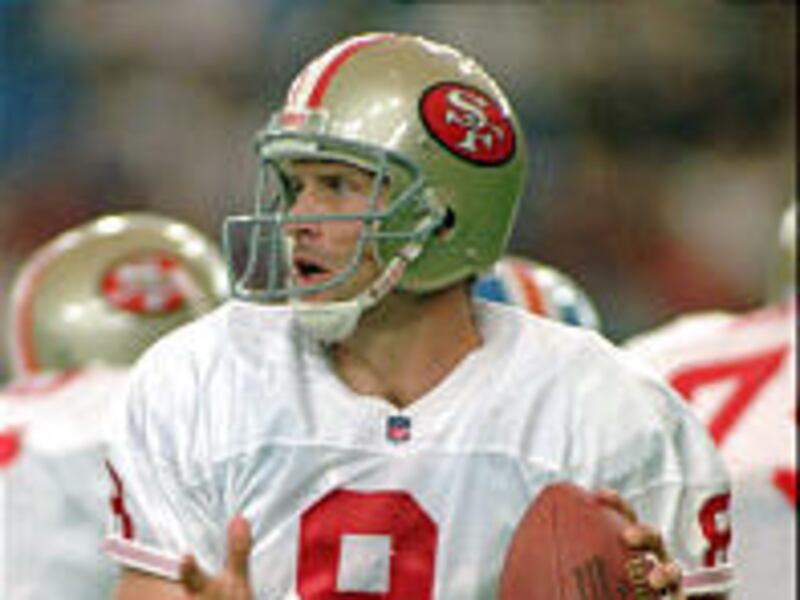
Flash forward, past an all-American career at BYU, past his trials with the Los Angeles Express of the USFL and the awful Tampa Bay Buccaneers, and past his trials as a backup to the beloved and gifted Joe Montana with the San Francisco 49ers. Stop the Steve Young tape on Oct. 30, 1988, in Candlestick Park, the 49ers against the Minnesota Vikings.
The 49ers were losing the game 21-17. Young was in for an injured Montana and struggling to settle into the offense. The setting was a 49er battle to keep from dropping to 5-3 and further behind the Los Angeles Rams and New Orleans Saints in the conference standings. There was a minute left in the game, and Young had been sacked half a dozen times.
On third-and-4, Young dropped back for a "double underneath" play, looking for two inside receivers to break to the outside while two wideouts dragged across the middle. The play broke down. Young was deep in the pocket, and quarterback killer Chris Doleman had his hands up in Young's face, blocking his vision downfield.
Young spun away from Doleman and frantically looked for tight end Brent Jones, to no avail. So he took off running for a first down. But a quick burst of speed sent Young out of a tackle at the line. He then pivoted toward the east sideline as Viking linebackers tried to recover and pursue. Viking defensive backs tried to knock him out of bounds, but Young cut back, veering away from tacklers. He saw teammate Tom Rathman make a block, and he cut behind Rathman. He got a block from Jerry Rice and continued his moves toward the middle of the field.
Carl Lee grabbed Young's jersey, but Young broke free. He cut in front of Viking defenders Brad Edwards and Cris Martin, leaving them clutching air. Young broke free inside the Viking 10, and with legs pumping, miraculously kept his balance and practically "willed" his way forward, stumbling and lurching his way into the end zone for the winning touchdown.
That run, many NFL experts say, may be the greatest run by a quarterback in league history. But in the bigger picture, that run may symbolize, forever, the personality of Steve Young.
"He's one of the most driven people I've ever met," BYU athletic director Tom Holmoe said.
"He had to learn patience for the things he wanted to come his way," retired LA Express and BYU trainer George Curtis said.
"On Sunday morning, when you have to play Young," Atlanta defensive end Tim Green said, "you wake up with a sickening feeling and a headache. I can honestly say those are the only times I've ever approached a game conceding that an opposing player's going to make big plays no matter what we do."
Said former 49er coach George Seifert, "Steve's got to be one of the greatest quarterbacks of all time. I've been fortunate to work with two of the greatest quarterbacks — Steve Young and Joe Montana. Joe set the standard. And Steve has been talented enough to build on that."
Add this to the pile: Somehow after BYU, the USFL and NFL, Young was disciplined enough to earn a law degree.
Canton? Of course.
People scratch their heads when Young or others make reference to Young's plight as a Cougar freshman, deep on the bench. There are descriptions of how deep that bench really was. Some say eight deep, others say it was half that. But then offensive coordinator Doug Scovil wanted Young to switch to defense. Quarterback coach Ted Tollner believed otherwise.
The official depth chart was something like this his freshman year: Jim McMahon was the starter and was backed by Royce Bybee, then Eric Krzmarzick. Then came Mark Haugo, Gym Kimball and Mike Jones. And then Steve Young. The light at the end of the tunnel was far away and dim. There were seven bodies in the way.
With Tollner lobbying coach LaVell Edwards in behalf of Young, Steve eventually made a move with some hard work. Krzmarzick (Florida), Haugo (San Diego State), Kimball (Utah State) and Jones (Cal-Lutheran) transferred.
Three seasons later, Young was an all-American. In 1984, before Tiger Woods and Michael Jordan's money, Young was the highest-paid professional athlete in the nation. His $40 million salary topped Magic Johnson ($25 million) and Dave Winfield ($25 million), who were ahead of Wayne Gretzky and Larry Bird. For Young, however, it was an embarrassment. He'd really done nothing for the fledgling L.A. Express, but that notoriety was thrust upon him.
Young's tale drew focus as a backup to Montana, one of the greatest quarterbacks of all time. Patiently, Young kept his mouth shut and worked.
It paid off. Young painted his own picture, one that will be presented in Canton this week — as one of the greatest who ever played the game.
Coming from deep on BYU's quarterback bench, Young was enshrined into the College Football Hall of Fame in 2001, right behind Jim McMahon (1998), Marc Wilson (1996) and Gifford Nielsen (1994).
A backup to Montana was supposed to fail. Not this one. He's going to Canton.
Young's story is an inspirational one. Stuff lectures and lessons can be pinned to. They had to tell Young to quit football. Multiple concussions over the span of his career sidelined him. It didn't come from a task, a challenge, an opposing defensive scheme.
Said Young, "I wish parents would understand that if their child drops eight fly balls one day, then only drops six the next, that's a reason to go to Dairy Queen. The principle is competing against yourself. It's about self-improvement, about being better than you were the day before."
In 1995, GQ Magazine featured Young on the cover. The headline read: "Steve Young walks on water." The article inside was entitled "The Arm With the Golden Man," by Peter Richmond.
In this piece, Richmond wrote: "We've been granted our wish: the consummate good-guy athlete, a teetotaling Mormon lawyer, no less. So why aren't we a little more excited about the ascension of Steve Young?
"It's not so much that a good man is hard to find. That much we've known for years. It does seem curious, though, that lately, when we find him, we don't seem to want him. We talk a good game, but we've come to prefer decidedly mortal heroes. We've grown so pathological as a species that we can't abide the idea of true heroes among us."
Come this weekend, Young will receive one of the highest honors the game he loves has to offer. Making it to Canton is no easy task. But for this star, a man for whom fashion has never been the science of "seeming" but really "being," it is, for once, a fitting tribute to the man, a guy who rarely coasted in all his days.
E-mail: dharmon@desnews.com
Dick Harmon is author of the book "Steve Young: Staying in the Pocket."