

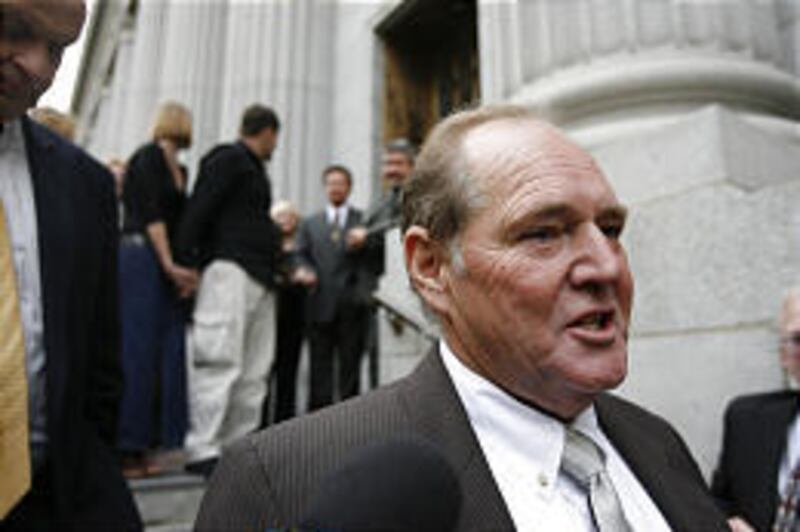

Melvin Dummar said it felt good to have his day in court, despite indications by a federal judge Thursday that he has some serious concerns about Dummar's claim to a portion of the estate of the deceased eccentric billionaire Howard Hughes.
"I felt like I was left out on a limb 30 years ago," Dummar said of the trial in Nevada back in 1976 where a jury concluded a will that bequeathed one-sixteenth of Hughes' $2.5 billion fortune, or $156 million, to Dummar was a fake.
Dummar's story has become legendary. The once lowly gas station attendant says he rescued a man he thought was homeless from the Nevada desert just outside of Las Vegas in 1967 only to find out later that the man was Hughes, who in a handwritten will left him part of his estate. The "holographic will," also known as "the Mormon will," listed 16 beneficiaries, including The Church of Jesus Christ of Latter-day Saints as well as the Boy Scouts.
Dummar's car ride with Hughes has been depicted in a movie as well as books.
Last June Dummar and his attorneys announced they had filed a federal suit against Hughes' cousin, William Rice Lummis, and former Hughes staff member Frank William Gay, alleging the two conspired to conceal evidence that would prove Dummar's story and legitimize the "holographic will."
Specifically, Hughes' aids testified in 1976 that Hughes never left the casino where he stayed on the day Dummar said he picked him up. But years later Hughes' personal pilot came forward to say that he flew Hughes to a brothel outside of Las Vegas on that same day but returned without him.
In court Thursday, attorneys for Lummis and Gay fought back with a motion to dismiss the suit, calling it a "fanciful speculative claim" that is "too little, too late."
Gay's attorney, Peggy Tomsic, criticized Dummar for waiting 28 years since the trial to come forward at a time when the original judge is dead, many of the witnesses are dead and all but one of the jurors are dead.
"Mr. Dummar did nothing; he sat around for 28 years," Tomsic said, adding that her client is now 85 and stands to re-live the drama all over again.
Lummis' attorney, Randy Dryer, said Dummar was fixated on the handwritten will and was looking for a "third bit of the apple" in trying to get money. "The Mormon will has been adjudicated a fake, not once, but twice," Dryer said, pointing out that after the Nevada jury trial, a case in Texas also concluded the will was a fake.
Dummar's attorney countered that Gay and Lummis did a perfect job in concealing the truth and that the pilot was only discovered recently. "They have perpetrated the perfect fraud," said New Mexico attorney Stuart Stein.
Stein said the 1976 jury was deceived and jurors would have changed their opinion had they heard the pilot's testimony.
In his suit, Dummar is alleging racketeering, unjust enrichment and common law fraud. The federal RICO statute allows a plaintiff to seek triple damages, which means the $156 million inheritance claim could end up much larger.
U.S. District Judge Bruce Jenkins indicated he had concerns about Dummar's claims, saying some were ambiguous. Jenkins said the RICO claims were "almost indecipherable" and that the unjust enrichment claim "seemed to have no general connection" with Dummar's claims.
Outside of court Dummar and his attorney declined to comment on the specifics of the hearing, saying they are choosing to wait until Jenkins issues his ruling in writing within the next few days.
Whichever way Jenkins rules it is anticipated that the case will be appealed to the 10th Circuit in Denver.
E-mail: gfattah@desnews.com