

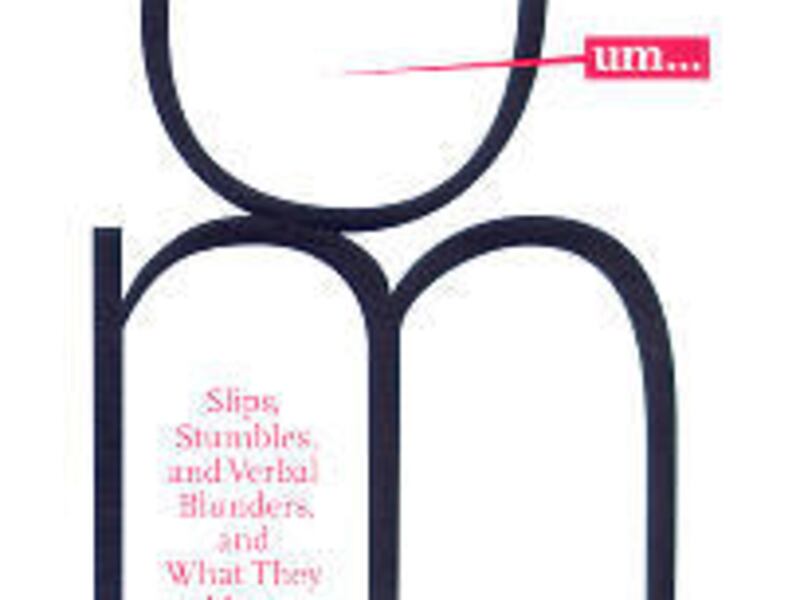
UM ... SLIPS, STUMBLES AND VERBAL BLUNDERS AND WHAT THEY MEAN, by Michael Erard, Pantheon, 287 pages, $24.95
A verbal blunder is "a slip of the tongue, i.e., any moment when something we've planned to say somehow goes awry."
Or it might be "a speech disfluency ... repeated sounds and words, fragments of words, restarted sentences and silent pauses."
This according to "Um ... Slips, Stumbles and Verbal Blunders and What They Mean," by Michael Erard, who has academic degrees in linguistics and English.
"It is not," he writes, "laughing, crying, shouting, sighing, panting, yawning, coughing, throat clearing, spitting, belching, hiccupping or sneezing."
Erard became interested in the subject of verbal blunders during the 2000 presidential campaign, when George W. Bush's malapropisms were referred to as "abnormal" in media reports. Erard thought critics were too hard on Bush, because he believes all of us commit verbal blunders.
He is convinced that making mistakes in speech is not a sign of a lack of intelligence. It is often caused by anxieties — people repeat words and restart sentences if they're nervous. Or they may simply be accidental.
Erard cites the Rev. William Archibald Spooner of Oxford University, who made outrageous verbal mistakes in the 19th century. He transposed words, thus creating the "spoonerism," or simply "a spoo."
One example was something he is supposed to have said to toast Queen Victoria at dinner: "Give three cheers for our queer old dean." Once he welcomed a group of farmers as "noble tons of soil." He cautioned some young missionaries against having "a half-warmed fish in their hearts."
Another famous verbal mistake is the "Freudian Slip," named after psychanalyst Sigmund Freud. For Freud, "the unconscious conveyed its own desires via verbal blunders." Today, we use the term "Freudian Slip" to describe lapses that are "obscene or salacious." Freud allowed no accidents in speech. He thought all of them were "willed by the dynamics of the unconscious."
Most of us don't believe that anymore, but we still have fun identifying what appears to be a "Freudian Slip" in conversation and then mocking the person who uttered it.
Erard gives an example from George W. Bush in a press conference, defending his decision to go to war in Iraq. Asserting that democracy was emerging, Bush said, "Who could have possibly envisioned an erectsh — an election in Iraq at this point in history?"
Because he corrected himself before finishing the word, his error is called "a repair." An analyst might either say the comment was Freudian or it was accidental, because Bush anticipated the "r" in Iraq and the "l" in election.
Erard recounted a study by Bell Labs of 1,900 phone calls including 80,000 words and found that 25 percent of the words were "nonwords," such as "um," "uh," "uh-huh," etc. Another 10 percent consisted of laughter or profanity.
Age is apparently one reason for slips or problems of speech. One study found "a sharp decline in the size of a person's active vocabulary after 70 years old, and between 74 and 78, people rapidly lose their ability to produce complex sentences."
This is not a sign of the onset of Alzheimer's, however — and it changes little between the age of 70 and 100, except that older people usually speak more slowly.
There are many fascinating studies and stories in this book, but most people can apparently take delight in understanding that verbal slips are not intellectual gaffes, nor do they suggest the unconscious desire to say something salacious.
E-mail: dennis@desnews.com