

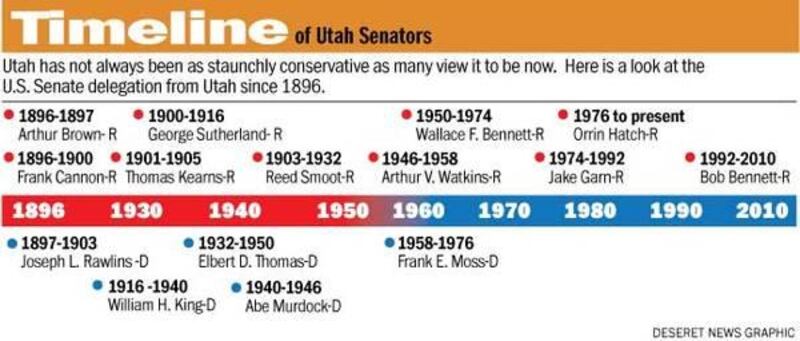

SALT LAKE CITY — A lot of people wonder what possessed Sam Granato to want to run for the United States Senate as a Democrat in a state that has elected exactly one Democrat to the Senate in the last 60 years and none in the last 34.
What was it, a death wish? A dare? Did he lose a bet? Is it some kind of fraternity initiation?
Two years ago, Granato might have wondered right along with them.
But something happened on Election Night 2008 that changed his perspective.
His 18-year-old son, David, had spent the year working on the campaign of a person who had an unusual name that ended in a vowel and was considered a longshot when he entered the race. All through the spring, summer and fall, David worked hard, passing out fliers, making calls, pounding campaign signs in people's lawns. He pounded two in his dad's yard, with absolute instructions they were not to be moved.
On Nov. 4, 2008, when Barack Obama won the presidency, David Granato threw his arms in the air, shouted "We did it!" then turned to his father and said, "Now what about you?"
In that moment, a U.S. Senate campaign was born.
Granted, it's a reflection on the relative strength of the Democratic Party, Utah version, that when Granato called party headquarters and said he wanted to get in line to run they answered, essentially, "What line?"
He breezed through the Democratic Party convention, then looked up to see his opponent in the general election, a Republican riding the tea party wave named Mike Lee — the only obstacle blocking his way to his very first elected office. Unless you count president of the Sigma Pi fraternity.
The first clue you get that Sam Granato is no easy-to-profile, stereotypical, one-party kind of guy is when you walk in his office at Frank Granato Importing Co. on Redwood Road, the family wholesale food distribution business his late father started in 1948 and he now runs.
On one wall is a picture of the pope. Next to it is a picture of Thomas S. Monson, the Mormon prophet.
It's not a conflict, it's more like a family genealogy. Sam's paternal grandfather, a Roman Catholic also named Sam Granato, emigrated from Italy just after the turn of the century, settling in Utah, first in Tooele, then in Bountiful, to raise goats. His maternal great-great-grandfather, a Mormon convert named William Stirling, emigrated from Scotland in 1862, crossing the plains with a company of Mormon pioneers 650 strong. Upon arrival William was dispatched to southern Utah, where he and his wife Sarah Ann helped settle the town of Leeds, just north of St. George.
Granato is a proud, and practicing, product of these hybrid roots. Name the Utah line, he's either crossed it or straddled it. He grew up in Holladay in northern Utah and spent summers at the old homestead in Leeds in southern Utah. He attended an urban high school (Olympus High in Salt Lake City) and a country college (Southern Utah State, now Southern Utah University, in Cedar City). Over the years he's registered as and voted for both Republicans and Democrats (and Mormons and non-Mormons). As a non-drinking Mormon he led the charge that liberalized Utah's liquor laws (it was Sam who, as a member of the Alcohol Board, was Republican Gov. Jon Huntsman Jr.'s go-to person in getting the private club laws abolished in 2009).
But nothing shouts his propensity to effectively cross over better than the framed photo in his office just past the ones of the pope and the prophet.
Wearing a big smile, there's Sam sandwiched between his pals Mac Christensen, the president of the Mormon Tabernacle Choir and clothier to a million missionaries, and Frank Layden, the Irish-Catholic basketball coach from Brooklyn.
"My close, close friends," he says.
The first thing he did after announcing his run for the Senate was ask them to be honorary co-chairmen of his campaign.
"We're the odd couple," says Layden, a statement uttered verbatim by Christensen.
Both agreed to lend their support to the campaign, but not before first registering the requisite shock.
"One day, Sam calls and says, 'Come by and have lunch,'" remembers Layden. "When I sit down he says, 'You're one of the first people I've told, I'm going to run for the Senate as a Democrat.' My first reaction: Run for the Senate? As a Democrat? In this state? What are you, crazy?"
"I told him he was nuttier than a fruitcake," says Christensen, a longtime friend, adviser and devoted fundraiser for sitting Republican Sen. Orrin Hatch. "I asked him who came after him and talked him into this and he said, 'No one. I called them.'"
Christensen, like Layden, quickly said yes. "The guy is my friend," says Mr. Mac. "And friendship is much more important than whether you're a Republican or a Democrat."
Both Christensen and Layden knew Sam's father, Frank, first.
Layden had barely set foot in town in 1979 as general manager of the newly transplanted New Orleans Jazz NBA franchise when Frank Granato invited him to lunch. Granato held regular Saturday luncheons at his warehouse on 300 West, inviting newcomers and old-timers alike. You were as likely to be sitting down for pasta next to a Catholic priest as a Mormon general authority, Layden recalls, or a truck driver or the chief of police.
"He (Frank) said, 'We gather, we get people together, it would be a chance for you to meet some people," remembers Layden, who adds, "and they give you a lot of food."
Christensen also met Frank Granato through Granato's extensive social network — back when social networks tended to be face to face.
"I had friends who were real close to Sam's father, so we became well acquainted and then I met Sam. That's been over 30 years ago," he says. "The friendship has only grown from there."
If the message coming through all this is that the son is the father, you'll get no argument from Sam. "He set the bar: people first," he says of his dad. "He loved people."
Sam was ready to join his dad in the family business as soon as he graduated from high school. But Frank wouldn't have it. "Go to college," he said. "Go have fun. You have the rest of your life to work."
"I may have taken that have fun advice a little too literally," says Sam, who moved 200 miles away from home to Southern Utah State in Cedar City, enrolled in business classes, joined a fraternity and basically gave up sleeping for four years.
But the old man was right. Sam's been working ever since — inside the business and out.
"A workaholic," Christensen calls him. "He's always waiting on somebody."
"He'll do anything for anyone," says Layden. "If somebody needs a job, 'Hey let me make a phone call.' 'They need food? 'Where do they live? I'll deliver it.'"
Sam has been in charge of the family business since 1991, when his dad died "much too young" at 76. Frank Granato had remained a Catholic all his life, although he was known to go to the LDS ward with his kids (his wife Edith's pioneer roots won out where the children's religion was concerned). His funeral was held on the Friday before the semiannual LDS general conference; family friend President Monson, then a counselor in the First Presidency, made his way to St. Ambrose Catholic Church and spoke at the service.
Such was Frank Granato's influence and magnanimity that people openly wondered, as Sam attests, whether he had it in him to take over from his father.
"They said I wouldn't last six months," he says.
But not only has Granato Importing lasted, its business has tripled over the past 20 years with an expanded wholesale operation and retail stores that sell imported foods and sandwiches.
It's true that under Sam's watch the lunches his father sponsored have disappeared.
"We don't do the Saturday lunches anymore because now we do them all the time," he says.
In the process, Granato's — with signature deli-type stores on 300 West, on Redwood Road and in Holladay — has become a kind of "Cheers," Utah style, without the bar.
"Sooner or later, everybody goes in there," says Layden.
There's also an Italian mafia kind of feel to the place, without the mafia. It was in the "war room" on 300 West, for instance, that Gov. Huntsman and Granato held the Liquor Control Commission meetings that changed the private club laws — with all the sandwiches and pasta anyone cared to eat.
Granato's campaign strategy is also straight out of the sandwich shop.
"Getting out and meeting people, that's my game plan; make it personal," says Granato. "I'm not a died-in-the-wool, won't-listen-to-their-side kind of guy. Utah isn't as red as people think we are. We're a moderate state. I'm convinced that's who we are. Those are the people I want to appeal to. Those are the people who will send me to Washington."
A testament to his strategy, he says, are the more than 20 endorsements he's already received from mayors and county commissioners throughout the state.
Granato just turned 60 and says he is not at all bothered about leaving the family business in the capable hands of his wife and his grown sons as he heads off for Washington.
The only thing that bothers him is people telling him the long odds against him.
"I'm going to win," he says, "and when I do I already told Orrin Hatch I'm going back there and we're going to reach across the aisle and work together and make things happen for Utah."
And, for his son David, first chance he gets Sam plans to make his way to the White House — and shake Obama's hand.
Faces of Utah Democrats
A look at Democratic candidates Utahns are contributing to.
Jim Matheson: U.S. House of Representatives
Matheson has raised over $1.6 million in hopes to be elected for sixth term in the U.S. House of Representatives. Utahns have contributed $86,540 to Matheson thus far.
Peter Corroon: Governor of Utah
Corroon has received over $1.6 million in donations for his gubernatorial campaign. Most of that money was donated by Utahns.
Sam Granato: U.S. Senate
Granato has raised over $222,000 in his race against Mike Lee for U.S. Senate; 96 percent (over $170,000) of his total campaign donations have come from Utahns.
e-mail: lbenson@desnews.com