


Last in a four-part series.
CORVALLIS, Ore. — Mark Rampton is haunted by Haitians.
More specifically, recollections of Haitians wracked with pain and suffering.
Haitians he helped treat in the days after the catastrophic Jan. 12 earthquake.
Haitians he had to leave behind, uncertain if they would ever receive the ongoing medical attention they needed.
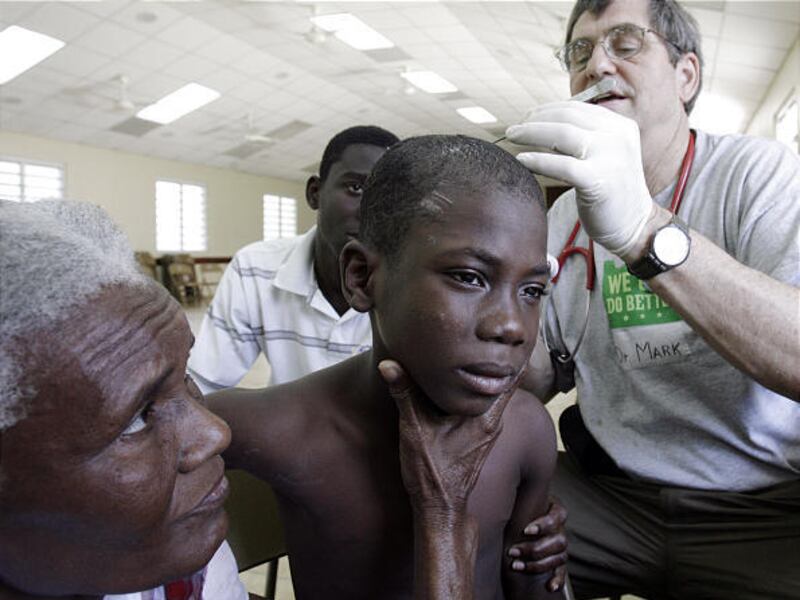
In his mind's eye, Rampton is constantly seeing the young boy he helped treat in Port-au-Prince. The boy who suffered both a fractured upper leg and a fractured lower leg. The boy who lost his father, mother and sole sibling in the magnitude-7.0 quake.
The boy whose face the 62-year-old family practice doctor from Corvallis, Ore., wonders if he'll ever forget.
"I think about him all the time," he said. "You have all these kinds of thoughts — they just haunt you."
Like Rampton, many of the volunteer doctors and nurses who rushed to Haiti and provided first-response medical care to earthquake victims still struggle with what they saw and did there — bodies mangled and torn in the upheaval, limbs needing immediate amputation, wounds exacerbated by Third World conditions, injuries infected by flies or maggots.
The volunteers treated as many as they could as fast as they could — with no likelihood of return appointments or follow-up treatments.
Hospitalization — if you can consider large tents and makeshift open-air shelters in streets and courtyards as hospital rooms — was a luxury for only the most serious of cases.
As Rampton describes it, he and other medical volunteers who labored in Haiti are facing feelings of abandonment — they having abandoned needy patients.
"They're real," he said of such feelings, "and I think most of us who went there are still dealing with it here."
But Rampton has an easy out in tempering that sense of abandonment. All he has to do is picture another Haitian face — one that doesn't haunt him.
One that hangs framed as a photo in his living room.
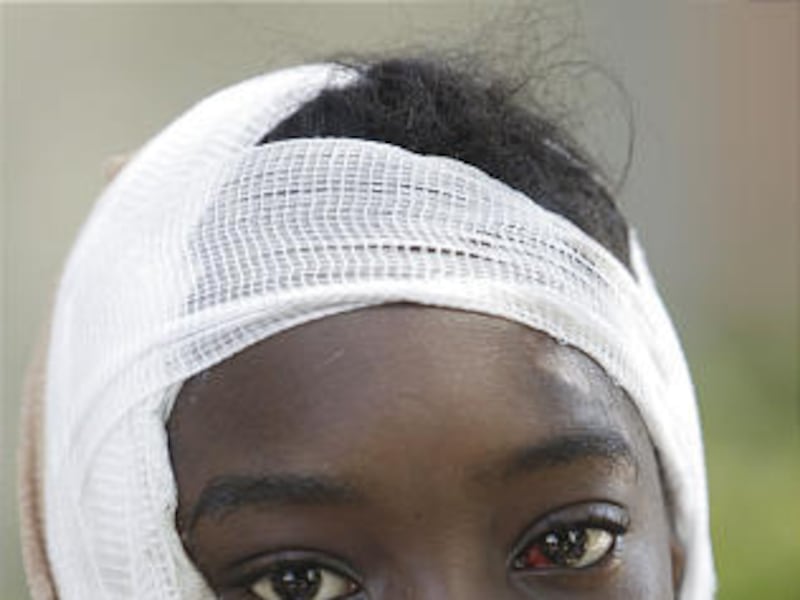
Twelve-year-old Phedeline MonFleury was walking near her Port-au-Prince home about 5 p.m. on what seemed to be a typical Tuesday evening.
Suddenly, the ground began to mysteriously move, multi-story buildings lining the street started collapsing, and massive blocks of concrete rained from the sky like missiles.
Fearing for her life, Phedeline quick dove underneath a nearby car.
But the car's engine had long been running, and she found her head and arm wedged under a searing-hot muffler and tailpipe.
Her life-saving act came with a price — third-degree burns covering much of the right side of her face and scalp and all down her right arm.
Burns that in many areas were bone-deep.
The paths of Mark Rampton and Phedeline MonFleury crossed exactly one week after the Jan. 12 earthquake at the Centrale Ward LDS meetinghouse in Port-au-Prince. Rampton arrived as part of the 14-member volunteer medical team sponsored by The Church of Jesus Christ of Latter-day Saints. Phedeline was waiting with her mother, Jeanita Souffrant, having heard of doctors and nurses on their way.
For an hour and a half that Tuesday in a meetinghouse classroom, Rampton worked on Phedeline, numbing the burns with skin-level injections and then carefully peeling off first her week-old bandages and then the dead, blackened tissue from her burns.
(The Deseret News has several photos of Phedeline and her burn injuries as she received treatment from Rampton; however, editors considered them too graphic to publish.)
"It was really awful," recalled Rampton of the first-day treatment. "It was one of those things that they'd usually put the patient to sleep for. She's a tough little girl."
Later that night, he couldn't sleep, emotional about the experience and wondering how he might get the girl out of the impoverished Caribbean nation and to the United States for the necessary skin grafts and long-term care.
The next day, the two were back at the Centrale classroom continuing the treatment, with Rampton aided by Marc-Aurel Martial, a Haitian native who lives in Orem and works as a critical-care nurse in Murray and was part of the LDS medical team.
With Martial's help communicating in Haitian Creole, Rampton first learned Phedeline's story and then arranged for a ride in search of better treatment options. Staying on the Centrale meetinghouse grounds was a Haitian church member who lost his home and had stockpiled his family's belonging in the back of an old Ford Taurus — he agreed to clean out the car and hire it out to Rampton.
With the two medical volunteers up front with the Haitian driver and Phedeline in back between her mother and another relative, the Taurus maneuvered through the capital city's rubble-strewn streets. Several times, the injured 12-year-old reached forward to give the doctor's forearm a squeeze.
"I got a feeling that she was thankful someone was taking her case," he said.
After an unsuccessful stop at the U.S. Embassy, Rampton tried the United Nation's medical tents next to Port-au-Prince's airport, eventually hooking up with Medical Teams International, a volunteer group out of Portland, Ore. They agreed to transport her to the private Kings Hospital while Rampton continued his quest.
He spent much of the next day, Thursday, back at the embassy and then linked up via e-mail with the head of the Shriners Hospital's Burn Center in Boston — who was in Haiti treating the injured — to get Phedeline accepted there.
But while Rampton couldn't get a flight for Phedeline to Boston, he did manage a spot on a National Guard transport to Miami, and the following day, Phedeline was on her way to Miami Children's Hospital.
Within days, both a returning Rampton and Phedeline were on American soil, albeit on opposite coasts. Rampton's wife, Alice, called an LDS stake president in Miami in trying to establish communications with the young Haitian girl, and soon Ruth Tracy was serving along with others as go-betweens between the Ramptons in Oregon and Phedeline and her mother in Florida.
Tracy happily forwarded gifts sent by the Ramptons — a dress, outfits and other clothing — and relayed updates on Phedeline's condition.
"I was just an instrument in the Lord's hands providing service for those too far away to help," she said.
Mark Rampton also was in close contact with Phedeline's plastic surgeon throughout her series of skin-graft surgeries.
He even has called to talk several times to Phedeline, thrilled to listen to her 20-word English vocabulary as she says simple phrases like "Hi, Doctor Mark," "I'm OK" and "Thank you."
Phedeline needs to be in the U.S. for several more months to complete her treatment, with all her medical costs covered by the state of Florida and other relief charities.
Their home in Haiti destroyed by the quake, she and her mother have been visited by a cousin who lives in New Jersey and an aunt from Pittsburgh — there's hope that maybe they can stay longer at either place. If necessary, the Ramptons have offered their Oregon home as well.
Phedeline MonFleury has since been transferred out of the hospital, joining her mother at an extended-stay hotel in Miami while treatments continue.
And in the past three months, Mark Rampton has squeezed in a dozen presentations to medical and civic groups about his experiences in Haiti. Besides taking time at each to tell a few stories — including his interactions with 12-year-old Phedeline — Rampton also highlights ongoing Haiti efforts by the likes of LDS Humanitarian Services and Healing Hands for Haiti and encourages contributions of money and service.
"It's one of the ways you can leave Haiti without feeling like a rat fink for leaving all the patients there," he said, adding, "It makes me feel like I'm not done."
Photos of Phedeline, their brief occasional phone conversations, the updates about her from others in Miami — every little thing helps limit the haunting recollections of other Haiti victims.
"It really means a lot," says Rampton of his ongoing associations with Phedeline.
"Because once you stick your foot in Haiti, it's really hard to pull it back out."
e-mail: taylor@desnews.com
4-part series looks at post-quake efforts to help Haitians
One hundred days ago Thursday, a 7.0-magnitude earthquake rocked Haiti, with the death toll reaching an estimated 300,000. Another several million Haitians were left homeless or displaced.
In a four-part series that concludes today, the Deseret News looks back at post-quake efforts as Utahns and the LDS Church rushed to help provide humanitarian aid.
Don't miss: A special 16-page section highlighting some of the Deseret News' post-quake reporting from Haiti is available free at Deseret Book locations along the Wasatch Front.