

LAS CRUCES, N.M. — Two years of successive financial cuts at New Mexico State University, a trickle-down effect of the state's sluggish economy, have taken their toll in the form of less spending on salaries and fewer jobs.
Of the $616.3 million in spending planned this year across all campuses, some 42.3 percent is expected to go toward salaries, according to numbers from NMSU. That salary pool of $260.5 million is about 6 percent less than 2009-10 — the first full year after the nation's economy sank. And the number of budgeted positions shrank by 421 over the same period.
While pay levels haven't entirely stayed flat — adjustments were made for some personnel in early 2009 and the start of this year in an attempt to shrink market disparities — no across-the-board, university-wide raises have been awarded since before the economic decline.
And that's fueling discontent among some of NMSU's most prominent class of employees: the teaching and research faculty who are the engine of a college campus.
The group, in general, may be one of the most well-paid on campus, but faculty members point to national studies showing they rank behind their colleagues in compensation.
Among a group of 15 peer institutions throughout the West, NMSU ranks last in average salary levels in two out of four categories: professor and associate professor, the highest ranks among teaching and research staff, according to a 2010-11 report from the American Association of University Professors. NMSU was second-to-last in the assistant professor category and about mid-range for instructors.
An NMSU professor earned on average $81,500 annually, compared to $102,900 at the University of New Mexico, $100,200 at the University of Texas at El Paso and $119,200 at the University of Nevada, the top-payer of the 15 schools, according to the data.
The most-recent pay adjustments were made as the result of a review, called the Mercer Corp. study, which tweaked salary levels based on market comparisons, NMSU President Barbara Couture said. However, Couture said she remains "very concerned" about the amount of time that has lapsed without more widespread pay increases for not only faculty, but also staff.
Those types of increases typically must come from the Legislature.
"Our full professors, on average, are about 24 percent below the national average for full professors; that's a very concerning figure," Couture said. "And our associate professors are about 15 percent below."
Pay increases from the study were aimed at bringing the employees who were below minimum standards up to an adequate range, according to a university memo.
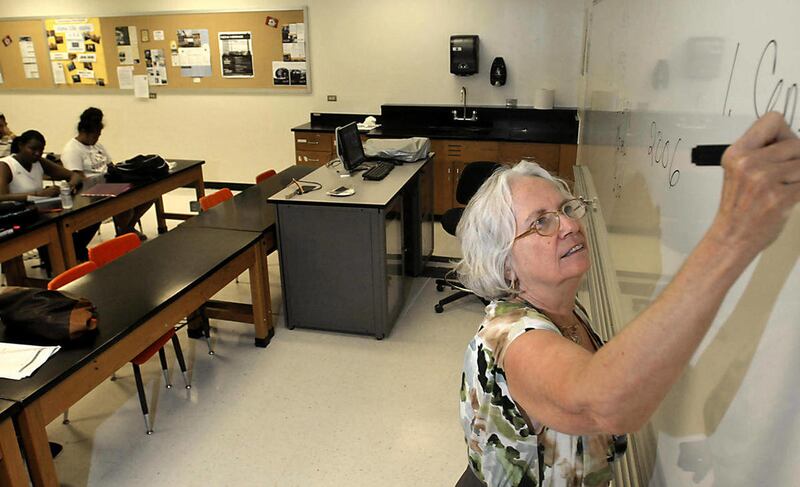
Joan Crowley, NMSU assistant professor in the criminal justice department, expressed frustration about the stagnant salaries, in light of the increasing workload professors are taking on because of the budget cuts. Instructors are teaching more students and being asked to host more online courses, she said.
Cynthia Murrell, a non-tenure track professor in the English department, highlighted a concern about her colleagues in many cases earning less than teachers at public schools. A non-tenure track English professor with master's degree-level education earns about $30,500, while an English teacher with similar education at Las Cruces Public Schools earns 18 percent more.
Couture said the faculty are valuable. Finding and hiring a qualified person can take one year or more, she said. Then, departments invest in mentoring instructors and continuing their professional development.
"We make a huge investment in a faculty member when we bring them here," she said. "But we're worried. If you're not giving these folks raises year after year, they're quickly falling behind their peers."
Couture remains the highest-paid NMSU employee, receiving $385,000 annually. Head football coach DeWayne Walker is second, earning a base salary of $363,000 per year. Head basketball coach Marvin Menzies remained in third at $285,000. Their pay did not change the past two years.
Across the NMSU system, 188 people earn $100,000 or more yearly, accounting for about 4.5 percent of employees, according to a university salary list. Of those, 29 make $150,000 or more, and among that pool, nine receive more than $200,000.
Some $4.2 million will be spent this year on salaries for the 82-person athletics department, according to the 2010-11 salary roster, produced in July. Seven employees in the department earn $100,000 or more — one fewer than two years ago.
In spite of the economic strain, a hiring freeze that had been in place at NMSU is thawing.
The university cut 110 positions — about 42 from academics and 68 staff — from the roster one year ago because of budget cuts mandated by the state, according to university documents.
And the university saved an additional $4.6 million last year beyond what had been required by the state, Couture said.
Other cost-cutting measures included freezing vacancies, implementing a vehicle reduction program and offering a retirement incentive, which saved $1 million in recurring dollars across its campuses, she said.
Couture said she got approval from the regents to spend a new $1 million on merit-based pay increases "for our most productive full professors" and hiring of new faculty in the 2011-12 year.
"I didn't feel we could continue to go without enhancing our faculty or ensuring against losing our best and most experienced faculty," she said.
But it was part of the reason for a tuition increase approved last spring.
Couture said the benefit to students will be more faculty on campus.
Crowley said she's troubled by the emphasis on merit raises.
"Who's defining that, and what happens to the rest of us not in that elite group?" she asked. "I have no problem with someone who is bringing a lot of (research) money in and who's getting an offer from another school getting a raise."
Rather, Crowley said, the compensation awards should be a mix of cost-of-living, equity and merit-based raises.
The pay increases given because of the Mercer Corp. study have been funded largely by internal dollars NMSU has saved, such as through the retirement program or a position elimination program, said D'Anne Stuart, human resources director for NMSU. And the increases have been maintained, in spite of permanent budget cuts handed down by the state Legislature, she said.
"We've had to try to look within our means to do this," she said. "Because we felt we owed it to the university to finish this study, even though, when it started, we were getting a legislative appropriation and it stopped in the middle of the study."
Based on preliminary information from the study, the first adjustments were given in early 2009 to about 76 percent of eligible 1,330 non-tenure track, tenure-track and tenured faculty.
Stuart said entry-level faculty salaries are now on target. But there's a problem with salary compression: more experienced faculty aren't earning commensurately more than newer faculty, or in some cases they're actually earning less.
Also that year, non-faculty employee positions funded by NMSU's two major sources — instruction and general, which are state-derived dollars, and grants and contracts — were given raises to address market inequities. About $1 million per year was distributed among 1,608 exempt and non-exempt employees, according to NMSU numbers. That included personnel in the American Federation of State, County and Municipal Employees, though the adjustments were given a different way to anyone in the union because of requirements for bargaining, Stuart said.
In January, NMSU finished the study, which set up a new pay classification structure for non-faculty staff across all campuses, Stuart said. That resulted in another $1.4 million per year in permanent pay increases for 649 personnel, some of whom received increases during the first phase of the study.
Couture said she'll argue a case for staff and salary pay raises before the Legislature next year.
While Couture said the university is aware that New Mexico's economic state is behind the current pains, allowing talented personnel to go elsewhere is a loss to the university.
"Our faculty are competitive nationwide, and other institutions are taking advantage of the misfortune of some state economies by starting to look for good people from other institutions," she said.
Robert Wood, professor and academic head of NMSU's Department of Human Performance, Dance and Recreation, pointed out that public universities in other states, such as California, have suffered severe cuts and have resorted to furloughs.
"I'm really grateful that has not been the case here," he said. "Sometimes it's easy to look at the bad, but we have a lot to be thankful for."
Information from: Las Cruces Sun-News, http://www.lcsun-news.com