


If you've been watching Real Salt Lake for longer than, say, a week, you might have noticed something a little different about the team's approach and setup.
Since 2008, which was former RSL coach Jason Kreis's second season, Real Salt Lake has rarely deviated from a shape that gained notoriety across Major League Soccer. The “diamond midfield” wasn't just a twist on a shape seen in Europe a few years earlier, when you'd have your midfielders in a wide diamond-like shape. (A deep midfielder, an attacking midfielder, and two wide midfielders — it shouldn't take too much to imagine.)
Each formation like that tends to play a little differently from the others around it, and arguably England's Chelsea FC played the most notable one under Jose Mourinho's tutelage. But Real Salt Lake's came from more southern roots, with Kreis picking up the look during a scouting trip in Argentina, where he saw teams play with diamonds in the midfield, just considerably more narrow.
That remained the shape for seven years, but to kick off 2015, the look has been decidedly. Jeff Cassar, who took over as Real Salt Lake coach when Kreis left for MLS newcomer New York City FC, has his side playing in what's known around the soccer world as a 4-3-3.
Here's where we break for a moment to make sure we're all on the same page: When talking about formations in soccer, it's common to have a quick, easy descriptor to ensure the basic idea is easy to parse. For example, a 4-4-2 represents four defenders, four midfielders, and two forwards. You can get more complex, too — a 4-2-3-1 would be four defenders, two defensive midfielders, three attacking midfielders and one forward. It's all very malleable and loose, but it's supposed to make things simpler, even if that doesn't always come to fruition.
Real Salt Lake's 4-3-3 sees two wide forwards; ideally, Joao Plata is one of those, but a broken foot has taken him out of the equation until April or May. Sebastian Jaime, who joined Real Salt Lake in September, is another player who could see his role boosted — after all, his arrival from Chilean side Union Espanol had him coming directly from playing as a right winger. Alvaro Saborio is the central forward who fills out the forward line, and it's a look he should know well.
Where RSL's diamond was built around midfielders, the 4-3-3 is a system built around forwards. It's a shape that looks to get the best out of attacks coming from wide positions, where Kreis's teams naturally struggled. It emphasizes forward runs from the outside to the inside as much as it does wide combination play with full backs who have pushed into advanced positions. It's the sort of formation that you'd wonder about — maybe dream about — but it's not an easy one to get right.
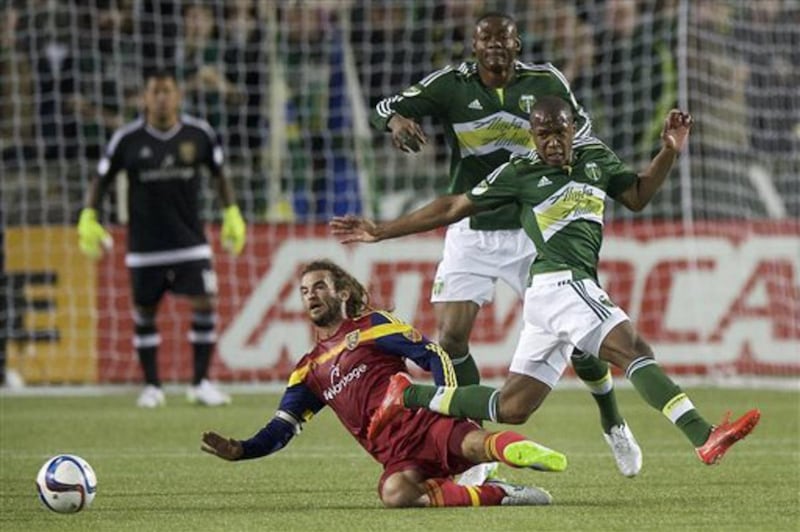
Watching Real Salt Lake struggle to build possession against the Portland Timbers doesn't provide a reason to throw the 4-3-3 to the wolves, but it does raise some questions, particularly when we look at the midfield. A starting lineup of Kyle Beckerman, Javier Morales and Luis Gil found it tough to calm play enough to get things moving properly, and while we can hem and haw about whether that's because of the new look, one match was never going to be enough to make a full evaluation.
But as difficult as it might have been to watch at times — with RSL clearing the ball repeatedly, especially — there are plenty of reasons that dismissing a new look shouldn't be the first course of action. After all, this is a tried-and-true approach that other teams have successfully executed. It's a staple of European soccer, and while that doesn't make it a great way to play, it does at least lend some sources for inspiration and some evidence that it can work with the right personnel.
There's no reason to think that Real Salt Lake's personnel can't build on the formation. The midfield is perfectly geared for it: Javier Morales can shift between the attacking midfielder spot and a deeper playmaker spot, while Luis Gil is proficient in shifting gears between attack and defense as the most busy of the midfielders. Kyle Beckerman in the deepest spot of the three is par for the course, and it's a formation he's been a part of with the United States national team.
As Real Salt Lake continues with this 4-3-3, there will be plenty of opportunity to get it right. No coach worth his weight in either salt or gold (or cobalt, for that matter) should take a single game as a reason to drop an approach. It'll inevitably take time, and that's to be expected. Iteration, adjustment, and revision have to be there every step of the way, but with some patience, Real Salt Lake's tactical constitution could eventually break away from where it's been for seven years.
Matt Montgomery is the managing editor of RSL Soapbox. Contact him at montgomery.matt@gmail.com.