

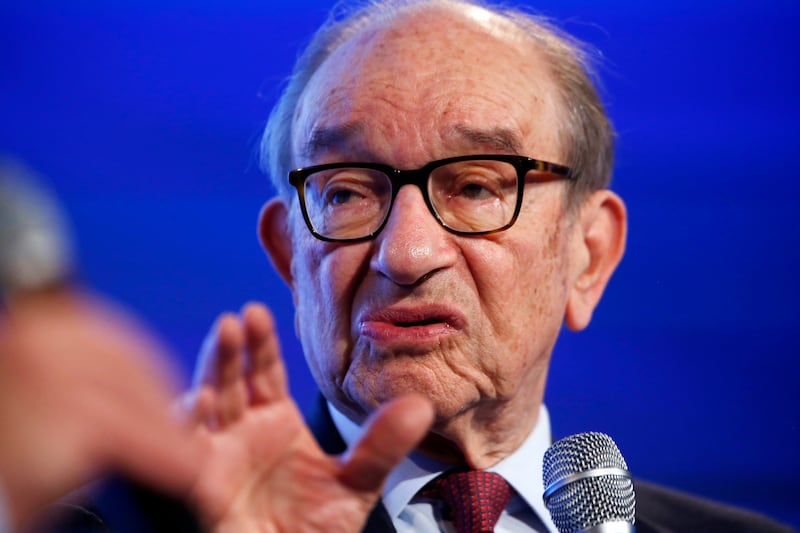

- U.S. economist Alan Greenspan died Monday from complications of Parkinson's disease.
- Greenspan led the Federal Reserve from 1987 to 2006, the second longest serving chairman.
- Overall domestic prosperity as well as a series of global financial crises marked his tenure.
Alan Greenspan, an American economist and second-longest serving chairman of the Federal Reserve, died at his home in Washington, D.C, on Monday morning. Greenspan was 100.
Greenspan served as head of the U.S. central bank from 1987 to 2006 through an era of a mostly prosperous domestic economy, though one marked by numerous challenges, including the dot com bust in the early 2000s and the lead up to the Great Recession.
In a statement, Andrea Mitchell, Greenspan’s wife and chief Washington correspondent for NBC News, celebrated her husband’s accomplishments as a globally influential fiscal policymaker and lifelong sports enthusiast.
“Alan passed away at our home this morning at the age of 100 from complications of Parkinson’s disease,” Mitchell said, per a Wall Street Journal report. “He was a giant of a man who helped shape the U.S. economy for decades under presidents of both parties, but was always honest in acknowledging his mistakes. To me he was my husband, who shaped my life from our very first date in 1984. He had ‘irrational exuberance’ for baseball, the Washington Commanders, tennis, golf and music, especially jazz. He will be remembered for his brilliance and his kindness. Being his life partner was the joy of my life.”
Greenspan was born in New York City. He received his bachelor’s, master’s and doctoral degrees in economics, all from New York University, according to his Federal Reserve biography. Before receiving his doctorate, he studied economics at Columbia University in the early 1950s under Arthur Burns, who would later become chairman of the Fed’s Board of Governors.
Greenspan began his career as a commodities analyst before launching his own economic consulting firm in the mid ’70s. He entered public service working for President Gerald Ford and later for President Ronald Reagan in various financial policy positions before Reagan nominated him to replace outgoing Fed chairman Paul Volcker in 1987.
An era of fiscal prosperity and tumult
Greenspan didn’t have to wait long for a test of his leadership on monetary policy issues, facing the October 1987 stock market crash shortly after assuming his spot as head of the Fed’s Board of Governors. His tenure also included navigating multiple events with major economic repercussions, including two U.S. recessions, the Asian financial crisis of 1997 and the Sept. 11, 2001, terrorist attacks.
“He had a reputation for being strongly anti-inflation, focusing more on controlling prices than on promoting full employment,” his Fed bio reads. “Many credit Greenspan with facilitating the longest official economic expansion in U.S. history. He was also known for his skill at building consensus among members of the Federal Open Market Committee on policy issues.”
Some critics point to Greenspan’s hands-off fiscal strategy as one of the underlying causes of the 2008 financial debacle and what would come to be known as the Great Recession.
Ben Bernanke, who was Greenspan’s successor and guided the economy through the crisis, noted Greenspan’s importance, per a report from CNBC.
“He was a great central banker who helped lead his country through almost two decades of prosperity,” Bernanke said. “I always found him generous with his time and insights. We are still learning from him, even if he is no longer with us.”
The Federal Reserve marked Greenspan’s passing in a post to its website and social media Monday.
“During his 18 years as chairman, he guided the Federal Reserve through periods of significant economic expansion as well as periods of considerable stress,” the statement reads. “Under his leadership, the Federal Reserve achieved a sustained era of price stability that supported economic growth and helped anchor the public’s confidence in the institution.
“He brought rigorous analytical discipline to monetary policymaking and helped establish the credibility that remains one of the Federal Reserve’s most important assets.”