



- A new poll finds a vast majority of Utahns concerned about the direction of the economy.
- Price increases on two household budget items, groceries and gas, pose the biggest worries.
- Economists say economic fallout from Iran war and high inflation could persist for months.
New statewide polling finds the vast majority of Utahns are worried about the direction of the economy right now as the cost of basic necessities continue to rise amid ongoing fallout from the Iran war.
The latest federal reporting pegged inflation at 4.1%, the highest reading since April 2023 and one driven in large part by supply shocks to the petroleum industry since the U.S. and Israel launched attacks on Iran in late February. Even after stripping out volatile food and energy prices, annual core inflation in May was 3.4%, the highest since October 2023, according to the Commerce Department’s Personal Consumption Expenditure Index.
On an annual basis, grocery prices were up 3.1% in May and have risen over 34% since 2019. Higher fuel costs are a factor amid still escalating food prices as are impacts from tariffs, supply chain disruptions wrought by global conflict as well as pricing decisions by individual suppliers.

Wholesale and consumer fuel prices have eased significantly since the start of peace talks, but average gas prices in the U.S. are still running 20% higher than a year ago. On Thursday, the average price of a gallon of regular across the country was $3.84, down from $4.29 this time last month but above the $3.17 per gallon average from a year ago, according to tracking by AAA. Utah gas prices continue to run north of the national rates, with the average cost at $3.87 per gallon statewide, per AAA.
A new poll conducted by Deseret News in partnership with the University of Utah’s Hinckley Institute of Politics asked Utahns how concerned they are, if at all, about the overall direction of the economy right now.
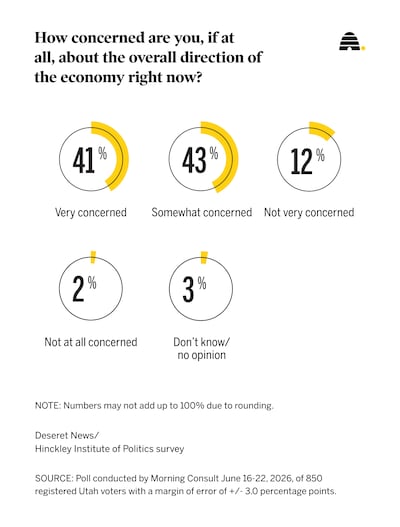
An overwhelming majority, 84%, registered some level of concern, with 41% saying they are very concerned and 43% somewhat concerned about the direction of the economy. On the other side of the sentiment question, 12% of respondents said they are not very concerned and 2% said they’re not at all concerned about where the economy is headed.

Feelings about the direction of the economy were similar among men and women as well as different age groups and across the income spectrum. But stark differences appeared when polling responses were filtered by self-reported political affiliation.
While 94% of Democrats who participated in the poll reported some level of concern about the path of the economy, only 75% of Republicans said they were very or somewhat concerned.
Morning Consult conducted the poll of 850 registered Utah voters June 16 – 22. It has a margin of error of plus or minus 3 percentage points.
The new findings mirror state and national data gathered by the Deseret News/Hinckley Institute in May where 80% of Utahns and 79% of Americans reported some level of concern about the economic fallout from the Iran war.
Phil Dean, chief economist and research director at the University of Utah’s Kem C. Gardner Policy Institute, reviewed the new survey results and said while Utah consumers are seeing some relief at the gas pump, the ripple effect of lower fuel prices may take longer to appear in other spending categories.
“These types of things often show up with a lag,” Dean said. “Elevated oil prices impact what you pay at the station but also affect the transportation costs of getting goods to market, and those aren’t showing up downstream yet.”
Dean also noted that markets tend to show different response times when it comes to price increases versus price cuts.
“These changes tend to be sticky on the downside,” Dean said. “They move up pretty quickly but are slower coming down and I expect that will likely be the case here.”
When it comes to which budget categories are causing the most pain for Utah households, two basic necessities stood well out from the others, according to the poll.

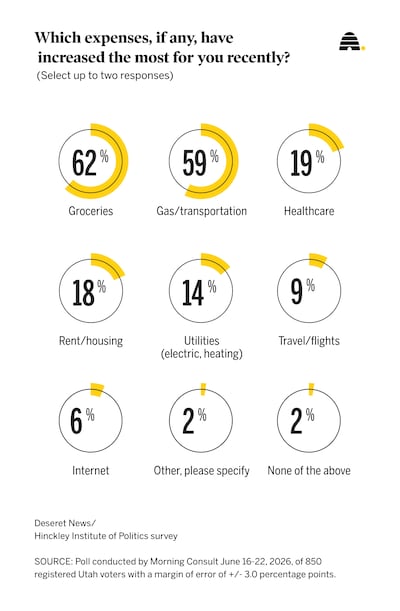
When asked to identify which household expenses have increased the most recently, 62% of Utahns selected grocery prices and 59% said gas prices saw the biggest jump. Much further down the list were healthcare, rent/housing costs and utilities, which were chosen by 19%, 18% and 14% of respondents, respectively.
Dean noted that while housing-related costs remain at historically high levels across Utah, the increase in those prices has eased a bit recently and price concerns are sometimes driven by volatility.
“With consumer expenditures, sometimes it’s the change in prices more than the level of cost,” Dean said. “When we get used to a particular rate, they tend to fall into the background a little bit. Unanticipated changes — that’s what really throws people off, and makes it hard for them to plan.”
When will inflation come down?
In spite of new Federal Reserve chairman Kevin Warsh’s signaling that addressing inflation is a top concern, economists are projecting that the monetary body won’t make any moves on an interest rate adjustment until this fall.
In the meantime, the consensus opinion matches Dean’s take that widespread, meaningful price relief could be a way off for those working to manage household budgets.
A Purdue University analysis released after the start of the Iran war predicted the broad energy shock precipitated by a sustained engagement could add three to six percentage points to grocery inflation over 12 to 18 months.
Joseph Brusuelas, chief economist at RSM, told Yahoo Finance last Thursday that the price drops in the wholesale petroleum market would show up, with some delay, in further relief at the consumer level but predicted inflation will remain persistent.
“Although those oil prices will eventually feed through to lower gasoline prices to provide relief to beleaguered down-market American consumers — the upper two quintiles of consumers is doing just fine — one should not anticipate a return to pre-war levels of inflation anytime soon,” Brusuelas said.