

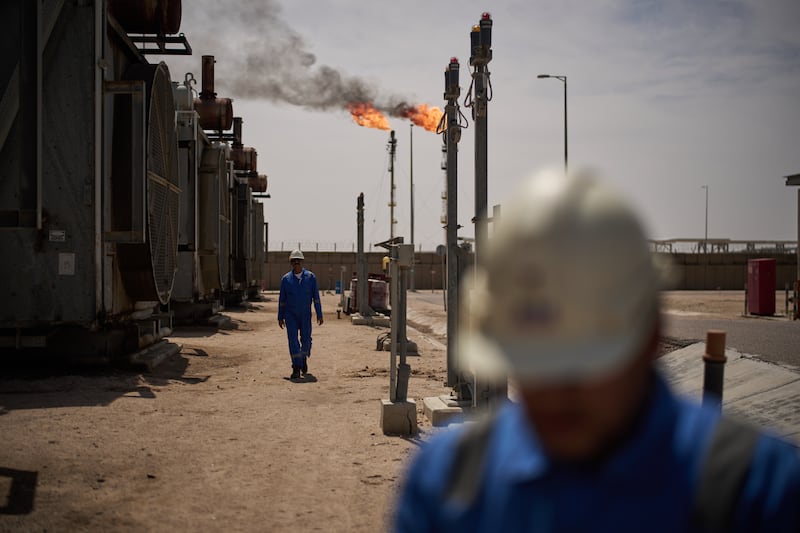

- Wholesale oil futures broke the $100 per barrel mark following Red Sea tanker attacks.
- Gas prices exceeded $4 per gallon earlier this week, and continue to rise.
- Renewed Middle East tensions and spiking fuel costs are likely to undo recent inflation declines.
Wholesale oil price futures surged Thursday following reports of attacks on petroleum shipping vessels by Iranian allies in the Red Sea.
International benchmark Brent crude jumped past the $100 per barrel mark after Houthi rebels claimed they attacked two Saudi Arabian ships in the Red Sea, making good on threats made earlier this week amid renewed military exchanges between the U.S. and Iran.
Brent crude was up over 7% to $101.04 per barrel Thursday morning and U.S. West Texas Intermediate crude spiked 6.4% to $92.37 per barrel. Oil prices have climbed more than 30% this month.
The Red Sea attacks follow President Donald Trump’s threat on Wednesday to destroy an Iranian bridge or power plant for every attack the country launches on ships traveling through the Strait of Hormuz, a critical passage that connects Persian Gulf countries with international shipping destinations. About 20% of the world’s petroleum output was traveling the route before the U.S. and Israel launched attacks on Iran in late February.

The average price of a gallon of regular gas was $4.09 on Thursday, per AAA tracking. That’s up nearly 15 cents from a week ago and 94 cents per gallon more expensive than this time last year. Utah drivers were feeling even more pain at the pumps on Thursday with the average gas price at $4.18 per gallon across Utah, up 18 cents from last week and 80 cents per gallon more than 12 months ago.
Before the renewal of fighting, now extending into a second week, wholesale and consumer fuel prices had been trending downward after the two countries signed a memorandum of understanding in mid-June that included, in part, an agreement to curtail attacks and re-open the Persian Gulf shipping passage. That agreement has not held and on Wednesday, U.S. Secretary of State Marco Rubio said negotiations on a peace deal remained stalled.
Speaking to reporters at a meeting of foreign ministers of the Association of Southeast Asian Nations in the Philippines on Wednesday, Rubio said Washington remains willing to negotiate an end to the war, per a report from CNBC.
“The U.S. would love to reach a diplomatic settlement, we’d love to reach an agreement if it were possible with Iran,” Rubio said. But the Iranians “don’t seem to be serious” about making a deal, he said.
Lower fuel prices helped bring headline U.S. inflation down to 3.5% in June, according to a Labor Department report released last week, down from May’s 4.2% annual rate and the biggest month-over-month decline in six years. A return to price escalations could push that figure higher in the coming weeks, however, amid renewed fighting.
Consumer worries on the rise

Recent statewide polling conducted by the Deseret News in partnership with the University of Utah’s Hinckley Institute of Politics found an overwhelming majority of Utahns, 84%, registered some level of concern with the overall direction of the economy right now, with 41% saying they are very concerned and 43% somewhat concerned.
On the other side of the sentiment question, 12% said they are not very concerned and 2% said they’re not at all concerned.
Feelings about the direction of the economy were similar among men and women as well as different age groups and across the income spectrum. But stark differences appeared when polling responses were filtered by self-reported political affiliation.
While 94% of Democrats who participated in the poll reported some level of concern about the path of the economy, only 75% of Republicans said they were very or somewhat concerned.
Morning Consult conducted the poll of 850 registered Utah voters June 16–22. It has a margin of error of plus or minus 3 percentage points.
The new findings mirror state and national data gathered by the Deseret News/Hinckley Institute in May when 80% of Utahns and 79% of Americans reported some level of concern about the economic fallout from the Iran war.