


- A New Mexico judge ordered Meta to pay $567 million into a harm-abatement fund.
- The court found Meta platforms a "significant contributing cause" of the teen mental health crisis in New Mexico.
- The judge ordered time limits for underage users, hiding "likes" on minors' photos by default and visible risk warnings.
Months after Meta was hit with $375 million in civil penalties for the harm its social media platforms do to kids, the Facebook and Instagram parent was slammed again when the judge during the second phase ordered the company to create a $567 million harm-abatement fund, as well.
That brings the total Meta has been ordered to pay just in New Mexico to $942 million.
And there are other, similar lawsuits in other parts of the country that are yet to be decided. As Deseret News earlier reported, “And at least 40 state attorneys general have filed lawsuits alleging Meta has played a key role in the youth mental health crisis through the addictive features on Instagram and Facebook.”
But the financial penalties in New Mexico are not the only thing First Judicial District Judge Bryan Biedscheid did. He ordered the company to install safety features that include limiting how much time underage users in the state can spend on Facebook and Instagram. Meta is ordered to make it a default to hide the number of “likes” on minors’ photos. And the platforms must visibly warn those users that the platforms pose risks.
Biedscheid called Meta a “public nuisance” and said the platforms were a “significant contributing cause” of a teen mental health crisis in New Mexico, writing that “Meta’s platforms create a public nuisance because their purpose and effect is to optimize engagement, including in ways that are detrimental to teenagers’ health and safety.”
Meta has promised to appeal the ruling.
What’s the fund for?
Per Biedscheid’s ruling, the fund is to pay primarily for mental health treatment and education. The fund will include $420 million for treatment of young people harmed by the platform and the balance is to be used for “awareness and prevention, screening services and other costs over the next five years.“
Other changes ordered by the judge include making it easier for people to report underage usage and teaming up with schools or child safety groups “to create a reporting portal where school administrators can flag suspected accounts where users may be under 13 years of age across any social media platform.”
The algorithms, however, are not part of the ruling. Per CNBC, “Biedscheid wrote that doing so could conflict with Section 230 and First Amendment protections. The judge added that Meta will not be required to stop supporting end-to-end encryption on Facebook.”
A bit of background
In March, Deseret News reported that the jury in New Mexico had awarded a $375 million verdict against Meta. At about the same time, a jury in Los Angeles sided with the plaintiff in a lawsuit against Meta and YouTube that claimed her depression was largely a result of becoming addicted to Instagram and YouTube. The suit alleged the company had been negligent. She was awarded $6 million after the jury said the platforms’ negligence was a “substantial factor” in her mental health harm.
Both the Los Angeles and New Mexico cases were considered harbingers of what might be coming for Meta.
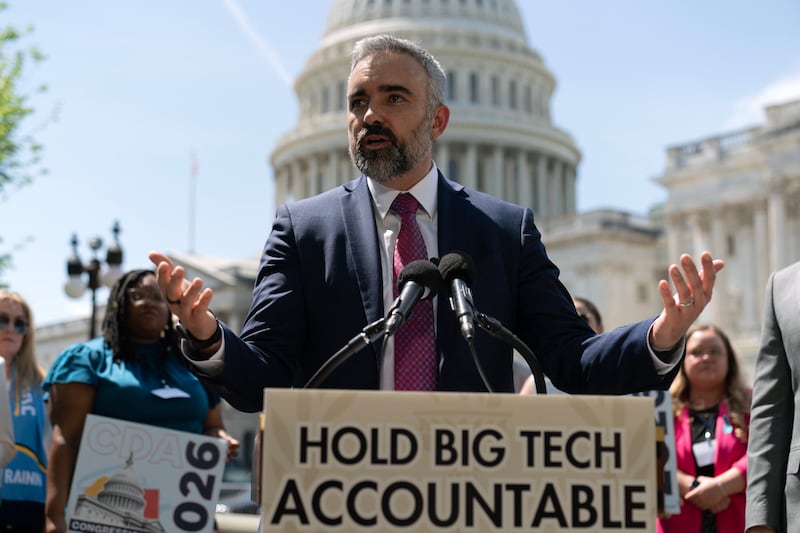
The Washington Post reported that “New Mexico Attorney General Raúl Torrez brought the case against Meta following an unusual undercover probe in which investigators posed as children in an attempt to prove that Facebook and Instagram’s algorithms connected young users with abusers.”
CNBC described the undercover operation bluntly: After Torrez’s office created a fake social media profile of an imaginary 13-year-old girl, he told CNBC that the nonexistent girl “was simply inundated with images and targeted solicitations” from child abusers.
In a written statement after Biedscheid’s ruling Thursday, Torrez said, “For years, Meta knew its platforms were harming New Mexico’s kids, from feeding a youth mental health crisis to connecting predators with children, and it chose engagement and profit over their safety. Today, Meta is paying for that choice.”
Meta released a statement, noting that “we work hard to keep people safe on our platforms and have been transparent about the challenges of identifying and removing bad actors and harmful content. We remain confident in our record of protecting teens online and will continue to defend ourselves against claims that misrepresent the facts.”
Meta and other social media companies have defended themselves in the past by citing free speech protection and the Section 230 communications law. More recent lawsuits have taken a different approach, claiming that the actual design of the platforms is defective, making them “faulty products.” Faulty products are not afforded those protections.
The applicable law used against Meta in New Mexico was an unfair practices act.
Lots of legal action pending
Utah joined a lawsuit in October 2023 alleging deceptive practices and child addiction as part of lawsuits against TikTok, Meta and Snap. Per the notice on Utah Attorney General Derek Brown’s website, “The lawsuits focus on alleged unconscionable design features and business practices that may encourage prolonged and compulsive use by minors, misrepresent the level of safety provided to parents and young users, or fail to adequately protect children from harm. Utah’s position is that companies that knowingly allow or profit from children using their platforms have a legal obligation to be truthful about risks and to implement reasonable safeguards.”
The Wall Street Journal reported that Meta faces “thousands of lawsuits from state attorneys general, school districts and individual plaintiffs that allege the company gave priority to growth over the safety of its underage users.” The article said the New Mexico case was the first to test liability for content on their platforms.
The next trial, brought by attorneys general in California, Colorado, Kentucky and New Jersey, starts in Oakland, California, Aug. 12.
Meta reported that in just the second quarter, legal proceedings have cost it $2.4 billion.
TikTok is also facing similar lawsuits in a number of states.
Attitudes among adults about social media and kids
A Deseret News/Hinckley Institute of Politics poll in February showed that Utahns and U.S. adults have mixed feelings about social media. More see social media as bad than good, but nearly half said “neither good nor bad.” Utahns are slightly more likely to say it’s bad for society, at 34% vs. 30% nationally. The poll had a margin of error of plus or minus 2 percentage points.
And as Deseret News reported, “In November, the latest edition of the American Family Survey — a joint project of Deseret News with Brigham Young University’s Wheatley Institute and its Center for the Study of Elections and Democracy — found that U.S. parents with minor children at home believe that social media is more negative than positive, 38% vs. 19%.”
Utah is among states that have banned access to smartphones during school days and has passed an age-verification law to be sure social media companies have parental permission before children can sign up for accounts.
Social media isn’t an American-only problem. Different countries are tackling the issue. France banned social media for kids younger than 15, for example, while for Australia a ban is in place for youths younger than 16.