
The audience of The New Yorker doesn’t all live on the coasts, but they’re the sort of people often characterized as the “coastal elite.”
Highly educated, affluent and largely left leaning, they go to the venerable magazine for erudite reviews of plays, films and books, as well as essays and reporting, and of course, the cartoons. The magazine’s iconic image of a French aristocrat studying a butterfly through a monocle, the nose tilted just so, is about as far from heartland America as you can get.
So what happens when The New Yorker turns its monocle on “The Chosen,” the popular television series exploring the life and ministry of Jesus Christ?
We found out this week in a piece by Rachel Monroe entitled “Act of Faith: How ‘The Chosen’ spurred a golden age of Christian filmmaking.”
It was a surprisingly neutral headline, given that The New Yorker newsletter that directed me to the article was entitled “Hollywood Comes to Jesus.” And a 2023 article about “The Chosen” star Jonathan Roumie was similarly irreverently titled.
But what of the story itself? Here are 5 things we learn when an unbeliever who writes for The New Yorker looks at a series globally beloved by people of faith.
1. Hollywood forgets about Christians
“Although the United States has become a much more secular country since the 1990s, the majority of Americans still identify as Christian, a fact that Hollywood regularly seems to remember, forget, and then remember again,” Monroe writes.
But right now, Hollywood is in a period of remembering, she says, writing “2025 was arguably the best year for Biblical content in decades.”
“Prime Video had a hit with ‘House of David,’ an Old Testament-inspired fantasy epic complete with giants and soothsayers. ... An animated musical called ‘David’ became one of the highest-grossing Biblical films in more than a decade. In April, there were three Jesus-themed projects in the box-office Top Ten — two were theatrical releases of “The Chosen” episodes, and the third was the South Korean animated film ‘The King of Kings.’"
Moreover, she notes, “Mel Gibson is at work on a sequel to ‘Passion’ that will be released next Easter weekend. Two seasons of ‘Martin Scorsese Presents: The Saints,’ a docuseries narrated and executive-produced by the filmmaker, have aired on Fox Nation.”
2. Religious content is seen as ‘niche’
According to Monroe, “The success of media projects is increasingly driven by devoted fan bases rather than by widespread appeal. With the decline in churchgoing, observant Christians are now members of a distinct subculture, one that can be targeted by marketers who speak the idiom of faith.”
She quotes a former editor of The Hollywood Reporter, Matt Belloni, who says, “If you can identify a niche that you can overserve that feels underserved in the market, then you can have a successful business.”
She also says creator Dallas Jenkins “seems temperamentally inclined to treat faith audiences as a capacious majority rather than as an embattled minority.”
3. Fans adore Dallas Jenkins
“Jenkins is built like a football player — he sometimes gets mistaken for Tom Brady in airports — but he comes off as guileless and geeky, with an obsessive’s bottomless enthusiasm for talk,“ Monroe writes.
She said that she watched promotional videos Jenkins and his wife did about “The Chosen” on YouTube. “The more I watched, the more he reminded me of Kermit the Frog with biceps.”
That may or may not have made Jenkins laugh. Suffice it to say that in forthcoming episode of the “Deseret Voices” podcast, he says, “I care about what God thinks and what my wife thinks, and after that, it’s not all that important to me, other than wanting to make sure I’m serving God faithfully.”

4. You can be too friendly
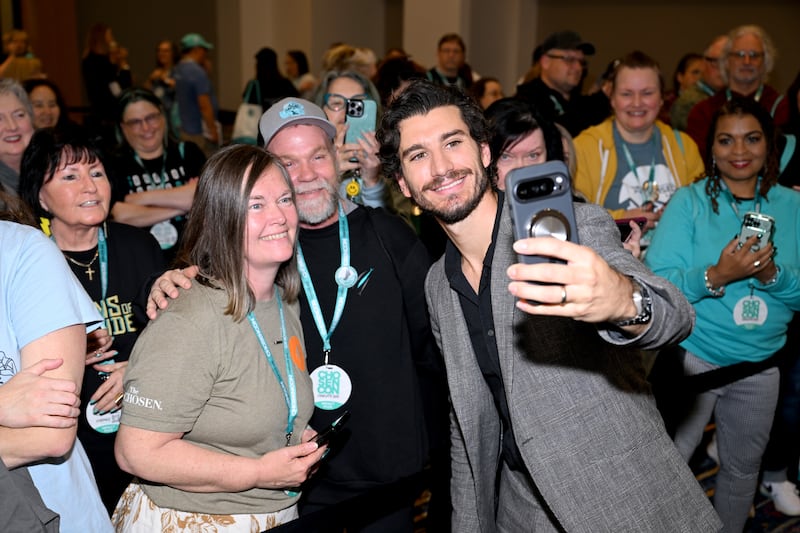
At a ChosenCon in Charlotte, Monroe writes, “The atmosphere was saturated with a friendliness that occasionally tipped into intrusiveness. My shoes came untied, which I noticed only when a stranger bent before me to tie them.”
5. The storyline isn’t suspenseful enough
“I did not find the show as bingeable as its core audience does,” Monroe says. “Some crucial element of the experience — perhaps a feeling that what I was watching was providential and urgent and true — was inaccessible to me as a nonbeliever. Instead, I was left with the sense that this was a narrative that had stakes but little suspense, since it is never in question how this story is going to turn out.”
It’s true that we know how this story turns out; fans of “The Chosen” have made that point. The satirical Christian site The Babylon Bee recently joked that the show was “jumping the shark” because it planned to have its main character die, “only to resurrect him next episode.”
The X account of “The Chosen” humorously responded, “Admittedly we are running out of new ideas.”
But, of course, knowing what happens on Easter Sunday is why more than 2 billion people worldwide profess the Christian faith, making it the largest religious group.
The global appeal of ‘The Chosen’
It is that nuance that is missing from The New Yorker’s take on “The Chosen,” which, in its focus on monetization and merch, fails to get at the heart of the show’s popularity.
In a forthcoming episode of the “Deseret Voices” podcast, Jenkins delves into that “deeper truth,” telling Sheri Dew, executive vice president and chief content officer of Deseret Management Corporation, that when he encounters fans of the show, many of them start crying.
“It’s not a celebrity thing,” he said. “It’s a gratitude thing. They’ll just say you have no idea how much this show has changed my life, it’s changed my heart, it’s changed my heart, my relationship with my family. I’ve never been this close to God. I’m pursuing Jesus like I never have been before.”
Jenkins goes on to tell Dew that “The Chosen” is now the most-translated show in television history, and the intent is to eventually translate it into 98% of the world’s languages.
Moreover, the idea of faith audiences as an “embattled minority” is curious, given that Christianity remains the world’s largest faith group, and that Hollywood has been losing influence in America in large part because it has neglected the values and interests of people of faith.
To her credit, Monroe’s article for The New Yorker acknowledges the worldwide appeal of the show, noting, “Season 1 is available in a hundred and twenty-five languages, including Finnish, Tulu, and Kyrgyz; when it streamed on Netflix, it was in the Top Ten in Paraguay, Honduras, and Brazil.”
And also, it should be noted that Monroe herself is not a “coastal elite” — she lives in Texas, albeit in Marfa, a city recently called “the unlikeliest of global art capitals and hipster hangouts” by Texas Monthly.
Monroe ends her article with an anecdote about Jenkins asking fans on a livestream to share content on social media.
And she describes character of Jesus Christ, played by Jonathan Roumie, as a depiction of a “a tender and benevolent manager.”
For The Chosen’s fanbase, which vastly outnumbers The New Yorker’s circulation, that’s an understatement to say the least.