



- Utah’s 2026 wildfire season has been fueled by record-low snowpack, drought, dry vegetation and high winds, creating conditions for some of the country's largest fires.
- The Cottonwood Fire has burned nearly 94,000 acres and destroyed more than 150 structures in Beaver County.
- As firefighters battle active areas, officials warn that long-term wildfire prevention will require better forest management and an overhaul of NEPA permitting.
Smoke still rises from the Tushar Mountains in southwestern Utah. The grass beneath the sagebrush and Gambel oaks is yellow and dry. Like much of the state, miles of this range’s rolling wild lands have been dehydrated for months.
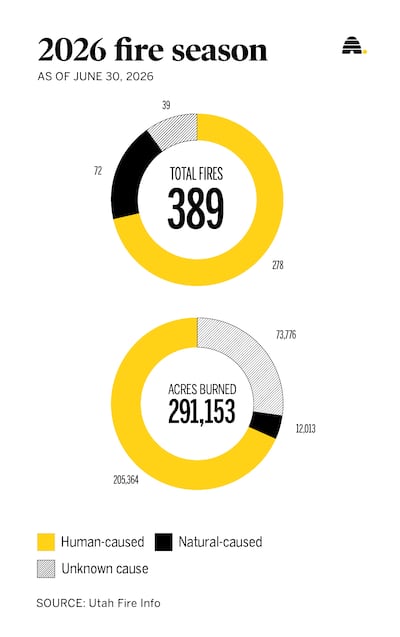
With about half of the summer remaining, Utah has already experienced 390 wildfires. The majority of the burnt acreage is due to a handful of massive fires that quickly grew out of control.

The recipe for the flames is simple. Utah’s warm and dry winter led to an early meltoff. Then in the low-humidity weather, vegetation dried out, died and now acts like fuel for the fires. In the case of the Cottonwood Fire, the largest wildfire in the country, the dry air and 50 mph winds sent the fire racing across the landscape with few impediments.
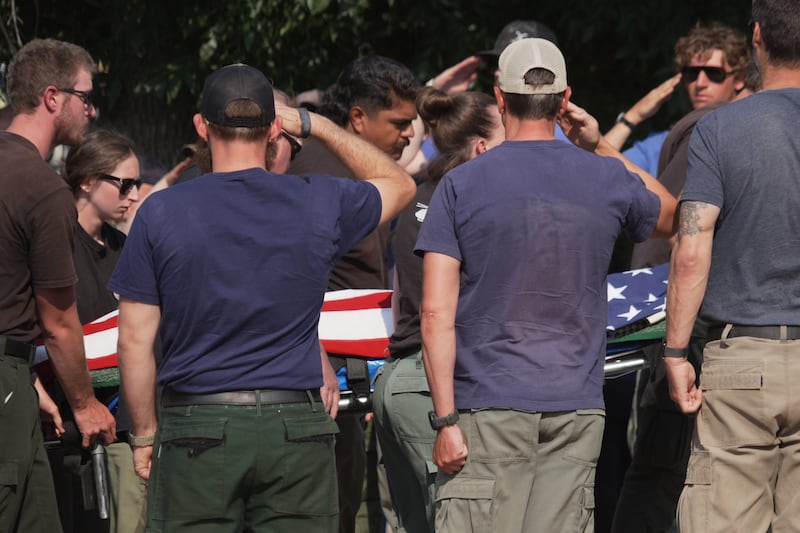
Across the West, the fires have already been deadly. On Utah’s eastern border with Colorado, three firefighters were killed and two were injured in the Snyder Fire.

Tom Schultz, chief of the Forest Service, remembered the firefighters in his remarks at a Western Governors Association meeting in Park City, Utah, on Tuesday: Emily Barker, 38, of Clinton Township, Michigan; Nick Hutcherson, 27, of Glendale, Arizona; and 27-year-old Sydney Watson, of Warrior, Alabama.
Schultz said they were “much loved” by all who knew them, and “dedicated public servants” who made the “ultimate sacrifice.”
In an interview with Deseret News, Schultz spoke about the magnitude of this year’s fire season — how the number of acres burned so far is 50% above average nationally, and the number of fires is 30% above average.
He wouldn’t predict where the fire season is headed from here, but said given the conditions “it’s not surprising what we’re seeing.”
“The conditions are really tough in the landscape,” Schultz said. “It’s dry. There’s a lot of fuels on the ground, and you get the spark in the wrong spot, and it can be a problem.”

He said the Forest Service, which is moving its headquarters to Salt Lake City, already has five complex management teams in Utah, and the preparedness level in the state and region is at a 4 on a scale from 1-5, where 5 is the most serious, which means national resources are “heavily committed.”
The fires burning across Utah are not all the same; in order of size, the largest are the following:
- The Cottonwood Fire: Started on June 22, located just outside Beaver, covering about 94,000 acres.
- The Iron Fire: Started just west of Utah Lake, covering about 42,000 acres.
- The Babylon Fire: In San Juan, covering about 38,000 acres.
- The Cherry Fire: Just southwest of the Iron Fire, covering about 34,000 acres.
- The Snyder Fire: On the border of Colorado in Grand Junction, covering about 30,000 acres.
- The Hastings Fire: Just west of Tooele, covering about 26,000 acres.
Utah is likely ‘worse off’ than other states

Jamie Barnes, Utah’s forestry, fire and state lands director, told the Deseret News on Tuesday that the state experienced worse drought conditions than many of its neighbors through the recent winter and spring.
In 2026, Utah’s snowpack peaked nearly three weeks early, and on April 1, it was just 2.7 inches — the lowest on record since 1930. Combined with high temperatures and low humidity, Utah has about 600 communities at risk of wildfire leading up to the Fourth of July.

Barnes referenced drought conditions, lack of precipitation and a build up of fuels as drivers for the fires.
“We’re also in historic drought conditions,” Barnes continued. “So we’re seeing really low fuel moisture — those fuels down there are basically combustible."
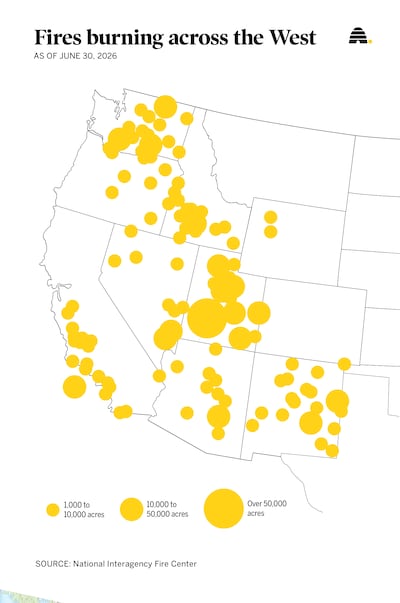
Though slightly better, Colorado, Wyoming, New Mexico, Arizona and Idaho suffered similarly dry winters and warm springs. Just as in Utah, weather conditions have made the states a breeding ground for wildfires.
Will the rest of the summer be this intense?

When asked whether the intensity of the fire season will continue, Barnes told the Deseret News that “it’s hard to say.”
It would take a significant amount of rain to pull the state out of its current conditions, she continued, adding, “We’ve seen some storms push through the state, but there hasn’t been any measurable amount of precipitation.”
Tim Tyson, a fire behavior analyst, told Beaver residents on Monday, “The bottom line is, as you guys all know, this is the second year in a row you haven’t had any snow.”

“And we started out the spring with really warm temperatures. And so the vegetation is stressed and very dry,” he said.
Days with cloud cover, higher humidity and lower temperatures will help.
Philip Dennison, a professor of geography at the University of Utah, said the outlook for the rest of the summer looks “pretty grim.”
“Low precipitation this past winter, combined with hotter temperatures this spring and summer are setting the stage for a difficult fire season across the West. We’re only just getting started, especially at higher elevations where fuels haven’t dried out yet in many areas,” he said.
150 structures lost above Beaver, Utah

Early last week, videos of the Cottonwood Fire began circulating. Matt Clarke recognized the area in one video; his cabin is about 150 yards away.
Clarke built his cabin with his wife and college friends over the past several years. They were nearly finished with it when he got a video of his property after the fire went through. The only thing standing amid the blackened trees was his concrete foundation.
When asked what it was like seeing the video, Clarke said, “Ah, you know. Tears.”

“I knew the answer before I even clicked on it, but you have to hold out hope,” he said.
He’d bought two adjacent lots before property values at Eagle Point had skyrocketed, he explained.
“I don’t know if I have the energy to rebuild it, but hopefully with the insurance money, I can rebuild it with a contractor. I’m 51 years old now, and stacking 38 rows of logs seems daunting, knowing what I’ve done for three years to get to this point,” he said in a phone interview.
What does it take to fight a wildfire?

Fighting wildfires like the Cottonwood Fire takes a village. In conjunction with local officials, the U.S. Forest Service brought in scientific specialists, around-the-clock firefighters and heavy equipment.
Firefighters attack the flames both directly and indirectly. Ground crews remove dead material that would act as fuel, lay down fire retardant and try to protect people’s property.
Susan Oldroyd, who was camping in the mountains when the Cottonwood Fire started, told the Deseret News that when her son was allowed to go back up to retrieve his RV, firefighters had raked potential fuel away from the vehicle. Their efforts had saved his property, she said.
The Forest Service also uses aircraft to dump slurry and water on flare-ups. As of the end of June, more than 2,000 firefighters were in Utah — roughly one for every 100 acres of affected area.
NEPA regulations are getting in the way of wildfire mitigation

While the Forest Service is working around the clock to fight the West’s fires, there is a significant amount of prevention that should have been done — which was bogged down by overly complicated federal permitting, Matt Weiner, a co-founder and CEO of Megafire Action, told the Deseret News.
“We knew this fire season was coming,” Weiner said. “We had record low snowpack this winter, and then we followed it with the hottest March in 132 years.”
In Utah, which has more than 8 million acres of U.S. Forest Service land, there has been a significant build up of fuels.
“The biggest thing the federal government can do is better and more active land management,” he said.
To reduce the risk of massively destructive wildfires, Weiner said the Forest Service should conduct more mechanical thinning, create more fuel breaks and follow through with prescribed burns, “which we know is the best tool that we have to reduce the risk of catastrophic megafires.”
In his time so far as chief of the Forest Service, Schultz has tried to increase the active management of forests, and is traveling the country to convince others of the need to do so. He said he wants to see thinning and prescribed burns.
“If you care about the environment, and you care about the landscape that we live in, the most important thing we can do is actively manage the landscape,” he told the Deseret News.
Ultimately, managing the forests would mean less of them would burn, he said.

“The forest conditions in the West are significantly unhealthy. We have growth rates that are negative,” Schultz said. “We have more mortality than growth. We have so much to clean up and address. And if we do that, it will help mitigate the effects of catastrophic fire.”
Weiner referenced Utah Sen. John Curtis’ Fix Our Forests Act, which recently passed the House of Representatives.
The National Environmental Protection Act currently requires a rigorous permitting process to alter public forest lands in any way. “The irony, though, is that the biggest threat to our forests in the West now is not human activity. It’s wildfire,” Weiner said.
Curtis “has really been doing a tremendous job trying to not just identifying the problem, but trying to get really big legislation moving into it in a very bipartisan way,” he said.
Utahns come together

Local charities and numerous GoFundMe campaigns have popped up to support firefighters and the families who have lost their homes.
Co-leader of Girl Scout Troop 1686 Annie Melton told the Deseret News that she and her co-leader are gathering donations at the Beans & Brew in Nephi, Utah, “for as long as they’re needed.”
Donations they’re looking for include eye drops, protein-rich snacks, portable chargers, sunscreen, handwritten thank-you cards for the firefighters and gift cards for families who have lost their homes.
The donations will be sent out to those affected by the Cottonwood, Iron and Cherry fires, Melton said.
Contributing: Brigham Tomco