



This year’s wildfire season in Utah — comprising 843 individual fires collectively burning more than half a million acres of land — are shaping up to be the state’s worst on record. Two firefighter pilots were killed as the state faces soaring temperatures and longstanding droughts, while numerous homes and vacation properties were consumed in the blazes.
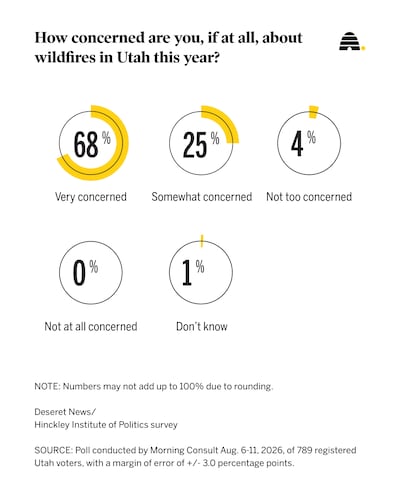
In an Deseret News/Hinckley Institute of Politics poll, 93% of registered voters in the state who were questioned said they were either “very” or “somewhat” concerned about the fires.
Virtually none of the Utah residents said they were “not at all concerned.”
Philip Dennison, a professor at the University of Utah’s School of Environment, Society & Sustainability, echoed Utahns’ concerns in an interview with the Deseret News:
“I think it’s a long-term trend that we need to be concerned about,” he said. “Every decade we seem to be escalating the areas that burn.”
Health impacts become a daily reality
Wildfires producing poor air quality have created widespread, tangible consequences for Utahns.
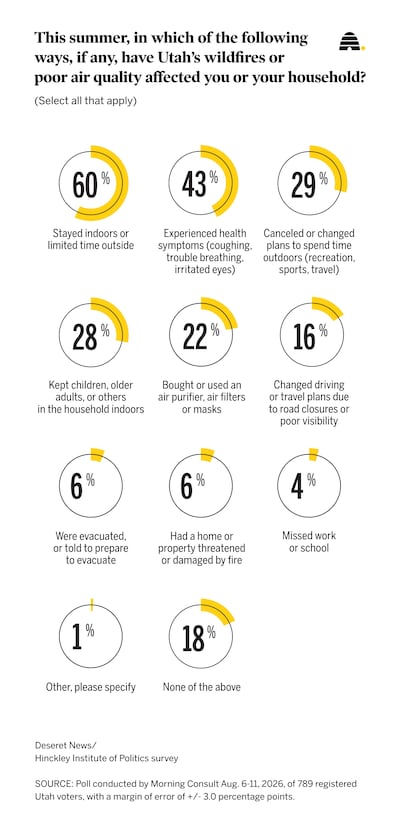
Just under half of all respondents to the poll reported experiencing health symptoms such as coughing, trouble breathing or irritated eyes. Almost 2 out of every 3 Utahns limited their time outdoors this season, with a fifth of those polled purchasing air purifiers, filters or masks.
Dennison said the numbers were “not surprising.”
“In many ways, this has been the worst year for wildfire in Utah’s history — we have never had three fires (burning) close to or over 100,000 acres before in the same year,” he said.
Derek Mallia, a research associate professor at the University of Utah’s Department of Atmospheric Sciences, tracked the radiative power emanating from the Cottonwood Fire’s smoke — a way to monitor the intensity of the fire and the estimated emissions output. On June 23, it reached 180 gigawatts.
That means one hour of the fire’s smoke is roughly equivalent to 83,000 cars driving for an entire year.

Worsening air quality in Utah mainly attributed to this season’s wildfire smoke might even be correlated with increasing suicides, a new study from the University of Utah found.
In the study, researchers found that for every 9-degree increase in temperature and high levels of nitrogen dioxide — an air pollutant — the risk of suicide shot up by 50%.
Even if Utah suppresses its own fires, Dennison noted that the 60% of residents who had to stay indoors or limit outdoor time would face regional impacts.
“Even in years when Utah isn’t burning, we’re going to suffer from smoke from fires in other states,” he said.
What went wrong — and what went right

Though devastating, Dennison said wildfires are inevitable — and in some cases, beneficial. An example, he said, of near-perfect wildfire prevention execution, yet undesirable results, is Monroe Mountain.
Monroe Mountain has a prescribed fire program — a system where professionals create fires to thin bushy forest areas to prevent future destructive wildfires. It’s one of the best in the state, Dennison argued.
Despite preventative efforts, a wildfire broke out on the mountain last year, burning over 10,000 acres.
“The moral of the story there is you can’t get rid of fire,” he said. “It’s still going to burn, and we still have the threat of large fires. Despite all of the negative impacts, we can realize some ecosystem benefits like restored aspen groves.”

Dennison said that when a state attempts to suppress every fire possible, more wildfires will burn in uncontrollable conditions, growing larger and more intense.
“The challenge for the management community is to understand which fires are beneficial and they can let burn without endangering people and without threatening to grow too large,” he said. “So that’s the real challenge: Which fires do you allow to have a beneficial impact?”
Potential preventative policies
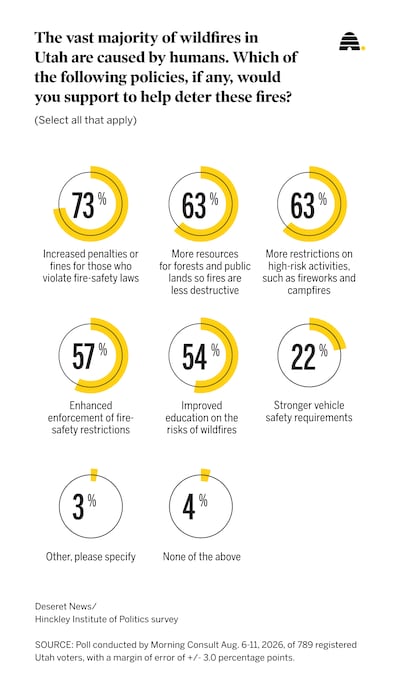
Regardless, wildfire management is unsustainable without ample resources. Among those responding to the poll, 63% support giving more resources to forests and public lands.
This is what Gov. Spencer Cox did when he issued his 30-day State of Emergency Executive Order on July 22, allowing the state to skip the normal bureaucratic steps that slow the allocation of funds to agencies critical to wildfire management.
As of July 31, the state had already spent over $100 million fighting the fires.
“I do think we need increased resources to reduce fire impacts,” Dennison agreed. “The biggest benefits, I think, would come from hardening structures in the wildland urban interface and then targeting fuels management to reduce the immediate danger to people and structures.”
Structure hardening refers to reducing shrubbery and bush that fuel fires around buildings and homes and strengthening infrastructure, preventing embers from entering. This measure is something other states like California are aggressively developing.

“This is something that Utah could pursue better,” he said.
Another element of fire prevention, something 73% of voters supported, is increased penalties or fines for violating fire-safety laws — and support was found across party lines.
“Human ignitions are important, and we do need to watch out during these red flag days and during days when fuels are dry and winds are high,” said Dennison.
However, half of adults also believe education is key, and so does Dennison.
“Both policy and education are needed to ensure that we reduce human ignitions,” he said.
Informed locals and increased education seem to have improved the dire fire situation this season, as Utah’s human-caused fires dropped to 51% from 85% in June of this year, KSL reported.
“I hear a lot of people asking, is this the new normal?” recalled Dennison.
“There’s really no escaping the impacts of fire,” he said. ”We’re going to be dealing with these impacts of fire in the West for a long time.”
