



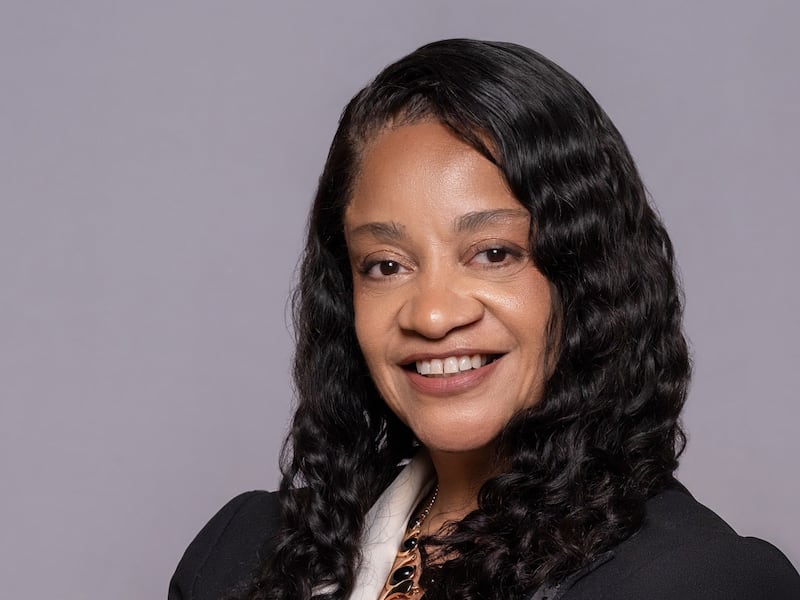
The Rev. Dr. Que English has raised her voice on many problems that kept her awake at night: ending solitary confinement for youth, combatting human trafficking, improving maternal health and wages for workers. Until last year, she rallied interfaith leaders as director of the Center for Faith-Based and Neighborhood Partnerships in the U.S. Department of Health and Human Services.
For the Rev. English, a leader in New York working at the intersection of faith, philanthropy and public health, her Christian faith compels a clear moral task: to stand against injustice and defend those who lack the voice to defend themselves. In her view, the Christian response to injustice is not quiet or passive. It is bold and courageous, just like Jesus himself, she said. But most importantly, it is never violent.
In recent years, the reports of political and religious violence in the United States have increased in frequency — an arson attack on Pennsylvania Governor Josh Shapiro’s residence, the assassination of Charlie Kirk, multiple assassination attempts on national leaders, including President Donald Trump.

On Saturday, a gunman opened fire at the White House Correspondents’ Association dinner inside the Washington Hilton hotel in Washington, D.C.
As the investigation into events of the attack continues, the manifesto allegedly left by the gunmen invoked Jesus’ teaching to “turn the other cheek.” Christ’s teaching was directed to the oppressed, Cole Allen, the 31-year-old alleged gunman, allegedly wrote. He didn’t see himself among them.
“Turning the other cheek when *someone else* is oppressed is not Christian behavior; it is complicity in the oppressor’s crimes.” Allen’s intent, he wrote, was to target the administration’s officials “from highest-ranking to lowest.” Allen is facing charges for an assassination attempt against the U.S. president, and also for transporting and discharging a firearm.
Threats against members of Congress reached record highs in 2025, rising about 60% in a single year. In 2024, antigovernment violence hit a 30-year peak, according to the Center for Strategic and International Studies. A report from Princeton School of Public and International Affairs described 2025 as a “serious escalation” in the political violence risk environment and described 2026 being on a “dangerous trajectory.”
Still, some experts believe that the country has seen worse, and there is hope to turn the corner.
“Part of our doom loop is not necessarily the political violence itself, but the narrative of democratic collapse that comes along with it,” Sean Westwood, expert on political violence in America, told The New York Times recently. “And history tells us that isolated incidents of political violence — even the assassination of elected officials or presidents — do not lead to the end of the Republic.”
He noted that incidents of political violence are relatively small compared to other kinds of violence, like those that are religious and racial in nature.
Activated by moral force
In her work to combat a slew of social ills, the Rev. English draws on the distinction between two kinds of forces: the “moral” force and “physical” one. “The gospel calls us to use every ounce of moral force — we have our voices, our presence, our organizing power to challenge injustice while refusing to harm others in the process,” said the Rev. English, who is the president and CEO of Elev8 Health, a national organization that equips faith-based and community groups with the resources and support they need to improve health outcomes in underserved communities.
She’s been at the forefront of growing a national movement to reimagine how capital, community and institutions come together to solve some of the country’s most urgent challenges like human trafficking, domestic violence and crime. She also leads the Faith & Philanthropy Collective that connects capital with faith communities.
During COVID, The Rev. English participated in an interfaith effort with The Church of Jesus Christ of Latter-day Saints to help children during Christmas in New York.
The phrase “to turn the other cheek,” which comes from Christ’s Sermon on the Mount, is often misunderstood, the Rev. English said. It’s not about submission and acceptance of injustice, but instead about resisting without violence and peacefully searching for solutions through dialogue.
“We’re called to be both peacemakers and protectors, never passive in the face of harm and never violent in the pursuit of justice,” she told me. Although theologians differ in their interpretations of the phrase, most agree that Jesus’ teaching, issued to Israelites during the Roman occupation, is meant to interrupt cycles of retaliation and reframe how people respond and stand up to what they feel is unjust.
The Rev. English’s work is fueled by Christ’s mandate to his followers to protect and stand with the vulnerable. In her view, there is no conflict between nonviolence and intervening on behalf of the oppressed. “In fact, for me, and for those that call ourselves Christian, love requires it,” she said. “Silence in the face of harm is not righteousness.”
Jesus himself was not passive, she added, but used his voice to challenge the structures that undermined the dignity of others. “His life shows us that love is not passive — it is active, it is courageous, and at times confrontational,” the Rev. English said. “Justice that requires violence against others is no longer justice, it has lost its moral foundation.”
Confronting power through dialogue
The Rev. English explains that the pain about the world’s injustices can serve as a guide to action. “What angers you is what you’re assigned to solve and what saddens you is what you’re assigned to heal.” The blend of the two shapes a sense of purpose, she noted, that drives people to act and defend principles and causes they believe in.
In recent months, some faith leaders and congregations have mobilized to voice their disagreement with the administration’s policies that they see contradicting their Christian beliefs. In February 2026, about 400 Christian leaders signed a letter urging resistance to Trump’s administration policies around immigration.
“Therefore, as Christians in the United States … we are compelled to speak out more boldly at this time,” the statement said. During an Ash Wednesday homily, one priest also spoke directly to immigrants and criticized mass deportation efforts.
Teaching the culture of nonviolence begins with education, the Rev. English said. The task of the faith leaders is to teach faith in a way that “the scripture’s never isolated from the core message of love, dignity and the sanctity of life.” The task of building the culture of peace has to do with expanding the vision of who is worthy of care.
The Rev. English sees herself as a link between the stakeholders in power and communities in need. The key to her success as an organizer is keeping the “bridge” with those in power intact. In coming to a dialogue, English looks beyond her grievances and tries to see the problem through the lens of the other.
“I can confront power and sit at the table with power,” she said.
“Because at the end of the day, I’m not just looking to be heard. I’m also looking for a solution. My whole purpose is that of reconciliation.”