


- New poll finds 6 in 10 Utah voters do not feel well represented by Republican or Democratic parties.
- Poll also finds 4 in 10 voters across the U.S. and in Utah would like to see a new major political party.
- 30% of U.S. voters said they did not engage with parties at all — mostly because of a lack of interest.
A majority of Utah voters do not feel like the Republican and Democratic parties represent their views, according to a new Deseret News-Hinckley Institute of Politics poll.
The share of Utahns who feel this way was significantly larger than American voters overall. Utahns were also more likely to support the creation of a new major political party.
“There is a connection between the party and their identity, but it’s more nuanced in Utah than just the political flag they’re connected to,” said Jason Perry, director of the University of Utah’s Hinckley Institute. “Utahns tend to connect to issues.”
At the state and national level, most discontented voters would like to see a more moderate third party, with smaller groups wanting a more progressive or conservative option.
Dissatisfaction with the two dominant forces in U.S. politics could have broad impacts, contributing to some voters becoming politically disengaged, according to the new poll.
Utah Gov. Spencer Cox reacted to the findings that 6 in 10 Utahns do not feel represented by the two major political parties during a broadcasted press conference on Thursday.
The results did not surprise the Republican governor, who said as he travels the state and country he hears how tired people are of political polarization and dysfunction.
“Normies just want normal politics again,” Cox said. “But neither party seems interested in that. Every party wins a very narrow election and thinks they have a mandate to completely implement everything they’ve ever wanted to do.”
Cox predicted, as he has for years, that the first party to figure out how to focus its message on the average, instead of the most ideological voter will win by large margins.
He expressed hope that a new generation of candidates will do just that. In the meantime, Cox expects more candidates will run as independents to avoid party labels altogether.
The unpopular parties
The Deseret News-Hinckley Institute of Politics national poll was conducted by Morning Consult from April 15-19 among 2,057 registered voters with a margin of error of ± 2%.
It found 49% of U.S. voters feel the major political parties represent them either “not very well” (31%) or “not well at all” (18%). Meanwhile, 43% feel the parties represent them “somewhat well” (29%) or “very well” (14%).
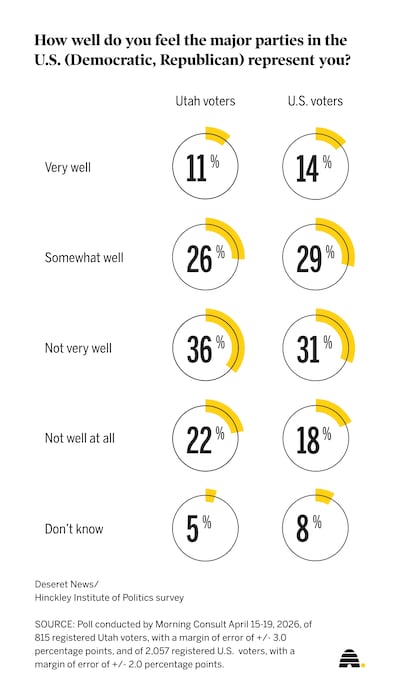
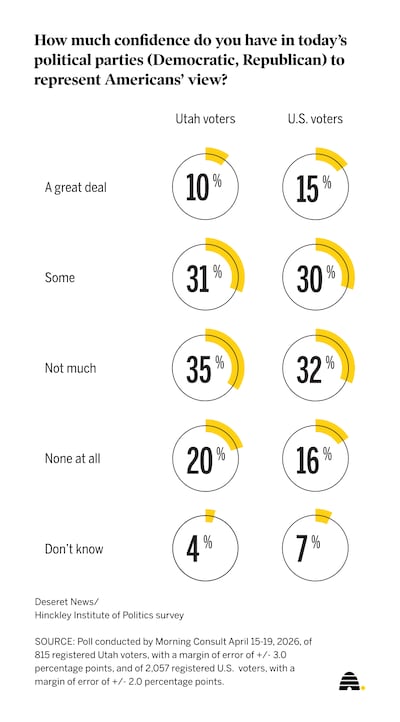
These results were nearly identical among U.S. voters when asked how much confidence they have in the major political parties to represent all Americans’ views, not just their own.
But there was a stark partisan split. Whereas 40% of Democrats — and just 21% of independents — feel well-represented by the two parties, 60% of Republicans nationwide feel well represented, the poll found.
“This is a reflection of who is in charge, whether or not they agree entirely with those policies,” Perry said. “You have a Republican president, a Republican controlled Senate and House.”
While a slight majority of Utah Republicans (51%) also feel well-represented, Utah voters overall are much more likely to feel not well represented than the rest of the country, according to the state poll of 815 voters with a margin of error of ± 3%.
Nearly 6 in 10 Utah voters say the major parties don’t represent them very well (36%) or not well at all (22%). At a combined 58%, the share of Utahns who feel poorly represented is 9-percentage points higher than voters nationwide.
Utah resident Bruce Bartholomew disassociated from the GOP about 20 years ago. The “independent constitutional conservative” says the dissonance between his views and the substance and style of national politics has only grown.
“It’s become increasingly polarized, and I think both political parties look after the needs of the extreme ends of the political spectrum,” he said. “I don’t think there’s enough honoring the needs of people who are more in the middle.”
Bartholomew, who eventually settled in Heber after meeting his wife, Margaret, at Brigham Young University, pointed to immigration. He believes the country needs abundant legal immigration, not an open border or an immigrant moratorium.
The Bartholomews cannot participate in Utah Republicans’ closed primary process — which is where they feel the most can be done to nominate less extreme candidates. Instead, they are “intrigued” by third-party experiments like Forward.
Politically (dis)engaged
Recent polls by YouGov and CNN find both parties deep underwater, with favorability around 30%. This can have a negative effect on political participation because people do not feel like their voice is being heard, according to Perry.
More than 60% of national poll respondents said they were registered with a major political party, 8% said they were registered with a third party and 20% said they were not registered. This ratio was almost identical among Utah voters.
Both polls likely showed an exaggerated level of involvement in primary elections. Around 30% of voters typically participate in presidential primary elections — 62% of U.S. voters and 71% of Utah voters said they did.
Other forms of political participation were limited to a small minority of voters: Fewer than 10% of U.S. or Utah voters said they attended caucus meetings or campaigned for candidates. Fewer than 15% said they donated to candidates.
Across the country, 30% of voters said they do not engage with political parties at all. This rate fell slightly, to 24%, for Utah voters. Among those who do not participate, reasons centered around trust, representation and apathy.
The top reasons U.S. voters gave for not participating in politics were not being interested in participating (30%), not trusting political parties (24%) and feeling that political parties do not represent their views (20%).
A greater share of Utah voters agreed with all three of those reasons, but added another as their top concern: 34% of those who do not engage with political parties said it was because they don’t think it will make a difference.
“When one side has the clear majority, there’s a minority in opposition, but even within the majority itself, it’s possible people start to feel like their voice doesn’t carry quite as much weight,” Perry said. “And this creates an impact on participation.”
The frustration may not be as much about ideology as it is about process, according to Perry, who pointed to poll results showing that a significant number of Utah voters who want a third major political party focused on centrist outcomes.
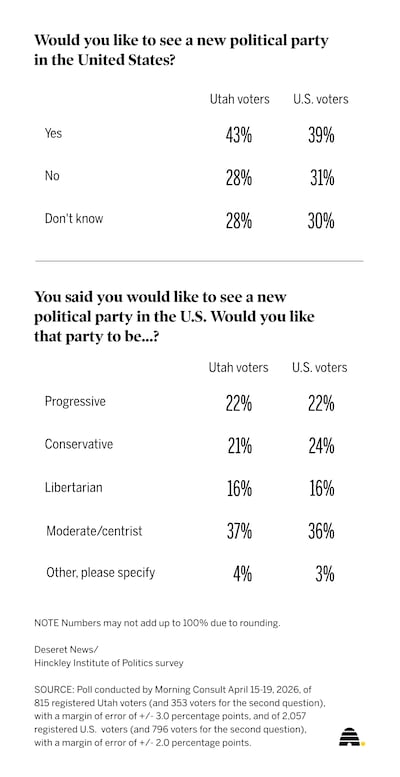
The poll found 39% of U.S. voters — and 43% of Utah voters — want a new major party. The largest share of these voters, 36%, want the party to be “moderate/centrist.” Around 1 in 5 voters say they want a more conservative party, while another 1 in 5 want a more progressive party.
As a pro-life, pro-immigrant Catholic who was raised in a conservative home, Missouri resident Jacob Herring considers himself thoroughly “politically homeless.” But he knows exactly what it would take to make him feel at home.
Parties that “meet in the middle,” find common ground and help Americans compromise to better understand each other.
“I would love to see like a merging of both parties into a third party,” Herring said. “Because there’s so much good in both and there’s so much bad in both. But take away the bad, leave the good.”