
This article was first published in the ChurchBeat newsletter. Sign up to receive the newsletter in your inbox each Wednesday night.
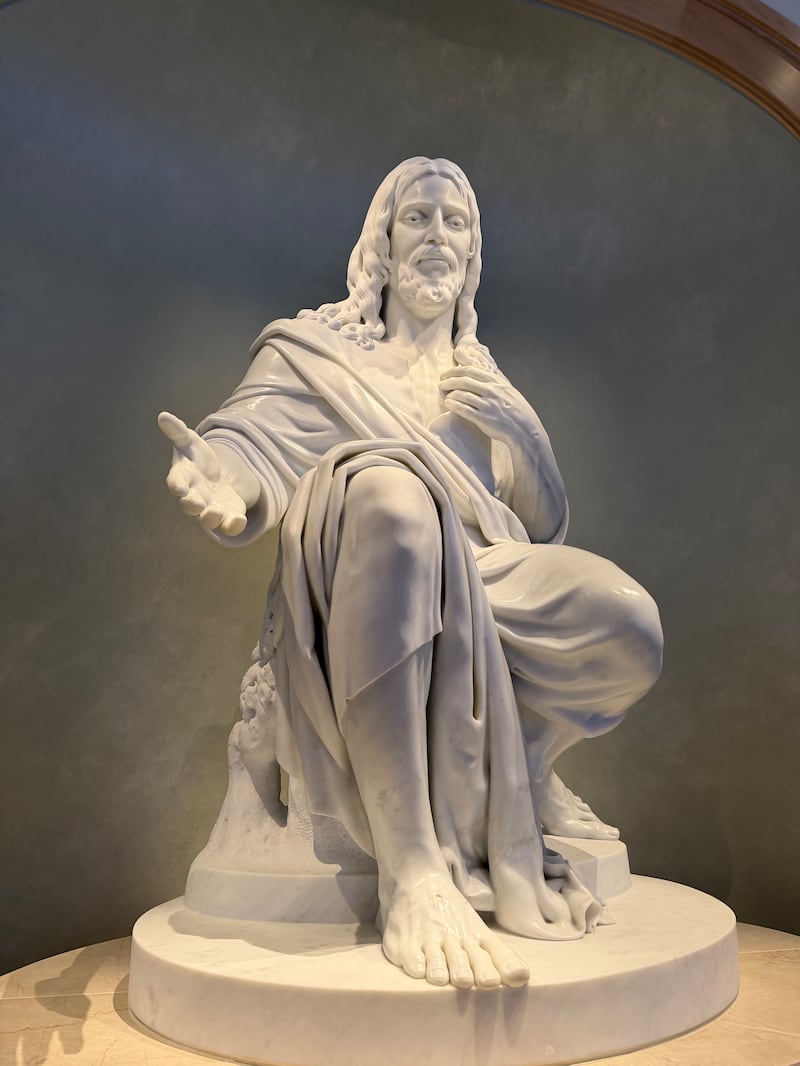
The immediate impulse her small grandchildren showed at the new statue of Jesus Christ on Temple Square surprised Young Women General President Emily Belle Freeman.
“I watched them walk up to this statue, and I watched them walk all around and look at it, and then I watched all three of them come and stand just here,” she said, pointing to a spot in front of the statue.
“I bent down to see what they were looking at,” she said, from their point of view. What she found filled her heart.
“He was looking right at them once they got here to this level,” she said.
The Swiss sculptor, Christian Bolt, was there when President Freeman described the experience.
“I cannot explain it probably adequately,” he said, “but that touches me. That’s great. It’s all about helping people coming closer to the Savior. It’s all about this.”
Bolt spoke with the Deseret News and shared his journey finding the God inside the marble block he selected from the same famed Carrara mines of Italy that produced the marble for Michelangelo’s David and for Thorvaldsen’s Christus, a Temple Square landmark for six decades.
He explained why this Christ is seated, how the statue was commissioned and some of the symbolism embedded in the sculpture.
Bolt also paints and works with bronze, but his specialty is marble. He studied at prestigious academies in Carrara and Florence and received a professorship at Europe’s oldest and most esteemed art academy, the Accademia delle Arti del Disegno in Florence.
He also is the former president of the St. Gallen Switzerland Stake of The Church of Jesus Christ of Latter-day Saints.
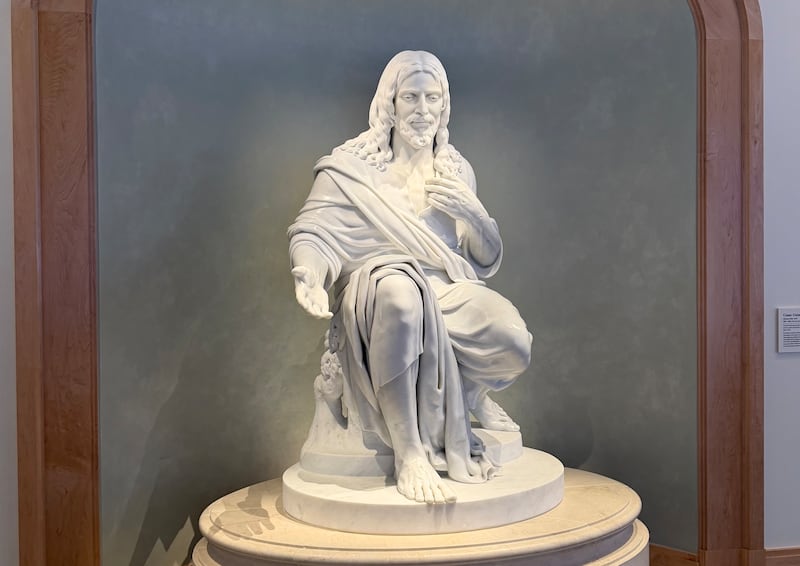
His statue, titled “Come Unto Me,” is now paired with the Christus statue as bookends inside the Salt Lake Temple Visitors’ Center, one on the top level and one below in what may could well be called the hall of temples because it displays about a dozen models of temples around the world.
Tad Walch: How did this statue come into being?
Christian Bolt: I decided at least once in a lifetime you should participate in the Church History Museum’s international art competition, where I met Laura Paulsen Howe, the museum’s art curator. When the Temple Department asked the museum if they knew somebody in the church who sculpts marble, she remembered me. This was in 2019 or 2020. The project really started in 2021 or 2022.
TW: What is it like to work on a piece commissioned by the First Presidency?
Bolt: I started by making a series of three very small sketches (or maquettes, which are small, three-dimensional scale models). I offered these to the First Presidency so that they could give direction on which direction we should develop the project. Then the feedback came that they wanted to have a sitting Christ and not a standing one, because of the iconic Thorvaldsen piece. I received a challenge to realize. We made another maquette in scale and the First Presidency approved it.
TW: Where does this marble come from?
Bolt: It is from Italy, from Carrara, the famous quarries there.
TW: That’s the same quarry the marble for the Christus came from, is it not?
Bolt: Yes, but you need to imagine that it’s a huge area.
TW: How did you, as a church member, find the Christ that you wanted to sculpt? How do you find that face, that feeling, that person, that God?
Bolt: It was a deep inner process for me. I felt that this statue was not about a representation of the Savior. I felt that I should not go in that direction. It’s not about representing him, but it is more presenting him. It’s a manifestation. Then the Spirit, during the process, told me, “Don’t be focused on my look, but on my spirit and on my power.” This was really helpful for me, because I think as human beings, we are simply not able to represent, really represent the Savior in his power, but we can present to the world his Spirit and power, which is so full of love and elevation for everyone. So this became my motivation. I knew the spirit, how it works and how it feels like, but working through the process I kept searching for it again and again. Can I feel it? Can I feel this spirit? I wanted to feel it and maybe even stronger. This was the challenge, or maybe the privilege, and it was a battle. It’s not something you do lightly, trying to infuse that Spirit into the marble.
TW: Was there a scripture or scriptures that guided you?
Bolt: Absolutely. I suggested to the First Presidency that we have a strong reference to John 15, where the Savior stated, “I am the vineyard. You are the branches. If you are in me, and I am in you, you can do everything, but without me, you can do nothing.” (John 15:5) They liked that choice and approved it. There is a symbol of this in the movement of the drapery (intertwined across Christ’s chest). It’s the symbol of the covenant — we in him, and he in us. This is what happens if we follow the invitation of the Savior. It is also in the general movement of the statue (as Christ’s robe draped over his knees) makes the symbol of the alpha. There is also the symbol of the omega in his robe by his left foot on the ground. He is the beginning and the end of our faith.
TW: What else should we notice?
Bolt: It was to important for me to realize in an image of the Savior some movement. When the First Presidency asked for a sitting Christ, I knew movement would be difficult, because a sitting person is static. I wanted to bring in movement so that he’s not just sitting here and waiting for somebody, but he’s moving. That’s the reason why the toes are almost curling over the edge of the platform like he was coming forward. And with one hand he is inviting, reaching out, and with the other arm and hand, he is opening his love and power to individuals. It also was important that when we stand here, that we have the opportunity to look into his eyes and face.
TW: What does it mean to you to have sculpted a statue that ties Christ to a temple, the house of the Lord, in this way at the Visitors’ Center?
Bolt: I believe when we enter into the house of the Lord, we are the guests there. We are in his house and in his kingdom. This specific statue should be a symbol of how welcome we are in his presence. I have great respect for Thorvaldsen and his statue, but it maintains much more distance between the observer and the piece. My vision was to create something which really unites you with him. You feel at home, you feel loved and you can come close. You feel you could touch him or get in touch with him.
About the church
President Henry B. Eyring dedicated the Lindon Utah Temple and Elder Dale G. Renlund dedicated the Davao Philippines Temple. Read about the dedications here.
Church leaders provided a discussion guide and other resources for a fifth-Sunday lesson on religious freedom.
Elder David A. Bednar shares lessons learned from the victims of the deadly attack at Latter-day Saint meetinghouse in Michigan.
Elder Gary E. Stevenson taught young adults in a worldwide devotional about spiritual exploration. So, what does space have to do with faith?
The First Presidency set the dedication date for Idaho’s next Latter-day Saint temple.
Deseret Media Companies vice president Sheri Dew spoke at BYU Women’s Conference and said faithful Latter-day Saint women are the "greatest rebuttal to Hollywood’s insanity."
Here’s how Latter-day Saint youth can prepare for the new curriculum and new Sunday meeting schedule.
What I’m reading
This is a good question about the new spinoff: “The Secret Lives of Mormon Wives Orange County” and what do words even mean anymore?
There is and will be so much coming out about Latter-day Saint membership retention that I am going to share this again from a BYU researcher: For accurate conclusions, look at the best data.
At Alan Osmond’s funeral, his family said, "He was a missionary at heart."
In case you hadn’t noticed, podcasts are going nuts over Latter-day Saints these days. So here are a few reports on a couple of those:
- A philosopher went on a podcast and gave a shout-out to Latter-day Saints.
- A Latter-day Saint and an evangelical podcaster debated their beliefs. Here’s how it went.
- What’s wrong with "debating’ faith differences?"
A Christian leader spoke about violence: "Justice that requires violence against others is no longer justice."
Behind the Scenes