

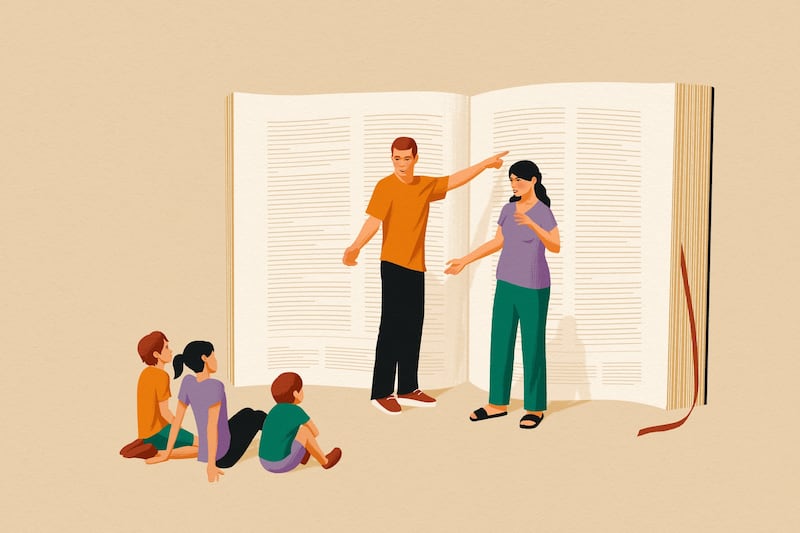

- A new Sutherland Institute report says parents have the prime responsibility to teach children the values they believe will provide a strong foundation for a successful life.
- The report argues that other entities should defer to parents' authority to raise their children including directing education, development and religion.
- The author recommends an "opt-in" standard before involving children in sensitive topics like sex education, rather than placing the burden on parents to object.
A doctor recommends a child receive a medical treatment that parents fear will be harmful or that counters their faith. A school teaches sex education that parents would be more comfortable providing in their own way in their own home. One state’s law — Washington’s — says parents don’t have to be informed that a runaway minor is in state care if the family’s fracture was a disagreement over the child’s gender identity.
They are all real examples of conflicts between parents and other entities.
But who should get the final say in such cases that have sparked us-versus-them debates and may now be making their way through court systems over topics of religious freedom, gender identity, education and children’s healthcare?
In a new report published by the Sutherland Institute, “Religious Freedom and Parental Authority ,” William C. Duncan writes that parents have a prime responsibility to teach children the values and habits they hold dear and believe will provide a strong foundation for a successful life, including the right to practice faith as they see fit. And though he doesn’t use the phrase parental rights, that authority is something other entities should take seriously.
Absent abuse or danger to the child, it’s likely no one has more interest in a child’s well-being or dedication to it, according to Duncan, the Constitutional Law and Religious Freedom fellow at the Utah-based conservative public policy think tank that focuses on research, education and advocacy.
In only limited cases, he said, should that parental authority be usurped and only after careful consideration.
Parental influence needs “a very robust protection, but it always needs to pay attention to the fact that we’re really not talking about rights as much as we’re talking about protecting children by recognizing the reality that their parents are likely to be, in most cases, the protectors, with important influence in a child’s life.”
Duncan also told the Deseret News that assuming government and official entities should just leave parents alone entirely to do what they want “is not nuanced enough for what’s really happening.”
He said the courts that have gotten it right “are conscientiously trying to recognize parental influence as a good thing, but that of course there could be exceptions and we want to keep those in mind as well.”
Against the backdrop of several U.S. Supreme Court decisions and local and state laws, the report notes that parents having the deciding vote is fairly well established. He notes, for example, that states provide mechanisms for parents to opt their children out of mandated vaccines or sex education discussions, based on personal exemptions like religious beliefs those would contradict.
He said he was “somewhat surprised that virtually every state has some kind of protection for a parent’s ability to, at the very least, object to having their child involved in sex education classes.” He found just two exceptions, which “struck me as interesting.”
A parent’s influence
In the report, Duncan notes three distinct categories where parents’ influence comes into play.
Under “core rights,” he said parents should be able to direct how their children are brought up, including their education, development and religious life. That includes how schools and government agencies interact with their children.
He noted that the roles and the questions facing parents are different depending on a child’s age and that their influence, while important, likely does not look the same when you’re talking about a first-grader compared to a high school student. But the need for and fairness of having parental involvement, while a matter of degree, should not just go away.
“Balanced interests” form the second category, in which he includes things like state educational requirements, medical advice and the interests and independence of older children. For instance, while a state has a legitimate interest in mandating children receive an education, parents must be allowed to choose educational options for their children, including those outside the public school system.
The most concrete, clear category he calls “limits.” A parent never has the right to abuse or neglect a child, he said, noting that should go without saying, but is an important element of any discussion.
Report recommendations to protect parent role
Besides hoping to spark more robust, constructive discussion, Duncan also offers some recommendations on how to protect the parental role in a child’s life and interaction with other entities, like those schools and medical providers and government agencies.
Duncan suggests that parental authority to protect their children should be the foundational presumption that leads to action by others, including policymakers, schools and governments.
He said those entities should “give parents clear notice” about activities that affect the children, such as allowing parents to opt out of or opt into classes that might counter parental beliefs, like sex education.
Writes Duncan, “An opt-in policy is more appropriate. This means that schools would require affirmative consent from parents before addressing these subjects rather than shifting the onus to the parents to speak up. This could apply to other circumstances, like medical decision-making and children’s use of technology,” as well.
He’d like to see barriers taken down that would prevent parental participation in public programs when decisions are based on parents’ religious beliefs. Sometimes, that might require states to amend their constitutions, but “this is not a particular stretch, since these provisions are at odds with the Free Exercise Clause of the First Amendment,” per the report.
Duncan also recommends that parents be granted a “meaningful voice” in school curriculum and policies.
Finally, he said that parents should not have to go to court to exercise their ability to have a strong voice in their children’s lives.
And he told Deseret News this is just the first report on this topic. He hopes it will encourage more research and discussion of the intersection of parental and government roles and religious freedom.
While people talk about religious freedom, Duncan said “we need to return to the questions of the core freedoms. Can we really have protection of religious freedom if we don’t protect the most basic interests of people of faith and that is to practice their faith within their own families?”