

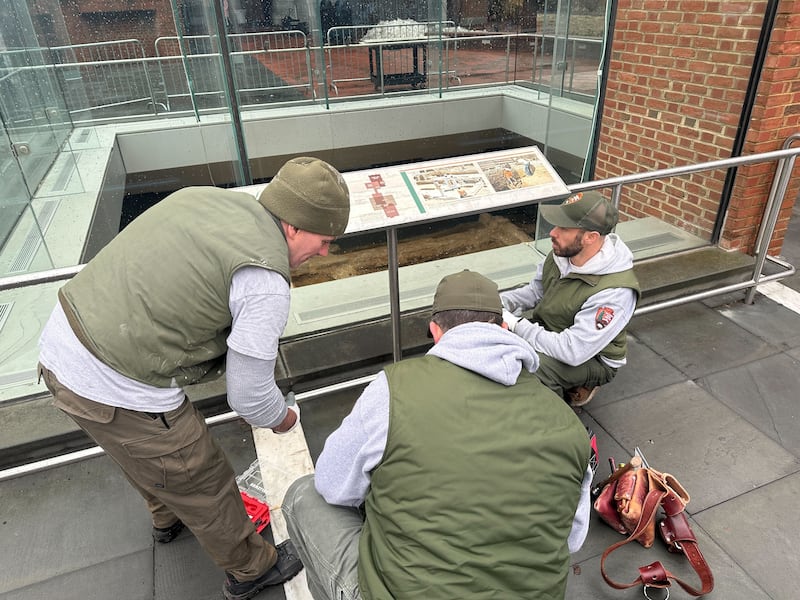

- A federal judge ordered the Trump administration to reinstall signage about slavery and climate change in public places.
- A YouGov poll found a vast majority of Americans say it's important to include the country's full history in national parks.
- Conservation groups sued the Interior Department over lack of transparency regarding the signage decisions.
The Trump administration’s effort to “restore sanity to American history” by removing signs, exhibits or various other installations from public lands and institutions that it considers “corrosive” or “disparaging” ran into a roadblock in the weeks leading up to the nation’s 250th birthday.
A federal judge in Massachusetts last week barred the Department of the Interior from removing exhibits or signage from nations parks, effective immediately. The judge also ordered that the history taken down since the executive and secretarial orders were issued in March 2025 — at least 57 different items about slavery, climate change and the mistreatment of Native Americans — be reinstalled.
“Plaintiffs have demonstrated a likelihood that defendants’ efforts, ostensibly taken in the name of restoring dignity, instead seek to rewrite the nation’s history with a white-out pen,” U.S. District Judge Angel Kelley wrote in the order.
“History cannot be faithfully told while excluding the experiences of communities whose contributions, struggles and achievements form an important part of our nation’s story.”
There was a similar case in Philadelphia where the court ruled with the White House, and with other litigation pending, it’s unclear how binding the decision will be. But that court’s ruling was one of several data points that surfaced recently regarding the ongoing debate about the portrayal of American history.
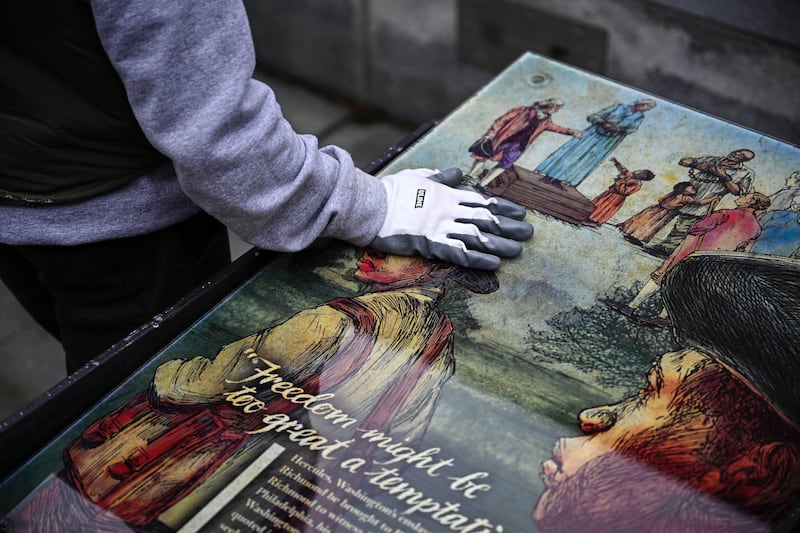
A public opinion poll and a study of public comments showed overwhelming support for not altering the history in public spaces, as did another lawsuit.
What was the Trump administration directive?
In March 2025, the Trump administration issued an executive order directing various government entities — such as the Smithsonian Museum and the Department of the Interior — to “restore federal sites dedicated to history, including parks and museums, to solemn and uplifting public monuments that remind Americans of our extraordinary heritage.”
The document accused the Biden administration of imposing “this corrosive ideology,” that “promoted narratives that portray American and Western values as inherently harmful and oppressive.”
As such, rather than “content that inappropriately disparage(s) Americans past or living,” those institutions were to “focus on the greatness of the achievements and progress of the American people or ... the beauty, abundance, and grandeur of the American landscape.”
Subsequent to the White House’s order, Interior Secretary Doug Burgum issued an order to restore “truth and sanity” to American history.
Both orders required agencies to conduct an analysis of signage and replace anything that fit into what one lawyer referred to as “very nebulous requirements.”
9 in 10 Americans want the uncomfortable history to remain

The Trust for Public Land released polling conducted by YouGov that showed overwhelming support for public lands to tell “the full American story,” rather than leaving out unsavory parts.
Some 88% of Americans completely or somewhat agree that it’s important to preserve a more complete cultural history in the country’s outdoor spaces. That includes the difficult facts about slavery, climate change and the mistreatment of Native Americans.
Even when 2024 Trump voters are pulled from the sample, 84% agreed.
“The majority of us by a lot — by a lot — want to say, ‘No, let’s tell the whole story,’“ said Jocelyn Imani, senior director of Black History & Culture for Trust For Public Land.
What are the parameters for what stays or goes?
The language in the executive order is declarative, but it can be interpreted to mean different things depending on a person’s perspective. There are no specific parameters that have been released to the public that make clear which signs or exhibits should be taken down or left up.
That confusion over who decides what is corrosive or disparaging is at the heart of a lawsuit recently filed by the Public Employees for Environmental Responsibility, or PEER.
After nine months of failed Freedom of Information Act requests to find out how those decisions were made, PEER sued the Interior Department.
“The public has a right to know who inside this administration is deciding what version of American history gets told at our national parks and other public lands, and on what basis,” Tony Irish, PEER’s senior council, said in a statement.
“Instead, the Office of the Secretary (of the Interior) has spent nearly a year stonewalling a simple records request.”
Irish pointed out that the only information shared has been about the national park system which has been the focus of the media and legal challenges.
“The main driver in this lawsuit is the fact that these actions have been directed not just against the Park Service, where we’ve seen a lot of moves already, but also against the Fish and Wildlife Service, the Bureau of Land Management, and the Bureau of Reclamation,” he told the Deseret News. “Getting insight into what is going on on those perhaps lesser known to many, but no less important, lands is very important.”
What did the public comments show?
QR codes were installed at national parks that asked the public to inform the administration if they encountered a sign or installation with a “disparaging” message about parts of American history.
In May, the Interior Department released more than 35,000 comments as a result of Freedom of Information Act requests by KOAA News in Colorado.
After reviewing the tens of thousands of responses that were received within 475 national park units, the Center for Western Priorities — a conservation advocacy group — found only 47 comments flagged a sign for removal.
Of the responses, almost 10,000 were classified as “general opposition to the order.”
“These comments pass the vibe check with flying colors. Americans support our parks and the stories they tell, and they aren’t happy about the Trump administration’s efforts to rewrite history,” said Lilly Bock-Brownstein, the author of the report.
“Instead of helping Trump censor our national parks, visitors used the comment form to tell the Trump administration to respect our parks or get lost.”
‘For we’s sake’
Irish said that the way the orders were written opens the doors for them to be broadly interpreted. Depending on what words are considered — corrosive, oppressive, disparaging — and by whom, they could be adopted in reference to many different parts of the nation’s history.
While they are being applied to slavery and the mistreatment of Native Americans, they could easily be directed towards other moments in the last 250 years.
For Imani, she understands the issue as a matter of faith and said that it’s an opportunity for people to act out of a sense of love.
“I don’t actually need you to care about me for ‘me’s sake,” she said. “I need you to care about me for ‘we’s sake,’ ... let’s think about all of us. Please.”