

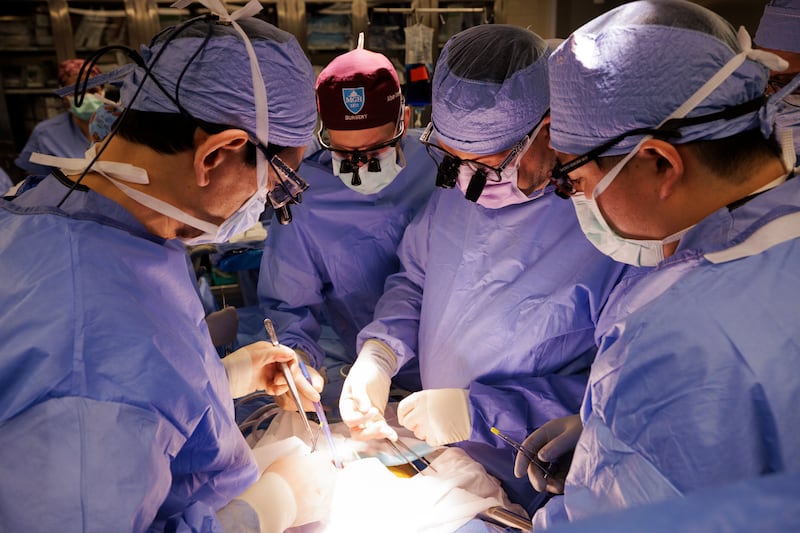

- Tim Andrews, 66, lived 271 days without dialysis using a genetically edited pig kidney — the longest such survival on record — before receiving a human kidney in January 2026.
- His case demonstrates that pig kidneys might serve as a "bridge" for patients with end-stage kidney failure awaiting a human organ.
- Lead author Leonardo Riella called the organ shortage "the greatest crisis we have right now in transplantation."
In January 2026, Tim Andrews received a kidney transplant — an intervention that happens daily around the world, though there are never enough human donors to meet the need.
His survival is especially interesting, however, because he lived 271 days with a genetically altered kidney from a pig. And he’s proof, according to his doctors at Mass General Brigham, that pig kidneys could be a valuable bridge to a human organ transplant and a possible solution to an organ shortage.
This week, The Lancet published his survival and transplant story, written by the Harvard Medical School researchers-doctors at Mass General and their colleagues.
Andrews is evidence that it’s possible for someone with end-stage kidney failure to survive with xenotransplantation — a fancy word for using animal organs, cells or tissues in a human — while waiting for a human organ to be available. And to do it without dialysis.

The pig kidney didn’t form a complete bridge. Andrews developed clots after that 271 days and the organ was removed, so he did then need dialysis. But it extended his life so that he was able to get that human organ.
Harvard News quoted the study’s lead author, Leonardo Riella, an associate professor of medicine and surgery at Mass General and medical director of Mass General Brigham’s kidney transplant program: “The organ shortage is the greatest crisis we have right now in transplantation. We know that the best treatment option for patients with end-stage kidney disease who have developed renal failure is transplantation, but we simply don’t have enough human organs to transplant in a timely manner.”
Eventually, it could be a “destination therapy in its own right,” he said.
A bridge to life?
Mass Gen claims the first-ever xenotransplant involving a genetically engineered pig kidney into a living patient. The Deseret News reported in 2024 that 62-year-old Richard “Rick” Slayman of Weymouth, Massachusetts, was doing well. However, he died after 52 days of what a Mass General Brigham news release called “cardiac causes unrelated to the transplant.” Slayman had previously received a kidney from a deceased human donor, but the organ failed after five years.
Per the news release, “No previous studies have documented xenograft survival beyond two months, a successful ‘bridge’ to receipt of a human organ, or the mechanisms leading to late xenograft failure in living recipients.”
An FDA Expanded Access Investigational New Drug application opened the door to Andrews’ pig-organ transplant, after which the researchers said he was “monitored for kidney function, rejection, antibody development and potential pig-to-human infection. The kidney functioned immediately. An early episode of T-cell-mediated rejection resolved with treatment, no pig pathogen transmission was detected and the patient was able to go without dialysis for 271 days.”
When Andrews got an infection, his immunosuppression medication was reduced, but the kidney developed blood clots and inflammation that grew into organ failure, so he received the kidney of a deceased donor.
“The findings illustrate both the promise and areas for improvement for xenotransplants as a bridge for patients awaiting human kidneys,” the news release said. “Importantly, the microvascular injury to the porcine kidney has implications in the development of immunosuppressive strategies, donor genetic engineering, and monitoring in future clinical transplantation studies.”
Not the first animal-to-human breakthrough
Animals have been at the heart of medical research for a very long time, medical breakthroughs typically building on studies involving nonhuman creatures. According to A timeline in ILAR Journal, in 1905 in France, slices of rabbit kidney were inserted into a child whose kidneys were not functioning properly. “The immediate results were excellent,” according to the researcher. “The volume of the urine increased; vomiting stopped.”
The child, however, died of pulmonary congestion, the article reported.
Other early 1900s medical research around the world included use of the kidneys of goats, pigs, primates and a lamb. None of them were successful for long, but researchers maintain that such efforts moved the science along.
But they have also raised ethical questions, with opposition particularly strong among animal rights groups. And many in the healthcare field have countered that saving humans is the moral choice. Those arguments continue, but as Catherine Remy wrote in the journal Animals and Surgery in 2009, people tend to be more opposed to use of primates, which are so similar to humans in many ways, than they are to pigs.
In 2011, Deseret News explained how research involving fruit flies, zebrafish and mice have led to cancer treatment breakthroughs, medication development and more that benefit human health.
Turns out other creatures are very similar to humans genetically in many ways.
Cardiac surgeons have for decades used pig-tissue heart valves in humans, after the living animal cells are removed to prevent rejection.
Chemical treatments have enabled the use of animal blood vessels and tendons and biological scaffolds to help human cells regenerate human tissue that was burned or otherwise damaged, as Upstate Medical University has reported.
The video noted that primates like monkeys and chimpanzees were part of kidney transplant experiments in the 1960s and ‘70s, but there were high organ-rejection rates and pathogen problems, along with ethical considerations.
More knowledge, better tech
CRISPR gene editing was developed allowing scientists to reduce rejection likelihood and make other changes.
The United Network for Organ Sharing, or UNOS, in February 2025 explored whether using organs from a source other than humans is viable, noting their researchers have teamed up with healthcare company Sanofi and United Therapeutics Corporation, which is among companies the FDA said can supply modified pig kidneys for clinical trial, to study xenotransplantation and its potential impact.
The article quoted Jennifer Wainright, UNOS senior research scientist: We’re closer than we’ve ever been to this becoming a viable therapy, so it’s important to know if the idea of receiving a modified organ from a pig is something people are comfortable with. Is it something patients want? Do doctors have concerns about performing this type of transplant? That’s where our research is focusing.”
Xenotransplants are not an approved therapy. Each one in recent times has been allowed under “compassionate use,” per UNOS.
Pigs have become the animal of choice largely because their organs are of similar size to that of humans and pigs reproduce quickly and have lots of offspring, according to the PKD Foundation, which focuses on polycystic kidney disease. The foundation said pig kidneys and hearts — yes, those have been transplanted into humans, too — work very much like those of humans. Pigs can live up to 30 years, so there’s hope their organs, once transplanted, could last in humans. And finally, “they can be raised in environments free from pathogens” to reduce risk of giving a human recipient a pig virus.
Animal experiments using pigs have been varied. For instance, NYU Langone Health received permission from the family of a patient who had suffered brain death and was on life support to see if a kidney from a “10-gene pig” could avoid acute rejection and blood clots. Per the PKD Foundation, “Twice they attached a pig kidney to blood vessels in the thigh of the person to monitor survival of the organ and sample the tissue.”
Pig corneas and pancreatic cells have also been used experimentally in humans, too.