

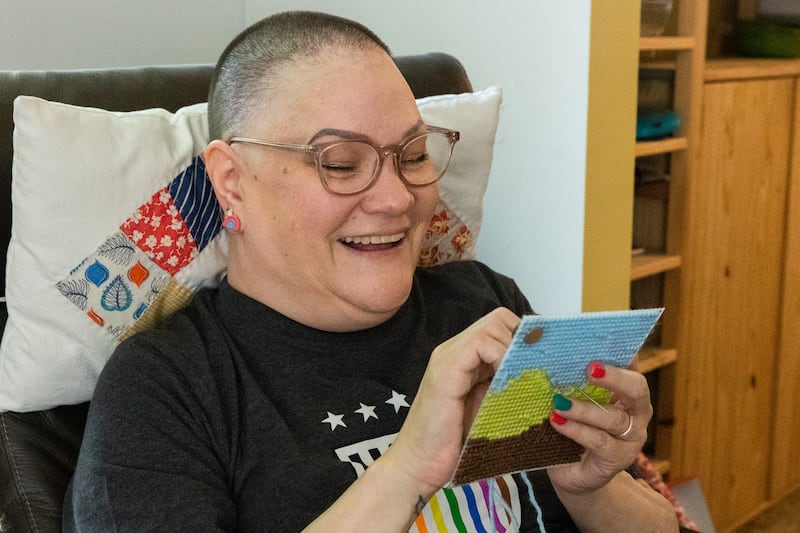

Sandy Spencer is a cross-stitcher. Ever since she was a young girl, she has liked doing things with her hands. Unlike more unstructured hobbies, cross-stitching follows a pattern so that she can watch what images are being formed as she creates them.
Typically, these patterns have messages about home, family or friends, said Kari Main, a curator at the Pioneer Memorial Museum in Salt Lake City. Made by cross-stitching, they are typically referred to as “samplers,” a term derived from a Latin word meaning “example.”
“The samplers that I create are an expression of who I am,” Sandy said. “They are a reflection of my interest in genealogy, women’s history and meaningful living. Friends and family can see on my walls what I am about and who I am by the samplers that are displayed there.”
“I don’t sit still very well,” Sandy added. “Creating samplers calms me, but creating them also goes beyond doing something relaxing. It helps me stay grounded and maintain a kinship with women in the past.”
Historically, needlework was a required skill for women to manage households, Kari told me. But it also served as a means of personal expression and unspoken family guidance.
The Daughters of Utah Pioneers (DUP) has compiled a book of vintage samplers from 1779-1857 to showcase their own sampler collection.
Stitching across time
Sandy Spencer has her own vintage collection including a stitched bedspread from Bristol, England, created in 1847. Christopher Wilson-Tate, who designs fabric from antique quilts, found this bedspread for her — a series of samplers stitched together to form a coverlet.
“Samplers weren’t always signed,” Sandy said. But this antique coverlet was signed “E. Winson.” After some research, she found an 1851 census listing Emily Winson as a dressmaker in Bristol. “I like to sew as well as cross-stitch, so learning about her has given me a connection to women in the past.”
Since pioneer samplers were developed by mothers, daughters and granddaughters, often working together, the creative work also created this communal connection, Kari told me. They allowed individual expression in a common way so there was a kind of “inside-out” mode of learning and sharing.
The original classroom worksheets
The Smithsonian Museum has a large collection of 17th- and 18th-century samplers online that help tell the story of life and times in earlier eras. Since many children — especially girls — were taught at home during this period, samplers provided both a curriculum and “worksheets” for lessons. Paper was not readily available until the late 19th century (before then, students used slates and chalk because of the scarcity of paper).
Girls used linen to learn the alphabet and numbers: both copying from teachers and others and adding their own personal touches. After learning to use basic stitches for their alphabet samplers, they also added personal flourishes to customize them.
“Samplers were like a personal resume for many girls,” Sandy said. “They used them to show their skills as well as represent their values.”
As formal education increasingly became available for girls, however, samplers as an educational tool became less common.
A heritage of handiwork
In pioneer-era Utah, while schools sprang up wherever there was a community that could afford one, samplers continued to be utilized. My ancestor Patty Bartlett Sessions, who became a popular and oft-used midwife in the Deseret territory, told about both delivering babies and completing samplers in her journals.
Primary, the children’s organization of The Church of Jesus Christ of Latter-day Saints which began in the late 19th century, included a curriculum of stitching and samplers for girls that continued through the middle of the 20th century.
Even after samplers were no longer part of the Primary curriculum, Utah resident Shirley Paxman recalled the opportunity that samplers still provided in promoting self-esteem for girls.
“Working a sampler was an art that took time to learn and even more time to do,” she said. “It was a child’s investment in the future. And more importantly, it helped the child learn that she had something to give — that what she created had value for others.”
Reclaiming the rhythm of the needle
Our fast-paced world can divorce us from the past and, at times, even alienate us from ourselves. So-called “Grandma Hobbies” like cross-stitching and samplers can help us remain centered and balanced in dealing with life’s daily challenges.
Some people may benefit from intentional mindfulness practices, while others may find that what Sandy Spencer calls the “head to hand to heart” connection from cross-stitching works better for them.
Who knew that stabbing a piece of fabric thousands of times to make a sampler to put on a wall could be such an ultimate form of self-care? Samplers may have started as historical homework for young girls, but today they serve as a counterculture rebellion against digital burnout.
By forcing us to slow down, unplug, and embrace the “rhythm of the needle,” cross-stitching offers a deliberate sanctuary from everyday stress disguised as a cozy hobby. In a world obsessed with speed, stitching a sampler is a time-tested way to claim peace of mind, stitch by intentional stitch.