


We sent a birthday gift and card recently to our teenage grandson Bennett. His parents took a video of him opening both of them so we could share in the excitement of his birthday celebration.
Removing the wrapping paper, he thanked us for the gift, his parents’ iPhones capturing the moment for us. “Open the card,” his father said.
Carefully unsealing the envelope the card was in, he took one look at it and tossed it across the room. “Cursed cursive,” he muttered. “Who can even read such squiggly lines anyway?”
A fading art
My wife, Stephanie, has such beautiful handwriting that it is almost like calligraphy. In elementary school, she often got the highest marks in handwriting on her report card and was frequently praised by teachers and classmates alike for her penmanship.
When we’ve told our grandchildren about practicing penmanship — and especially cursive handwriting — they are practically aghast. “Unbelievable,” one said.
“Did you have to start a fire in the fireplace back then as well?” another snickered.
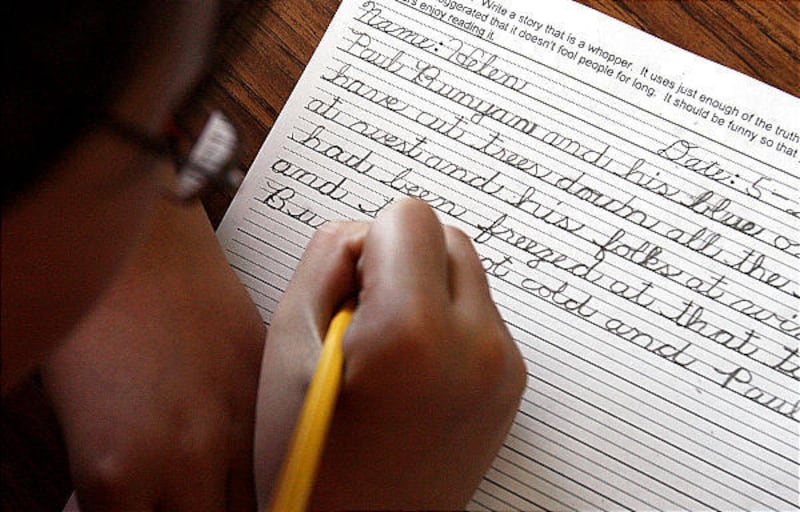
With today’s phones and laptops, penmanship is becoming a dying art form for many students. For hundreds of years, penmanship was a prominent part of primary education. Style and status were conveyed by handwritten scripts and creative signatures.
But in 2010, cursive was largely phased out of many U.S. school programs when the newly introduced Common Core State Standards dropped handwriting from the required K-12 curriculum. When these standards were adopted, most states and many school districts dropped handwriting entirely to free up classroom time for typing and keyboard skills.
However, over the past decade, the tide has slowly been turning back to requiring handwriting. Recognizing the developmental and cognitive benefits of handwriting, more than half of U.S. states have passed laws requiring penmanship instruction in cursive as part of the school curriculum.
I guess we’re not such dinosaurs after all.
Handwriting is good for the brain
As it turns out, taking class notes by hand (rather than typing or dictating them) has significant cognitive benefits. Research demonstrates that writing by hand engages elaborate neural networks across motor, visual and sensory regions of the brain.
Because handwriting is slower than typing, you also cannot physically write down every single word. This limitation requires you to actively synthesize and digest the material to capture the core concepts.
Studies show that forming letters and words by hand activates intricate hand movements that anchor memories much more deeply than the simple, repetitive keystrokes of typing. When you review handwritten notes, your brain is far more likely to trigger memory recall of the original learning experience.
Students who take longhand notes also perform better on conceptual, application-based exam questions, compared to those who type. Why is that? The latter group appears to often just transcribe lectures verbatim without truly engaging with the meaning.
A successful pitch to teens
While impressive, such studies have not convinced either Bennett or his cousin Everett, who is about the same age.
“I want to be a doctor,” Everett said. “They don’t even write prescriptions like they used to do, so I don’t need to use handwriting at all.”
Telling Bennett or Everett that taking handwritten notes would also help improve their recall and deepen study with fewer distractions was unconvincing.
So, I tried something else.
Handwriting lets you take a break, I said. When you are bored or tired, putting a physical pen to paper lowers stress levels and allows you to process thoughts without the constant ping of notifications breaking your focus.
If you are always taking notes on a laptop, it can feel like a chore. Changing things up can feel like a refreshing rest.
I could see they were starting to consider these possible benefits. So, I kept going.
Whipping out a notebook and writing something down by hand is an immediate power move, I said. It commands respect, instantly signaling that you are taking the class seriously. Teachers notice. When that happens, they are more likely to give you the benefit of the doubt when reading your papers and essays because they’ve seen you are serious about the class.
Now they were intrigued. A better grade just by appearing to pay attention?
Having piqued their interest, I pressed my advantage. If you really want to differentiate yourself, developing a stylish signature or handwriting style lets you stand out above the crowd. It is a form of self-expression that shows you are not just another copy-and-paste ChatGPT user.
Although these two grandsons may not be fully convinced, they are now occasionally taking handwritten notes in class and even sending us birthday cards in their own handwriting.
I’ve started taking more handwritten notes as well — occasionally sending handwritten letters too. It definitely feels more personal, more intimate, more natural. And I want the same cognitive benefits and recall ability that handwriting can have for me.
What’s good for the goose is good for the gander.