




In the national conversation about women and faith, it’s often assumed that women who struggle with religion — or step away from it entirely — are doing so over differences in opportunities for leadership in their congregation or denomination.
While some women certainly feel this way, the bigger picture of women and religious departure is more complicated.
For instance, if women were stepping away from their churches because they aren’t allowed to hold certain leadership positions, then we would expect to see measurably fewer women in more conservative denominations compared to their more liberal counterparts.
By this theory, denominations that ordain women should attract female parishioners from more conservative faiths as well as retain more of their own. But, by and large, the denominations that ordain women don’t have more women in their congregations.
A new national analysis
The Cooperative Election Study is a very large survey conducted every year, and in 2024 it asked very specific denominational affiliation questions. By looking at every Christian denomination that had more than 500 people in the data set and took a clear position on female ordination, the following became clear.
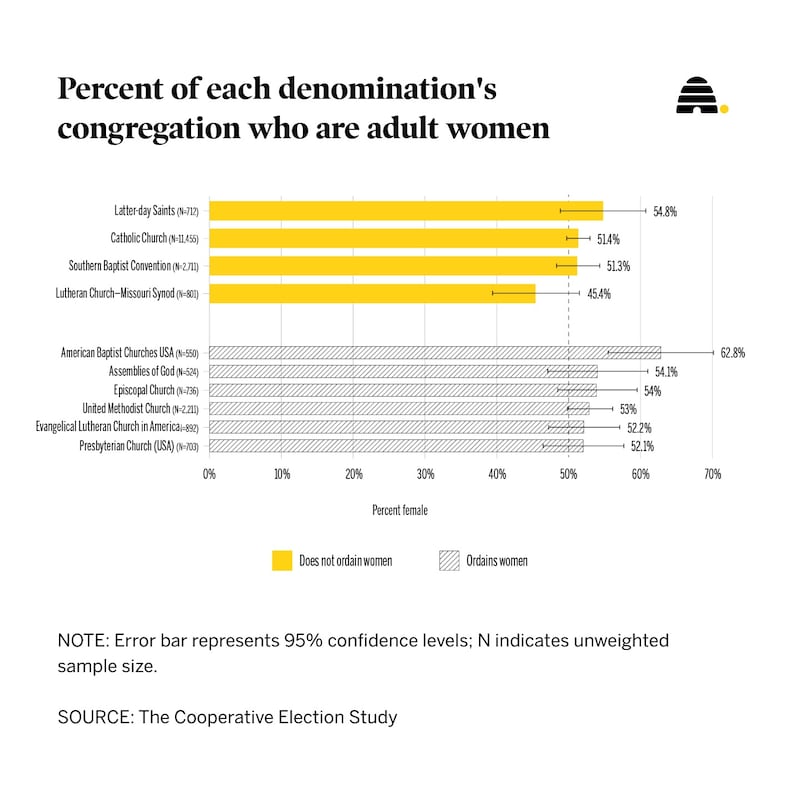
First, the CES aligns with the Pew Religious Landscape Survey: Women tend to participate in religion, with almost every denomination over 50% women.
Second, the Episcopal Church and United Methodists, which have both ordained women for many years, don’t have more female parishioners percentage-wise than many conservative faiths which do not ordain women.
It’s true that some more liberal churches that ordain women, like The American Baptist Church USA do skew female — while some more conservative faiths like the Lutheran Church-Missouri Synod skew male respectively. But in the aggregate, when you consider data across denominations, female retention doesn’t appear to be impacted by ordination.
It was interesting to find that women in liberal denominations generally tend to be older than counterparts in more conservative denominations that do not ordain women.
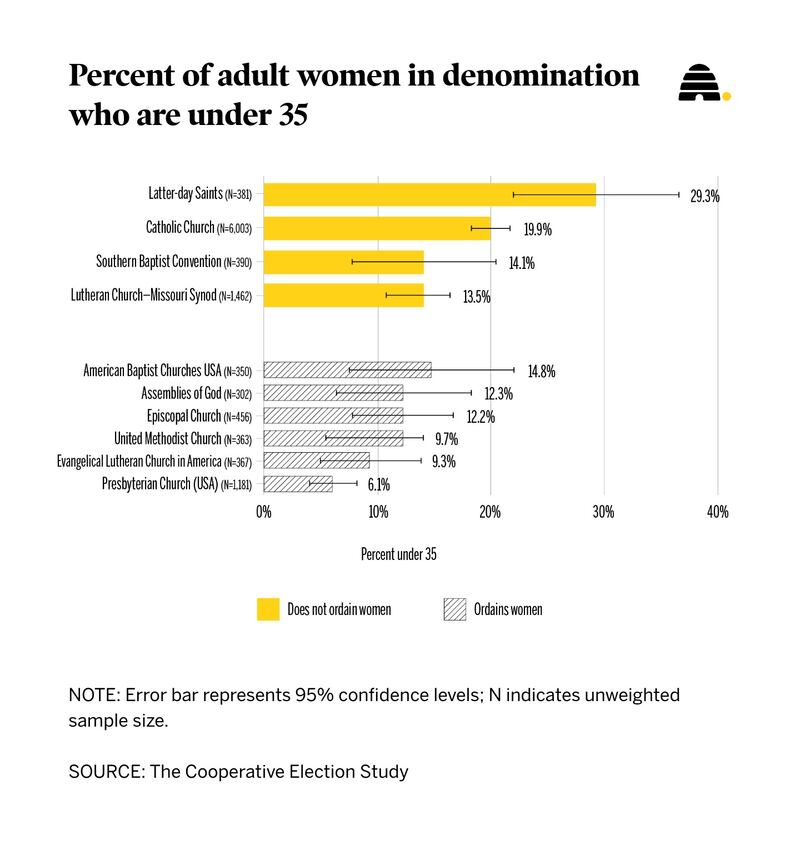
This doesn’t support the broad notion that young women who step away from their faith are being drawn to more socially progressive churches. Some of this age skew is likely attributable to the fact that families in liberal denominations simply have fewer children.
Either way, these numbers suggest that replacing a more gender-traditional outlook with a more liberal one is unlikely to revitalize a dwindling congregation that needs young people.
Stepping away for different reasons
These numbers surprise people, because many of the women they know who have left a conservative faith have cited gender inequality as a reason. Yet we should be asking whether this is one of a cluster of concerns, whether these women are representative of women as a whole in the church, or whether they simply represent the feelings and beliefs of the social class or demographic with which we are most familiar.
For example, how likely are we in the current online conversation to hear the perspectives of women from poor and uneducated backgrounds? Or women from other countries? Are we certain those in these demographics who step away from faith do so over social issues, or could their participation be limited more by a lack of time and resources for serving?
We know, for example, single parenthood negatively impacts religious participation for women. Church participation is more difficult for women who are deprived of the economic and social resources of stable family life.
These are real but less publicized hardships that may keep these women out of the pews. And the many calls for sweeping reforms based on this specific demographic of women risks making things worse for women grappling with other issues — potentially exacerbating more problems than are alleviated.
The gender gap has shrunk, not reversed
In our own religious community, we’re often asked about women’s faith struggles since we speak and write about women and religion. The assumption seems to be that women are exiting The Church of Jesus Christ of Latter-day Saints en masse over hot-button gender issues, and that we need cultural and doctrinal reforms to retain them.
If you selectively highlight some surveys, while disregarding others you can claim a male advantage in religious attendance. But again, very large and established surveys are not substantiating those claims.
As we’ve reviewed here, nearly all large denominations are majority women in the Cooperative Election Study. The landmark 2023–2024 Pew Religious Landscape Survey concluded that “women remain more religious than men in the United States by a variety of measures,” and that “women in every age group are at least as religious as men,” with women’s religiosity exceeding men’s in most groups.
The truth is, religiosity has been declining among both sexes for decades and while the gender gap has shrunk, it’s not yet clear which gender is more religious. “I am not willing to say the gender gap has reversed, but I am willing to say the gender gap has disappeared,” says Ryan Burge, a prominent sociologist of religion.
Advocating internal changes, while ignoring secular influences
Additionally, it’s simply not true that The Church of Jesus Christ of Latter-day Saints has a particular problem retaining women, when compared to other faiths. Drawing on the Pew Religious Landscape survey, BYU Professor Justin Dyer found that “the Latter-day Saint retention rate of younger women is slightly above the retention of younger women in other religions.”
In other words, the answer to the question of why Latter-day Saint women are flocking to the exits is: “they aren’t” — at least, not more than other churches. Because both traditional and progressive congregations are losing female congregants, we need to pay more serious attention to the wider secular influences drawing women away from religion more generally.
As Dyer notes, overstating retention issues “may lead to calls for shifts in practices that are actually helpful in retaining members.”
None of this is to say that we shouldn’t be concerned about dwindling retention or the women who feel their religion doesn’t treat them fairly.
But while gender issues could play a role in the declining rate of female participation, the larger picture of steadily declining religiosity suggests that a laser-focus on gender issues is unlikely to meaningfully address female retention.