

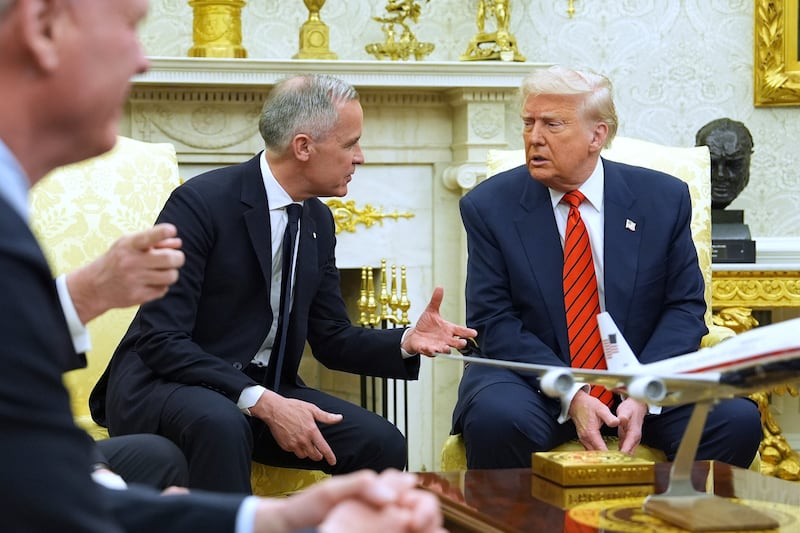

President Donald Trump and Canadian Prime Minister Mark Carney are engaged in both an online and financial battle after Carney walked away from negotiations and the two countries fell deeper into a trade war.
Each side blamed the other for the collapse of negotiations over the weekend, with the U.S. imposing 50% tariffs on some Canadian goods, including hockey sticks and building materials, and Carney vowing that Canada will retaliate within weeks.
Here’s what you need to know about the bitter trade battle between once-close allies.
Carney walks away from negotiations
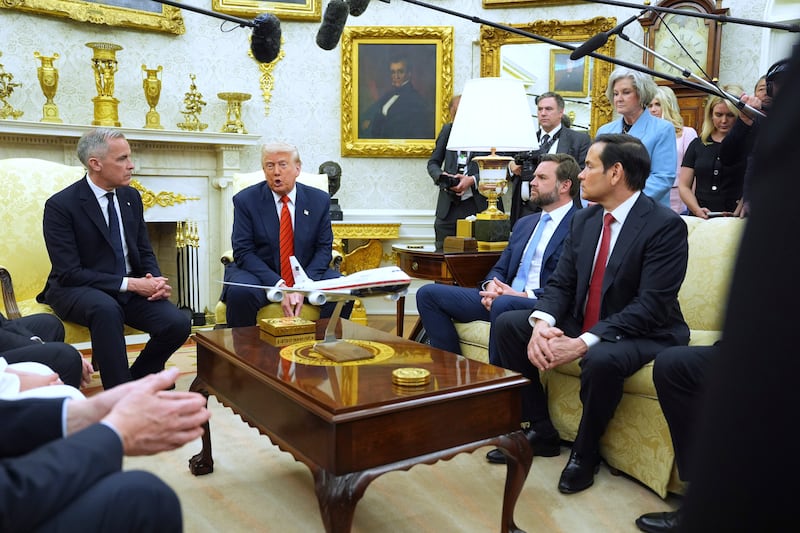
The prime minister on Friday pulled negotiators away from trade talks with U.S. representatives. In an address on Saturday, he said Canada has recognized that “America has changed.”
“We cannot accept what they offered and we will not give what they asked,” he said. “We were not prepared to compromise Canada’s sovereignty or undermine our key industries.”
Carney went as far to say that Canada was under attack by Trump’s sweeping tariffs.
The two countries had been negotiating for weeks to stop the tariffs that Trump threatened, but when Carney walked away from negotiations, the U.S. imposed a 50% tariff that impacted $20 billion worth of Canadian goods.
Carney said Canada was willing to drop the remaining retaliatory tariffs the country had placed on U.S. steel, aluminum and autos if the U.S. lowered its own tariffs and Canadian provinces were allowed to sell U.S. alcohol again, but he said the Trump administration’s demands were too far-fetched.
“They asked too much and offered too little,” he said.
He went on to say that the U.S. had added new terms that would have made it harder for Canada to make trade deals with other countries and weakened the country’s sovereignty. Carney said those demands were “unacceptable.”
Carney also said the breakdown in negotiations with Washington gave Canada a “new perspective” on the U.S. stance of the economic relationship between the two countries.
It also puts into question the stability and future of the U.S.-Mexico-Canada trade agreement, which is a critical agreement between the three North American countries.
Trump pushes back
While Canada and the U.S. have long battled over trade and economic issues, the two countries have remained friendly and willing to work with each other.
Trump’s approach to working with the close ally, however, had been a departure from the traditional relationship between the two countries.
His tariff agenda is an effort to bring manufacturing back to the United States. He’s also often prodded Canada about becoming America’s 51st state.
Carney said he doesn’t think the two countries can go back to their old relationship.
Trump went further on Truth Social on Monday, saying that “Canada has been ripping off the United States for years.”
He announced that on Jan. 1, 2027, there will be a 50% tariff on cars, trucks, automotive parts and steel.
“Canada will be treated like a State no longer!” Trump wrote. “On Trade, and in other ways, also, they are among the worst Nations in the World to deal with. They feel entitled, and yet, WE DON’T NEED CANADA, THEY NEED US!”
What it means for Americans and Canadians
After the Supreme Court struck down Trump’s sweeping tariff agenda earlier this year, he has been looking at other avenues in which to tax other countries.
For Canada, he invoked Section 338 of the Tariff Act of 1930, a rarely used Depression-era provision that allows tariffs up to 50% against countries that are discriminating against U.S. businesses. It’s a provision that was widely criticized at the time for worsening the Great Depression by restricting global trade, The Associated Press noted.
Since almost 72% of Canadian exports were to the United States last year, both countries are likely looking to strike some sort of deal, even with negotiations stalled.
Ryan Majerus, a partner at King & Spalding and a former U.S. trade official, told the AP that both sides will be under pressure in the coming days to “find an off-ramp.”
Trump’s tariffs impose higher costs on American businesses that are importing goods from other countries. After the Supreme Court struck down Trump’s justification for his early round of tariffs, the federal government is having to pay refunds to importers in the U.S.
Amid higher costs with the Iran war, it’s likely something U.S. trade officials and the Trump administration are wanting to handle, particularly before the November midterm elections.
However, Trump’s top trade negotiator, Jamieson Greer, told “Fox & Friends Weekend” that the U.S. has “said enough” and was taking countermeasures due to years of retaliation from Canada.
“Our interest is in protecting American workers and protecting American supply chains,” he said.
Name calling and social posts
On Monday, Carney said it was “not a surprise” that Trump would implement a higher tariff as a result of the negotiations falling apart.
“It’s not a surprise for us that the U.S. would take some form of reprisal to our response to their unjustified tariff, which was on top of other unjustified tariffs. That’s not a surprise,” he said. “What message does that send to the workers in Michigan, in Ohio, in Kentucky, in Alabama, who rely on Canadian demand?”
Carney went on to say that Canada is the United States’ largest customer for automobiles, more than the European Union, Japan and others. He said it was the “most successful automotive partnership in history” that has lasted his entire life.
“The president is doing what we, not just suspected, but we had confirmed through the terms that they were offering,” Carney said. “Instead of a quick change to the terms in the automobile industry, they were putting on the table terms that gradually would have that impact, and we wouldn’t accept that.”
“So, it’s very revealing that this is where they go,” he added.
It’s unclear how Canada will retaliate against the 50% tariff, but Ontario Premier Doug Ford told the AP on Monday that Ronald Reagan would be “throwing up” and “spinning around in his grave” over Trump’s trade policy. He also threatened to cut off electricity and critical minerals to the U.S.
“He underestimates Canada. We’re all in,” Ford said. “Up here, we’re at a fever pitch, everyone’s in for an economy war. They know they’re going to have to sacrifice.”
Ford went on to say that “everything is on the table” if the dispute between the two countries worsens.
“I’ll cut them off,” he said. “You won’t get a grain of sand out of Ontario.”
Ford’s comments struck a chord with the president. Trump posted online that Ford is known as the “less charismatic, intelligent, and overall unimpressive brother of the late, great, Rob Ford.”
“America has been carrying Canada for decades, but no longer! The U.S.A. will always be far bigger, richer, and stronger than Canada,” he wrote. “Without the United States, Canada couldn’t survive — it’s where they get all of their money and, because of their current bad leadership, primarily Governor Carney, and his Flunky, Ford, they will not be allowed to keep taking advantage of the United States.”
Trump said someone should “warn these clowns” to “fall in line” or else Canada will face consequences.
Ford, at an event in Hamilton, Ont., responded to Trump’s insult by saying “bring it on” because he’s dealt with “losers” like him all his life.
“I don’t respond to a dictator like President Trump, bully like President Trump. As I said before, he’s the type of guy in school that would take your lunch money,” Ford said.
He also highlighted how automobile manufacturing will be impacted in red states due to the tariffs. Canadian minerals that the U.S. relies on will be withheld, Ford said. He argued that Trump underestimates Canada, which “is a mistake.”
“He wants to put pain on Canadians. We’ll leverage every bit of pain we possibly can on Americans … I’ve always said I love the American people. I still stand by that statement because there’s a lot of people in the U.S. that are calling my saying ‘way to go, keep going,’” Ford said.
“Your own people, President Trump, don’t even like you, and they’re going to speak loud and clear when it comes to the midterms,” he added. “And if I was allowed to, I’d be down there door knocking.”