


Many Americans feel conflicted about protests, but that’s exactly how the War of Independence started.
We commemorate the Boston Tea Party, a 1773 tax protest where citizens threw crates of the stuff into the harbor. We often celebrate when people in other countries take to the streets, from the fall of the Berlin Wall to the Arab Spring and Iran late last year.
But when civil demonstrations hit closer to home, in a political system that offers citizens every opportunity to participate, the questions get harder.
Is protesting democracy in action? Or a selfish end-around?
Whose streets?
Protesting is inherently democratic.
Marching in peaceful demonstration is freedom of speech in action, a practical expression of the idea at the heart of the American system: rule of the people, for the people, by the people.
It can also be a warning or indicator for those in power. As Thomas Jefferson wrote in 1787, “What country can preserve its liberties if their rulers are not warned from time to time that their people preserve the spirit of resistance?”
Protests give voice to minority groups and opinions. Our pluralistic society protects those of smaller number, whether defined by ethnicity, religion, ideology or any other measure. They may not prevail alone at the ballot box, but the First Amendment protects their right to assemble and petition the government to correct whatever wrongs they perceive.
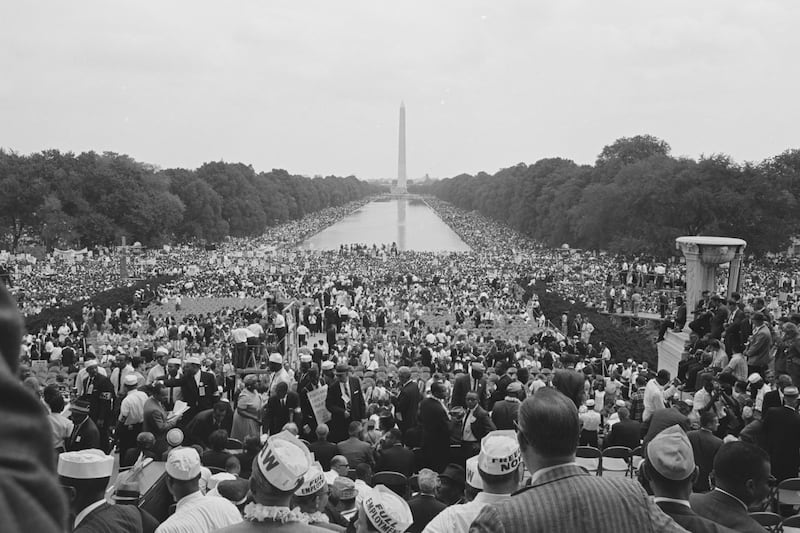
Demonstrations can also persuade fellow citizens to support a cause. For example, the Civil Rights Movement became popular after the widely televised March on Washington in 1963.
Peaceful protesting can prevent political violence. Like a release valve, it lets people vent the kind of resentment that might otherwise fester and lead some to more problematic actions.
We’ve seen examples of the opposite under authoritarian regimes around the world, but any government can find itself exercising authority beyond what its people are willing to accept. Even Martin Luther King Jr., known for his commitment to peaceful action, warned that “a riot is the language of the unheard.”
Protests may make us uncomfortable, but that can also make them effective. It’s why sit-ins, walkouts, boycotts, picket lines and traffic stoppages are popular methods: By interrupting commerce, disrupting governance and inconveniencing fellow citizens, they put pressure on those in power.
“Nonviolent protests put authoritarian regimes in a lose-lose situation,” as David Brooks wrote in The Atlantic last October. “Either cede the streets to the protesters, or crack down in ways that weaken your legitimacy.”
So when our neighbors march or occupy some public place, whether or not we agree with their cause, we can remember this observation of abolitionist Frederick Douglass in 1857: “If there is no struggle, there is no progress. Those who profess to favor freedom and yet deprecate agitation are men who want crops without plowing up the ground.”
Our streets!
Protesting is an unnecessary nuisance in America today.
Citizens can effect change through many avenues: creating or signing petitions; canvassing, fundraising or caucusing for their preferred candidate or party; volunteering to serve as delegates and electors; writing op-eds and letters to the editor to argue their positions; and even running for office themselves. Those who lack the time or energy to get that involved can easily make their opinions known thanks to modern technology.
More importantly, they can vote.
Protests are an attempt to circumvent our democracy. American governance is built on voting at every level. Congressmen, senators and the president are elected by the people. The Senate confirms the president’s nominees to the Cabinet and Supreme Court. Bills are written, revised and passed or rejected in a democratic process before they are ever enacted into law.
The system is designed to measure public sentiment with fairness, giving each voice equal respect. Protesters try to manipulate this system by being loud.
Public demonstrations undermine civil discourse. They deepen political divisions, rather than fostering the nuance and compromise that underpin democracy.
When crowds gather to shout their opinions, they contribute to tribalism — often attracting counterprotesters — and risk violence. The passions they excite form a powder keg waiting for a spark to turn that peaceful protest into a riot.
As psychotherapist Jonathan Alpert wrote in The Wall Street Journal, “Democratic systems depend on something more demanding (than emotional validation): the ability to tolerate disagreement, engage with complexity and distinguish between what feels true and what is demonstrably so.”
At worst, protesting can result in a “heckler’s veto.” Essentially, this is when a loud argument from a small number of individuals overwhelms the democratic process, making it impossible for governance to proceed, or simply drowns out the softer, more respectful voices of those with whom they disagree.
That’s what then-President Richard Nixon had in mind when he called on the “silent majority” of Americans to back him while chastising anti-war protesters, who he called “the minority who hold that point of view and who try to impose it on the nation by mounting demonstrations.”
There is a place for all opinions to be heard, and that is the ballot box.
This story appears in the July 2026 issue of Deseret Magazine under the headline “Heckler’s Veto.” Learn more about how to subscribe.