

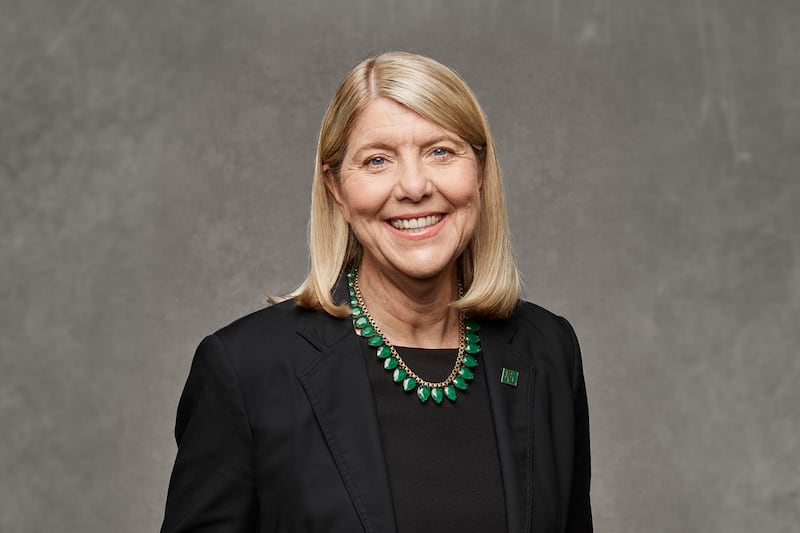

Baylor University’s Christian mission and deep Baptist roots make it unique among institutions of its size. But that distinction doesn’t make the Waco, Texas, school immune to the challenges facing higher education.
“I have this conversation often with parents of our students,” says Baylor President Linda Livingstone. “The landscape for higher ed has changed dramatically in the last few years, and we anticipate that continuing. We know we’re on the front end of the demographic cliff.”
Add to that uncertainty changes in federal funding for research universities like Baylor, challenges over access to international students, elected officials pressing for change, and the chaos surrounding college athletics. It’s a difficult time to plan for the future.
A former professor of business management, Livingstone also knows there is opportunity amid change. That mentality shapes her approach to the future of higher ed and Baylor, in particular.
“It forces us to put on a transformational mindset,” she says. “It’s a great time for higher ed to rethink how we do some things, make sure we’re putting our students at the center of what we’re doing and to really be creative about the work.”
Before taking over as Baylor’s 15th president in 2017, Livingstone and her husband both played basketball at Oklahoma State University, where she earned a bachelor’s degree in economics and management, a master’s in business administration and a doctorate in management and organizational behavior. Her experience as a dean and professor of management at George Washington University and Pepperdine University’s business schools, as well as associate dean of graduate programs at Baylor’s Hankamer School of Business, have uniquely prepared her for the challenges facing her school and others like it.
Jane Clayson Johnson, a contributing editor to the magazine and one of the hosts of “Deseret Voices” podcast, recently discussed the changing landscape of higher learning with Livingstone and the role religious-affiliated schools play in paving the path forward. Their conversation was edited for length and clarity.
Jane Clayson Johnson:
Baylor has become a leading university and a major research center while firmly rooted in its Christian identity. How do you preserve genuine academic freedom and excellence while also remaining faithful to your religious mission?
Linda Livingstone:
We care deeply about academic freedom at Baylor, and we care deeply about our religious mission. And I really believe that in some ways that gives us a great deal of freedom. We talk about all truth is God’s truth, and that because of that, all truth should be open to inquiry. That opens the door for our faculty to ask really hard questions and to look at difficult issues, and also to put a faith-based frame around those in ways that individuals at some secular institutions have difficulty doing.
So I believe it gives us a lot of freedom in the research that we’re doing and gives us opportunities to study issues and questions in ways that maybe other faculty have more challenges doing. So I view it as an opportunity. There are certainly challenges in doing that sometimes, but we try to look at it as a way to use our Christian faith in a way that moves research forward in a way that it wouldn’t at other research universities.
Clayson Johnson:
Is rigorous scholarship ever in conflict with religious commitment?
Livingstone:
In the world we’re in today, we have a lot of division over some really important and difficult issues, and there are strong differences of opinions around some of these issues. So when we have faculty doing research in some of those areas, they have to be thoughtful in their approach, and ensure that the research that they’re doing is objective. It’s using good scientific methods to do it. So they’re truly looking for the answer that comes from the study and the questions they’re doing. And I think sometimes the more difficult aspects of it come in the application of research.
And what does that mean for policy? Or what does it mean for how an organization should respond or how people should respond? I think if you’re doing really good objective research, you should be in a pretty good position. I think then sometimes where the biggest questions and issues arise is how you apply that research to solve problems because people have different perspectives about how you should solve some of these issues in the world.
Clayson Johnson:
Can you give me an example of where that tension may exist?
Livingstone:
There’s a lot of debate going on around the immigration environment and what we do with our borders, what we do with those who are here in our country. And this is a global issue. It’s not just an issue in the United States. And I think people of different faith perspectives may approach this issue differently. And then certainly those in the secular community may have different perspectives on it.
And I think many of us have faculty who care deeply about these issues, who are trying to study them and understand what’s going on, what’s the impact on our communities and what should policies be. Because it’s such a divisive issue, both politically and theologically, I think it can be fraught with challenges for faculty doing research in those areas. And so again, making sure they’re doing really solid, good, objective research that they can put out there so that those that then are using that to make decisions can judge them and use them in the way that they think is best given how they might view those issues.
Clayson Johnson:
Whether it’s research or anything else related to university life, how do you think a Christian university contributes to American life in ways that perhaps a secular university may not?
Livingstone:
There are multiple ways that happens. One, at the core of what we do is educating our students: that the experience we provide students has a richness to it and an element to it that you don’t see at secular institutions.
For instance, at Baylor, we have chaplains in every residence hall. We have chaplains in some of our academic units. Our students are required to go to chapel a couple of times a week and we have over 70 different chapel choices. So we meet students where they are spiritually and help them grow from there. We have some required Bible classes and then we hire faculty and staff that are of the Christian or Jewish faith, and we hope that no matter what kind of classroom they’re in, what kind of research lab they’re in, that they are present for our students. And really, they’re not just to help them academically, but to help them both personally and from a spiritual perspective. So I think it embeds the academic experience with our students in different ways than you might see at a secular university.
We have a very rich life of the spirit on our campus that integrates with the life of the mind. And then we talked about the research. I do think it allows our faculty to ask different questions, to look at these questions through different lenses. What I hope is that we’re putting research out into the world, we’re putting students out into the world that have a deep care for the academic study that they did, but also layer across that a deep care for people, a deep care for the world, and that their kind of faith commitment is impacting how they go out into the world and seek to solve problems and be present in their organizations.
Clayson Johnson:
Artificial intelligence is forcing universities to reconsider not only how students learn but why they come to college in the first place. How is AI changing the conversations you are having as president of Baylor?
Livingstone:
We’re clearly looking at it from an infrastructure perspective of how can we use AI to be more efficient and effective. And how can we provide better service to our students and our faculty and staff by how we use it from an administrative support perspective.
Then we see it in the classroom. And there’s a couple of ways it impacts the classroom. One, there continues to be a lot of concern about the unethical use of AI by students. So faculty and students are having to learn the appropriate ways to use the tools, to use them to learn and develop in whatever academic field it might be, but also to protect the academic integrity of the evaluation process and the learning process. We’re also seeing our faculty use AI a lot on the research side, particularly in the fields where they do a lot of analytical work. It is helping in their research to be much more efficient and effective than in the ways we’ve done it historically. So I would say that across all aspects of what we do, we’re seeing the impact of AI, but we’re early in the process. So we’ve got a lot to learn, and we’re gonna continue to see that grow and develop over time.
Clayson Johnson:
For generations, education was measured by how much information a student could master. And now with information instantly available and with AI being able to analyze and problem solve and even do the thinking for students, what do you see as the value of a university education?
Livingstone:
I think in a way it raises the bar on what we have to do as part of the learning experience for our students. As you say, information is so readily available at the fingertips of students now. But I think that also poses one of the challenges. I think we have a great responsibility to help our students understand how to discern whether that information that they can get so easily through AI, through the internet, through other tools is actually accurate and truthful. So we’re really having them develop better skills at discernment, at critical thinking.
And now that there is so much information available, how do you decide what parts of that information are the most relevant for the work that you’re doing? So in many ways, a broad liberal arts education, an education that teaches you how to think, how to ask the right questions, how to be discerning, I think is even more important.
The other piece of it is the moral and ethical element to AI. We know any new technology can be used for good or it can be used for evil. And so we have to help our students understand how to approach the use of AI tools, that tremendous access to information that they have, in an ethical way to actually help move society forward in a positive way and to protect us from the negative implications.
Clayson Johnson:
Do you think it’s fundamentally shifting the university’s mission toward cultivating judgment and wisdom and moral responsibility?
Livingstone:
I hope that’s always been a core part of what we do in higher ed, but I absolutely believe that’s the case. I think there’s going to be less emphasis over time on entry-level technical skills because much of that can be done by AI, and more on these higher-level skills. And I love that you use the word “wisdom.” I think that’s a wonderful thing that we’ve got to work on. How do we help our students develop a wise way of thinking about the world and gathering information? So I do think it’s going to shift to these higher-level ways of thinking and skills than maybe we’ve done in parts of our educational experience in the past.
Clayson Johnson:
Public trust in higher education has fallen dramatically over the past decade. Why do you think that’s happened? And what do you think it will take for universities to rebuild trust?
Livingstone:
I think we’ve probably been a bit slow to acknowledge that there may be some truth to that. There’s been a sense in higher ed that if we just tell our story better and we really emphasize the value of what we’re doing, we shouldn’t have to change anything and that will change the public’s view. And that has not been helpful in changing people’s perceptions of higher education. So I do think it’s important that we take seriously the criticisms we’re getting, taking seriously questions about affordability, about preparing students in the right way to go out into the world that’s very different than it was 10, 15, 20 years ago. And making sure that while we’re continuing to still provide a really fabulous broad-based education, we have to make sure that we’re preparing students for the careers they’re going to have, not just when they graduate, but five, 10, 20 years from now. And I don’t know that we’ve paid as much attention to that as we should. If we start to do that and do what we say we’re going to do, that will certainly help us begin to shift that narrative and that perception of higher education.
Clayson Johnson:
You talk to students today who are just coming out of high school thinking about what their options are for the future, and they look at a possible college tuition bill of hundreds of thousands of dollars and they just kind of wonder if it’s worth it. Do you worry about higher education being only for people who can afford it?
Livingstone:
It is a deep concern both nationally and then certainly within the higher education community. One of the wonderful things about higher ed in this country is you have such a diversity of types of institutions that they can serve such diverse and broad populations in our country. But I think you’ve got to continue to find ways to support students in lower socioeconomic brackets to have the access that we want everyone to have to higher education. And it’s a big challenge as expenses go up and we have to continue to provide high-quality education while finding ways to support those that don’t have the means that some others do to pay for higher ed.
Clayson Johnson:
What keeps you up at night about the future of higher education and what gives you hope?
Livingstone:
What keeps me up is the ever-changing nature of higher ed right now and kind of the chaotic world we live in and figuring out how to navigate that in a successful way that continues to allow us to support our faculty, staff and students in the way that we want to, to help them to be successful. And what am I excited about? Well, you have to be excited when you’re on a campus with students who are excited to be there. They want to learn, they want to grow, they want to develop. And you’ve got faculty that are pouring their lives into those students and then doing research that’s really making a difference in the world. And so that gives me great hope, not just for higher education, but hope for our country, that we’re producing really amazing young people, amazing research that’s going to make a difference in the world.
This story appears in the September 2026 issue of Deseret Magazine under the headline “The Opportunity in Chaos.” Learn more about how to subscribe.