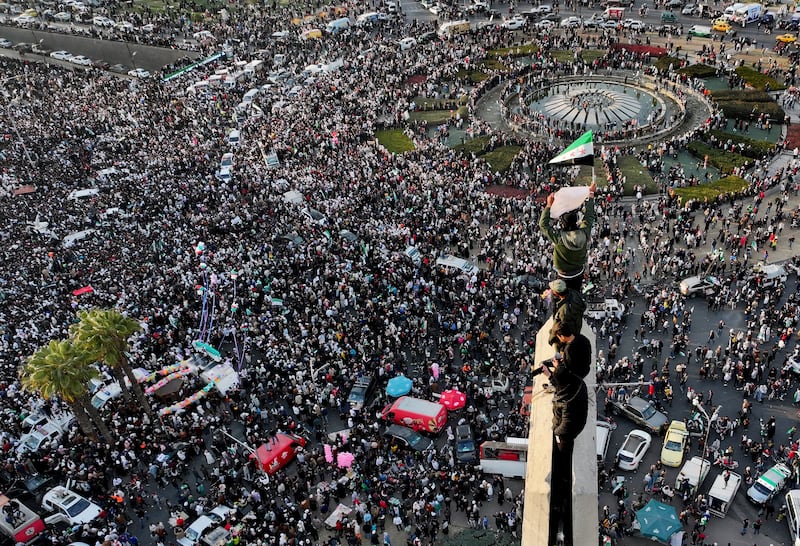
The sudden collapse of the long-established Assad family dictatorship in Syria changes the balance and constellation of competing forces in the Middle East. For many years, the Syrian government has been a client of Russia, and before that, the Soviet Union. Turkey has also intervened, mainly in pursuit of the Kurd minority regarded as dangerous.
In 2016, Ankara and Moscow brokered a ceasefire in Syria. They intervened again to damp down provincial violence in 2020.
Vladimir Putin’s decision in 2015 to intervene with military forces in the brutal combat in Syria has led to sustained expansion of Russia’s influence in the region. In the short term, Moscow greatly increased the staying power of the just-overthrown regime of Syrian President Bashar al-Assad.
Historically, Moscow has been preoccupied with secure national borders, especially in Eastern Europe, and generally abstained from sending military forces long distances. This traditional approach was abandoned by Putin, who became a daring military gambler in the Mideast.
Russia has a long history of involvement in the volatile region, especially Syria. The profoundly serious Suez Crisis of 1956 resulted in sharp rupture among Western allies, as the Eisenhower Administration refused to support a combined military assault by Britain, France and Israel to retake the Suez Canal and seize the Sinai Peninsula from nationalist Egypt.
From that time until the end of the Cold War, Moscow had significant influence. Hafez al-Assad, father of Bashar al-Assad, helped instigate a successful 1963 coup. By 1970, he consolidated his position and ruled until 2000. Ironically, given later developments, he was generally regarded as relatively moderate and an economic modernizer, though in the context of a dictatorship.
Syria developed a close military partnership with Egypt, and the two nations went to war together against Israel in October 1973. The Yom Kippur War also witnessed American-Soviet nuclear confrontation. This crisis was arguably as serious as the Cuban Missile Crisis of October 1962, though conducted almost entirely outside public view, in great contrast to the confrontation over missiles in Cuba.
The Watergate domestic political crisis colors recollections among some Nixon administration officials. Nevertheless, reasonable conclusions can be drawn.
First, Nixon aggressively pursued the essential need to get aid to Israel. At the same time, Israel was successfully pressured to show restraint regarding encircled Egyptian forces. In short, vital U.S. interests in the region were clearly recognized and protected.
Second, visible actions were taken to demonstrate U.S. military resolve: B-52 bombers were moved from Guam to the U.S., and the Army’s 82nd Airborne Division was placed on alert.
Third, the U.S. ultimately did not pursue a proposed joint “condominium” proposed by the Soviets. Interests were too divergent on both sides. This bears on Putin efforts for international collaboration regarding Syria. Moscow saw no reason to involve the U.S., but that may now change.
President Jimmy Carter brokered peace between Egypt and Israel. President George H.W. Bush and Secretary of State James Baker initiated complex negotiations which resulted in partial Israeli-Palestinian reconciliation. Moscow was involved.
President Barack Obama and his administration pursued a largely rhetorical approach to the ongoing brutal Syrian civil war. A declaration that use of poison gas by Syria would lead to military retaliation proved hollow.
Putin immediately seized the opportunity and secured a Damascus declaration abandoning chemical weapons. This marked the end of serious U.S. influence.
Obama Administration fecklessness does not argue for intervention now. Rather, the new Trump Administration should carefully evaluate U.S. national interests and act accordingly.