
The first fact is not the phrase reportedly scrawled on the gun.
The first fact is that children were inside.
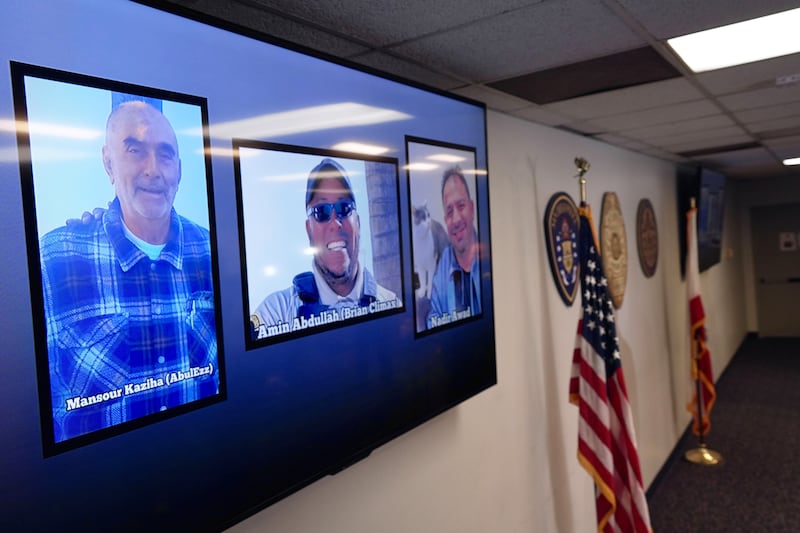
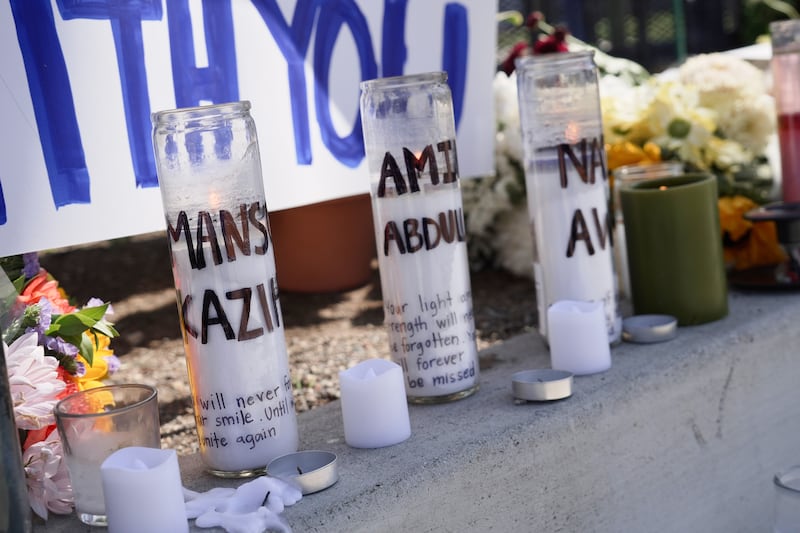
On Monday, two teenagers attacked the Islamic Center of San Diego while students were inside. Amin Abdullah, the security guard, triggered the lockdown that helped save them. Mansour Kaziha and Nadir Awad confronted the gunmen outside and helped keep the violence away from the children, and they were both killed in the parking lot.
The killers meant for none of this to be the story. They wrote a document, courted an online audience and scrawled a phrase on a weapon, each of it staged so the attention would land on them.
It should land elsewhere. Not on the killers’ document. Nor their online audience. And not the two words one of them reportedly wrote across a weapon. The story belongs to three Muslim men who stood between armed boys and a school full of Muslim children.
The words on the gun said, “Hate speech.”
Whatever the killers thought they meant, the phrase points to a real question: What do we do with speech that does not merely express hatred but feeds it, intensifies it and propagates it until it becomes violence?
But that question comes second. What matters first is why a mosque school had to become a battlefield at all. And why Muslim children were the target.
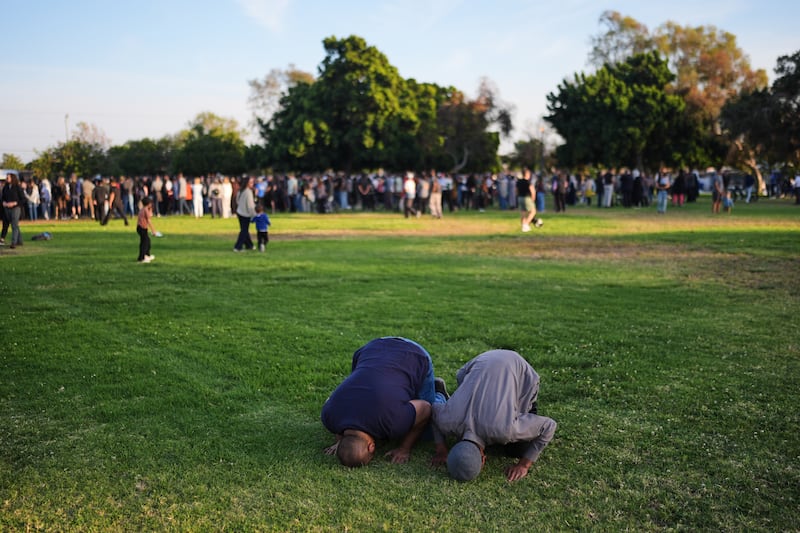
This is about a mosque full of children, three men killed while protecting them, and a community left to mourn, pray, reassure its children and bury its dead.
The words on the gun threaten to fold the men who died into a national argument about what to do with hateful speech when what they did was simpler and braver: They kept children alive.
The attackers wanted a different story. They were not only trying to kill, they were also apparently trying to produce something.
The pair met online before they met in person and left a roughly 75-page document titled “The New Crusade: Sons of Tarrant,” invoking Brenton Tarrant, who murdered 51 Muslim worshippers in Christchurch in 2019, including multiple children and teenagers. In their online world, Tarrant is a founder to quote and imitate. To call yourself his son is to welcome an identity and announce a sequel.
This was not really a confession. It was a compilation, stitched from earlier mass killers and aimed at an audience trained to treat each massacre not as an endpoint but as source material. The killing generates content, and the content feeds an online subculture that turns murderers into celebrities: tribute videos, cute drawings, heroic edits, atrocity as fandom.
Such a subculture makes the next killing thinkable.
Abdullah, Kaziha and Awad broke that script. They made the story about rescue rather than spectacle, forcing the center of the event away from the killers’ symbolism and back onto the lives the killers tried to erase.
That’s where the focus should stay — on a story about anti-Muslim violence.
This is about a mosque full of children, three men killed while protecting them, and a community left to mourn, pray, reassure its children and bury its dead, while Washington was already treating Muslim life as a constitutional problem.
That broader society is not innocent, because the fantasy that drove the killers does not live only in hidden forums. The idea that Muslims are an invading force, that Islam is a civilizational threat, that Muslim public life is incompatible with America, has respectable versions: in committee rooms, television, campaigns.
The week before the shooting, Congress held hearings titled “Sharia-Free America” on the premise that political Islam and sharia law are incompatible with the Constitution.
There are careful ways to discuss religious law, pluralism, liberalism and extremism. But outside the hearing room, suspicion of “political Islam” slides easily into suspicion of Muslims as such.
That is why the phrase on the gun hurts in more than one direction. It seems to name the danger that speech can become while surfacing this dilemma: If speech is part of the machinery of murder, why should the law protect it?
The answer cannot be criminalizing hate speech. American law does not recognize “hate speech” as a category of unprotected expression, and the First Amendment protects a great deal of speech that is vile, racist, dehumanizing and dangerous in its moral effects. That is brutally hard to accept after a massacre. But it is also right.
A government powerful enough to outlaw hateful speech gets to decide which speech is hateful. In a country where official rhetoric can cast Muslim life as a constitutional danger, a hate-speech regime could easily be turned the wrong way, and the machine built to punish hatred might not point first at the men who attack mosques. It might point at the mosque.
The First Amendment protects a great deal of speech that is vile, racist, dehumanizing and dangerous in its moral effects. That is brutally hard to accept after a massacre. But it is also right.
But that does not mean the law is helpless. True threats are not protected, and neither is incitement — that is, speech meant to spark imminent violence. And facilitation, meaning operational help rather than persuasion, can be punished, along with conspiracy, weapons violations and direct participation in the crime.
The difficulty is that the manifesto sits near that line: protected as ideology, yet built to teach a reader how to inherit the role and continue the sequence.
The digital world lets one such document replicate without end — without any other amplification. Platforms do not have to host propaganda. Journalists do not have to reproduce manifestos. Politicians do not have to be spared shame when they launder anti-Muslim suspicion into official language.
The answer to protected hatred is not passivity but refusal: platforms not becoming archives of massacre worship, journalists not making murderers famous, politicians not treating Muslim civic life as suspect, and the rest of us not building a censorship machine around a vague phrase the state would get to define for itself.
The word on the gun was a dare. The answer is not a hate-speech law. The answer is not silence, either.
The answer is to say exactly what the attack on this mosque was, to confront the rhetoric that prepared the ground for it, to cut off the machinery that turns murder into famed inheritance, and to remember the men the killers tried to reduce to props for an online audience.
Amin Abdullah. Mansour Kaziha. Nadir Awad.
They are the story.