


It is all too easy to bemoan the abysmal rhetoric of our times. Strident and shrill, caustic and toxic, illogical and semiliterate — we ransack the thesaurus to describe its depths.
One recent study charts the rise of “conflict entrepreneurs” in Congress — national legislators whose desire for greater media visibility spurs their frequent resort to personal insult. Profanity and vulgarity from another branch of government is on the rise as well. All too often, we shower upon these conflict-mongers precisely the attention they crave.
As troubling as all this is, the real problem with much of today’s rhetoric isn’t just that it’s awful. It’s that it isn’t rhetoric at all.
For decades now, rhetoric has been given a bad name. “Rhetoric” is leveled as a term of abuse, denoting something tinseled and showy, insubstantial or downright deceptive.
But rhetoric has a noble tradition and a lofty aim. Aristotle defined it as discovering “the available means of persuasion” in any given case.
Much of today’s discourse, by contrast, does not aim to persuade. It vilifies and denounces, flatters and incites — but it doesn’t persuade.
Rhetoric, in its highest sense, is the art of persuasion. It is the craft of appealing to the reason — not just the emotions — of those we regard as our civic equals. A democracy that loses this art is doomed.
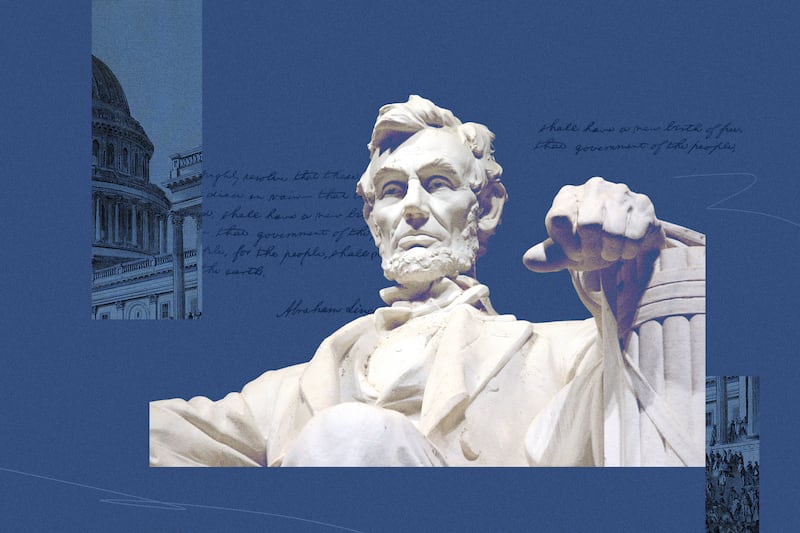
The United States has never had a greater rhetorician or more powerful persuader than Abraham Lincoln. He had a rare power, cultivated across a lifetime of study and practice, to move human hearts.
For generations, American schoolchildren learned his most famous words — the majestic cadences of the Gettysburg Address, the unobtrusive eloquence of the Second Inaugural — by heart. For the most part, this no longer happens. Memorization, like rhetoric, has fallen out of favor. But the loss, on both counts, is ours.
Lincoln was once our great national teacher of persuasion. His power to change hearts stemmed from his relentless insistence on appealing to reason. We would do well, in these troubled times, to remember his example.
Fortunately, Lincoln taught persuasion by precept as well as example. In one of his earliest preserved speeches — an address to the Washingtonian Temperance Society of Springfield, Illinois, delivered in February 1842 — Lincoln explored not only his assigned topic of temperance but also the broader topic of persuasion.
The Washingtonian Temperance Society movement was named after the first U.S. president, who was an exemplar of virtue and self-control, if not a teetotaler. The organization was in some ways a 19th-century antecedent of Alcoholics Anonymous. Only in this case, the alcoholics were not anonymous. The Washington Society relied on reformed drunkards to evangelize its temperance message — calling on people to abjure liquor and other strong drink.
Speaking to the society’s Springfield chapter on its namesake’s birthday, Lincoln addressed what he saw as the secret to its success. That secret, he explained, lay in the principle and the power of persuasion.
Earlier efforts to promote temperance had failed, Lincoln noted, because they ignored key principles of persuasion. They relied on “preachers, lawyers, and hired agents” to share their message — speakers who evinced “no sympathy or feeling or interest with those very persons whom it is their object to convince and persuade.”
These unsympathetic orators spoke “not in the accents of treaty and persuasion, diffidently addressed by erring man to an erring brother, but in the thundering tones of anathema and denunciation, with which the lordly judge often groups together all the crimes of the felon’s life, and thrusts them in his face just ere he passes sentence of death upon him.”
Unsurprisingly, people beset by drink were rarely persuaded by those who thus attacked them. Lincoln intuited what modern neuroscience has confirmed: The human mind responds to external assaults by throwing up its defenses.
There was, Lincoln said, a better way. “When the conduct of men is designed to be influenced,” he explained, “persuasion” (which he qualified as “kind, unassuming persuasion”) “should ever be adopted.”
Lincoln reinforced the point with a homey adage: “A drop of honey catches more flies than a gallon of gall.” Humans, in this image, were like flies. “If you would win a man to your cause,” Lincoln continued, “first convince him that you are his sincere friend. Therein is a drop of honey that catches his heart, which, say what he will, is the great high road to his reason, and which, when once gained, you will find but little trouble in convincing his judgment of the justice of your cause, if indeed that cause really be a just one.”
Lincoln was not proposing that we feign friendship with others in order to manipulate them. He was championing real friendship and gentle persuasion as the only path toward “convincing (another’s) judgment” — the very opposite of manipulation. Lincoln acknowledged but never manipulated the passions of his hearers. He labored instead to convince their reason. And that was possible only through friendship and persuasion.
For Lincoln, this required taking people as you found them and giving due weight to public opinion. It required viewing your fellow citizens and even your political adversaries (for Lincoln, this included even Southern slaveholders) as fellow human beings, endowed with reason and amenable to persuasion. It required speaking and writing in a manner calculated to convince adaptable minds.
Too few of us speak and write this way today. (Too few, in this age of AI, do their own writing at all, but that is a topic for another essay.) Too many see differences of opinion on deeply felt matters as cause for denunciation and avoidance, not for engagement and persuasion.
One of today’s wisest civic thinkers, Yuval Levin, has suggested that being a moderate does not mean holding middle-of-the-road positions. It means treating with moderation those you disagree with, regarding them as reasonable people worth trying to persuade, not as moral monsters to be demonized and dismissed.
One might be tempted to think that, for all Lincoln’s great faith in persuasion, the Civil War pronounced persuasion’s failure. But for Lincoln, it wasn’t the war that renounced persuasion; it was secession. By seceding against the results of a free and fair election, the slaveholding South was rebelling against governance based on reason, persuasion and consent — government, to borrow a phrase, of the people, by the people and for the people.
As for Lincoln, his faith in reason and devotion to persuasion never flagged. “Happy day,” he declared in his temperance speech’s closing words, “when, all appetites controlled, all passions subdued, all matters subjected, mind — all-conquering mind — shall live and move the monarch of the world.”
Lincoln continued, “And when the victory shall be complete — when there shall be neither a slave nor a drunkard on the earth — how proud the title of that land, which may truly claim to be the birthplace and the cradle of both those revolutions that shall have ended in that victory.”
May we heed these lessons from Lincoln. May we recover the lost art of persuasion. May Lincoln’s example persuade us still.