

Editors note: This is the second in a series of six pieces exploring the ideas behind America’s founding. Each piece will accompany one of five master classes on the Declaration of Independence from Utah Valley University’s Center for constitutional Studies. The classes are free and open to the public. Read more about and access the classes here.
“There is something absurd,” wrote Tom Paine in 1776. “In supposing a continent to be perpetually governed by an island.”
His pamphlet was part of a trans-Atlantic debate over the rights of America in which Samuel Johnson, a former pupil of my college in Oxford, had taken an opposing view the year before, denouncing the defense of liberty being made by American patriots as incoherent and hypocritical, in a pamphlet “Taxation no Tyranny.”
Independence Hall, where the Declaration of Independence was written, is over 3,500 miles from Oxford.
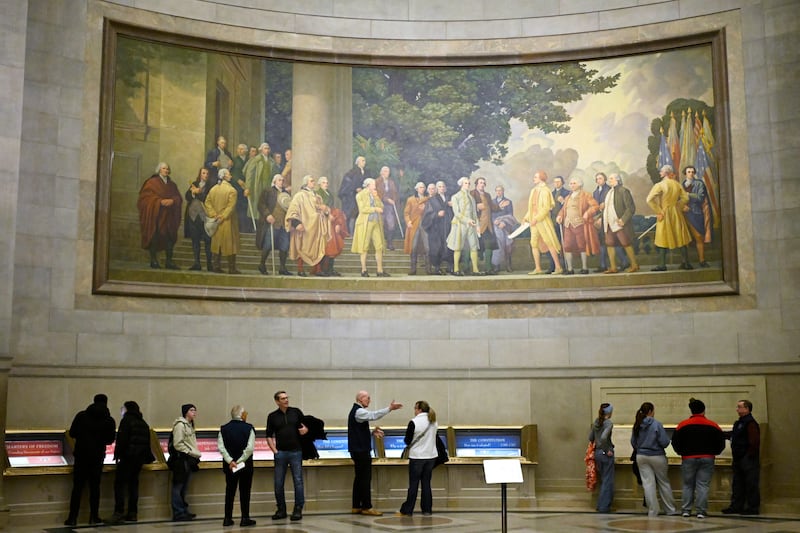
Independence Hall is one of the most powerful spaces I know. It has both an elegance and a simplicity that I have always felt captures something important and tangible about the intellectual world of the American Founding. The fact that the same room was the site of both the adoption of the Declaration of Independence and the negotiation of the 1787 U.S. Constitution gives the room a significance that seems almost impossible for one building to contain. I would defy anyone to stand in that room and not agree in that moment entirely with Thomas Paine. London seems impossibly far away.
The room in which the United States was born has nothing of the pomp of parliaments or of later capitol buildings. For many decades it was sadly neglected, and I have always been grateful for the careful restoration of the room. It now is, as it was in 1776, a simple appeal to a candid world.
I first visited that space in the summer of 2000; it left a great impression on me then. I have devoted most of my career to understanding the working of the debates in that room and others like it across America. But I could never have imagined that a quarter of a century later, I would be sitting there to record part of Utah Valley’s master-class series on the Declaration of Independence, as part of America’s celebration of the Declaration’s 250th anniversary. When my colleagues at UVU invited me to speak there about the Declaration, it was simply impossible to refuse.
What was there left to say about the declaration that had not already been said? In preparing my script, I thought carefully not about the text so much as what the room in which it was adopted reminds us about that text. That space calls us to remember that the foundational document of America’s independence was not written by one person but was, instead, a collective act.
Thomas Jefferson was, of course, the primary author of the declaration, but he was not the only one. He was part of a small drafting committee tasked with the work and their draft was debated and amended by Congress, meeting in Independence Hall. Indeed, the text that Jefferson wrote drew not only on the resolutions of Congress over the previous year, but on the wording of local declarations and resolutions. Jefferson’s name was not even present in the first printings, which were issued in the name of John Hancock, as President of the Congress.
Standing in Independence Hall, one is reminded that in contrast to the proclamations issued in the name of a monarch or his military and civilian representatives, America’s texts have been, from their very beginning, drafted by committees and have drawn their power and authority from processes of — at their best — sober and careful deliberation.
The operative passage of the document declaring independence had in fact not been written by Congress at all. It had been drafted by a convention in Virginia, and submitted to Congress for debate by Richard Henry Lee, who as Virginia’s representative in Congress, put the resolution before the delegates on June 7. “That these United Colonies are, and of right ought to be, free and independent States, that they are absolved from all allegiance to the British Crown, and that all political connection between them and the State of Great Britain is, and ought to be, totally dissolved.”
The Second Continental Congress was not a band of distant and ambitious politicians leading the American people to folly and debating only among themselves. American independence emerged through lengthy debate, public deliberation and procedural restraint rather than sudden revolution. Even its passionate advocates submitted to discussion, revision and formal processes before acting.
Congress refused to act hastily, even months after the first shots had been fired in what would ultimately become the war of independence. And even if some regarded British rule of America as ‘absurd’ in theory, Congress insisted on exhausting the avenues available to try and rectify actual grievances before acting. The declaration’s enduring power lies in this balance between universal ideals and practical, political necessity.
The Declaration of Independence laid the groundwork for a prosperous, stable United States of America, rooted in a respect for natural and civil rights. It has proved a sure and solid ground for the American experiment both because of the veracity of its principles and the careful, deliberative manner of its adoption.
The history of revolutions is replete with leaders willing to do anything to achieve their aims, confident that a good end can justify atrocities. But the men that put their names to the declaration believed that great things — necessary things — should nevertheless be done in the proper way.