

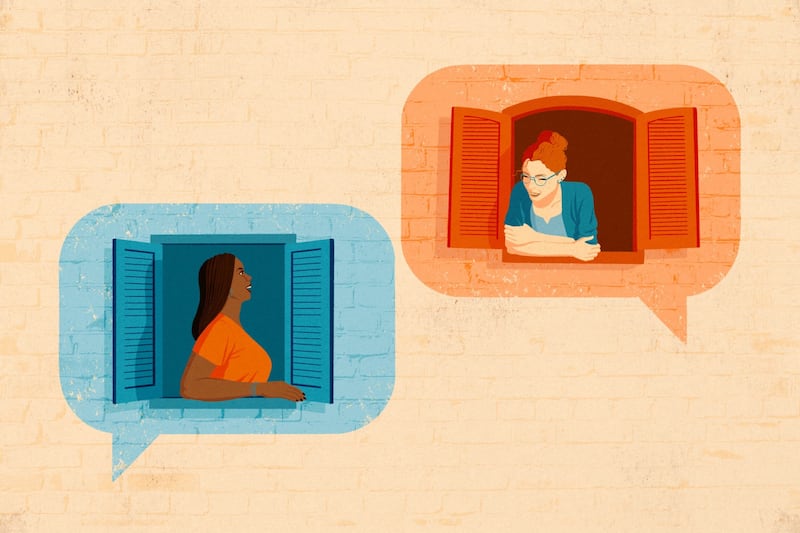


April is ideologically conservative; Mónica ideologically liberal.
We work together because some questions are best explored in conversation. And we believe that we have to do the work of peacemaking ourselves, in our own hearts and lives, in order to offer something credible to others.
But lately, this work has gotten harder. Every time we think our political life can’t get worse — that it can’t devastate our friend, family and community relationships even further, or shake our faith once more in a republic imperfectly designed to hold our differences — it shows us a new low.
And a new, fiercer longing for the heights we deserve. Isn’t that a familiar ache so many of us feel these days? It doesn’t have to be this way.
But what way should it be, then? In the swirl of so much hostility and controversy, it’s easy to lose our deeper sense of the best way forward anymore, both collectively and individually.
That underscores a question that haunts us these days: How do I know I’m doing the right thing right now?
The first episode of this new chapter of our podcast, “A Braver Way,” — which you can watch below — takes this question up, bringing together both secular and religious views on the topic.
The podcast, distributed in grateful partnership with Deseret News, asks what it takes to meet division with strength, how we stay both grounded and engaged at a time that tempts us toward numbness, outrage or resignation.
Recent surveys show what we’re up against: Nearly 6 out of 10 Americans believe our democracy is in danger of failing; 37% of us has seen a relationship break over political differences; and in a 25-country survey that stopped Moni in her tracks, no country’s citizens had a lower opinion of each other’s ethics and morality than our own.
Regardless of our ideological background, there are three practices that can help us reconnect with a deeper sense of right steps in our confusing modern age.
1. Refuse to live a lie
Václav Havel lived under the Soviet-aligned government of 1980s Czechoslovakia and articulated some of history’s most powerful insights about how to live righteously in a degrading situation.
Havel describes a greengrocer who was required by the regime to put a “Workers of the World, Unite!” sign in his window. At first the greengrocer complies, rationalizing the act as harmless. Eventually, though, he can no longer ignore the wrongness he sees in advertising party messages, and he refuses to put up the sign.
Havel noted that his regime ground people down by requiring tiny, everyday acts of complicity. By instead taking tiny, everyday acts of resistance, “the greengrocer steps out of living within the lie,” Havel writes, in “an attempt to live within the truth.”
In 1934, Hitler began to demand that the German church subordinate its theology to the state. A group of pastors issued the Barmen Declaration, which simply said no: The church worships Jesus Christ as Lord, not the Führer.
Havel may ask us today: Are we living as if the truth is true, regardless of others’ behaviors?
2. Test your limits
Angela Davis, an American civil rights icon, once said: “I’m no longer accepting the things I cannot change,” she said. “I am changing the things I cannot accept.”
Based on what you know about who you are and what is true, you might ask yourself: What, ultimately, can you not accept?
On a recent trip to South Africa, Moni was processing the tragedies of apartheid alongside a group of students when she suddenly understood, in a heart-stopping moment, that she quite literally could not live in a world where people could not say what they meant. And she would put her life on the line if necessary.
Knowing this felt scary, liberating and hugely clarifying in terms of next steps. Since then, Moni has been tracking assaults on free speech, supporting organizations working to ensure those rights hold and listening for internal calls to do more.
3. Own your beliefs
At a recent dinner party in San Francisco where both conservatives and Christians were lambasted, April found a moment to gently mention that she is a Christian conservative.
It was uncomfortable to do, and exhausting to feel she had to do. But doing nothing in the face of the misunderstandings others ascribe to her and to people like her felt much less acceptable. Thanks to her honesty, this group was led to question their assumptions, shifting toward something more honest themselves.
All of which leads to a useful tool to check if you are doing the right thing: Ask, “Are you willing to own it in public, and in front of those you love?”
One simple check for this is called the “grandmother test.” Could you explain what you want to do to your grandmother, and would she approve? Imagine she’s bored by details, unfamiliar with your trendy ideas and not interested in performance but spirit.
There’s another version of this test too: the grandchild test. When your grandchildren ask you, “When x happened, where were you? What did you do?” — will you be proud to answer them?
How do you know you’re doing the right thing right now? The answer — your answer — begins with finding your own integrity and ends with exercising your own courage.
The healthy relationships, communities and politics we deserve are within reach. We pray — in religious and secular terms, respectively — that we may all have the integrity and the courage to buck this hostile climate and create the world we yearn for.