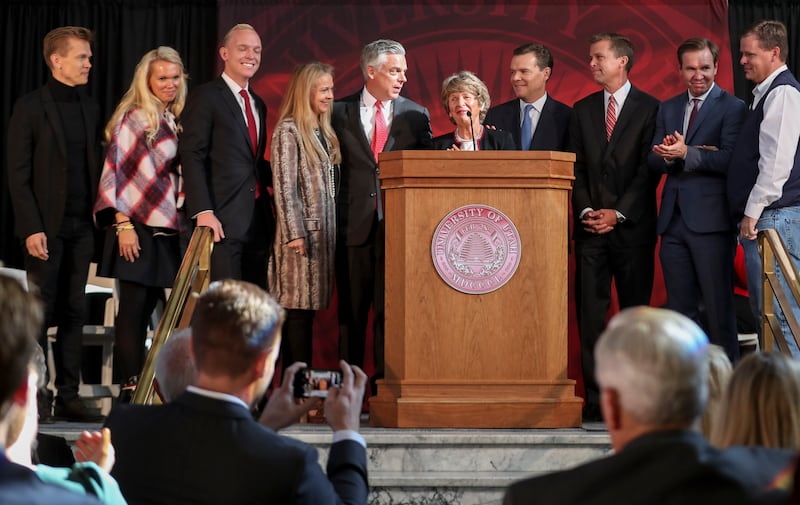
When Karen and Jon Huntsman Sr. dared to dream of a world without cancer, they built a foundation to ensure that pursuit would never stop.
Karen passed away on June 1, 2026, closing a chapter in one of Utah’s most extraordinary love stories — one written in research labs, clinical trials and the quiet courage of cancer patients who found world-class care in their backyard. In the days that followed, there was much said about the gleaming towers of Huntsman Cancer Institute, and rightly so. But the buildings, as extraordinary as they are, tell only half the story.
The other half lives with Huntsman Cancer Foundation: the philanthropic engine Jon and Karen built to ensure the institute’s mission would outlast any single generation. They knew the importance of building a sustained financial ecosystem that keeps the institution alive, growing and thoughtfully independent. It is their most enduring gift to Utah and the world.
The seeds of their gift were planted in grief. Jon had watched his mother suffer and die from breast cancer, and he made a promise that would come to define his and Karen’s lives. But promises alone, however sincere, do not fund clinical trials or attract world-class researchers.

In 1993, the Huntsmans turned that promise into action with a $10 million gift to establish a cancer institute in Salt Lake City. Two years later came a $100 million pledge — then the largest gift ever made by a single donor to medical research — to formally establish the Huntsman Cancer Institute. What had been an empty hillside on the University of Utah campus became, in Jon’s own words, “a magnificent structure, an unparalleled cathedral of optimism where cancer patients would come to be given world-class care, treatment, and hope.” This hope was never meant to stay on one hillside. The building was the beginning. Huntsman Cancer Foundation was the plan.
Founded in 1995, HCF was built on the belief that proved to be quietly radical: that the fight against cancer could not depend on a single family’s fortune. Karen and Jon wanted a community invested in the mission — neighbors, alumni, students, businesses and strangers across the world, becoming partners in something larger than themselves. And so, the Foundation was designed from the start as a vehicle for collective action, an open invitation to anyone willing to answer the call.
Today, the Foundation counts more than one million donors from all 50 states and several foreign nations, equating to over $1 billion in all-time giving composed of a veritable Mississippi River of gifts. After Jon’s death in 2018, Karen carried the mission forward, and the foundation raised over $108 million from donors alongside a $30 million family gift to fund a hospital expansion focused on women’s cancers. The foundation does not merely supplement the Institute’s work. It guarantees its future.
The results have been remarkable. More genes for inherited cancers have been discovered at the institute than at any other cancer center in the world. The institute manages the Utah Population Database, the largest genetic database on earth, with health and genealogical records linked for over 11 million people. More than 400 clinical trials are open right now, offering options where none existed before. The institute even launched the world’s first cancer hospital-at-home model, Huntsman at Home, bringing treatment directly to patients in rural communities across Utah.
None of this happens without stable, sustained philanthropic investment, the kind the foundation was built to provide, and the kind that Karen dedicated her life to nurturing. Karen understood something that is easy to overlook in the shadow of a $100 million headline: that grand gestures fade, but institutions endure through structure, stewardship and the ongoing commitment of a community.

She and Jon built the foundation as a guarantee, a promise that the work would continue regardless of what any single year brought in donations, headlines or hardship. In an endeavor that could have been defined purely by wealth or ambition, they represented something quieter and more enduring: the belief that the measure of a life is found in how much suffering you relieve in others. They turned a family’s grief into a community’s mission, and a community’s mission into one of the greatest cancer research institutions on the planet.
Jon passed almost a decade ago, and Karen has now followed. But the Foundation they built — the community it sustains, the research it funds, the cures it inches closer to with every year — is their living testament. The result of which is an improved human condition.
The Huntsman family and our state lost a remarkable woman, but the purpose she and Jon dedicated their lives to has never been stronger — because they were wise enough, loving enough, to build something that didn’t need them to survive. That is the most fitting tribute of all.