

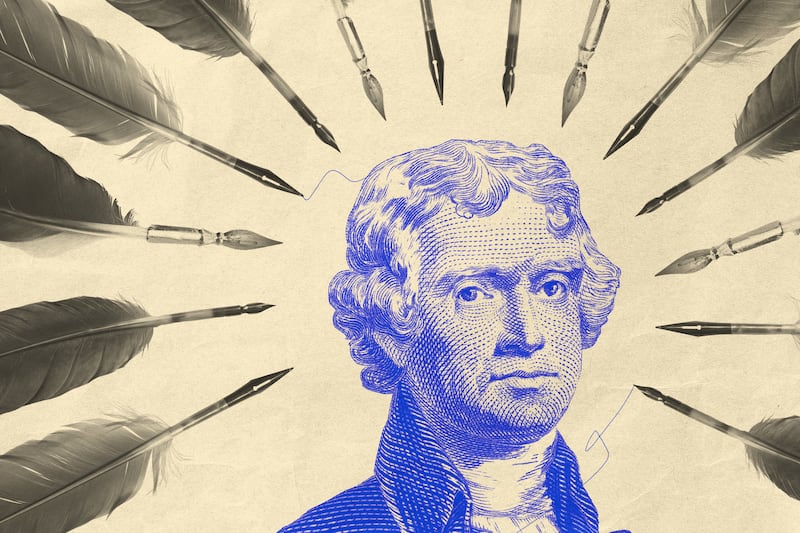

As Thomas Jefferson “fairly writhed” in his seat, according to historian Jon Meacham, 56 delegates to the Second Continental Congress group-edited the Declaration of Independence. Imagine the ordinary agony of a man who led one of the most extraordinary lives in history, forced to listen to “member after member offering his thoughts, wanting to change this and cut that.”
Having devoted my life to gathering people who don’t think alike into rooms of deep listening across enormous divides, I feel his pain. But I also recognize the genius reflected in that same moment: America was designed to be edited.
The result of their labor became a Declaration that made its way to a king, to a people — and in the 250 years since — into human hearts in even the darkest corners of the globe. So began the complicated business of navigating self-government — now in an America of almost 350 million opinionated citizens who are free to express those opinions (and rarely hesitate to do so).
As we mark the anniversary of the Declaration that brought our country into being, I have been struggling with where we are as a people. As inheritors of a transcendent idea planted firmly in a clear-eyed understanding of human nature, lately we seem to have all but surrendered to the coarser aspects of being human.
On this July 4, to our deep peril as a people, I fear we’ve forgotten the fundamental genius of our own idea. If we Americans are to continue our legacy of leading lives free of the whims of a king, we must by definition do it as a joint project with people we fundamentally disagree with — however wrong they often are — who also want to live free.
I’ve been lucky this year to explore the past and present of the American idea in the company of the giant thinkers of our time through the Village Square and Florida Humanities UNUM series. Our most recent conversation was with constitutional scholar Yuval Levin, who opens his book “American Covenant” with James Madison in Federalist 10: “As long as the reason of man continues fallible, and he is at liberty to exercise it, different opinions will be formed.”
To build on Madison and Levin, if there’s one thing I’ve learned from being in many rooms with citizens I disagree with, it’s that people can be shockingly incorrect, impressively self-deluding and breathtakingly hypocritical. I doubt I would have stayed in many of those rooms were this not my job.
But having done so, I know now that it’s not only my political foes who are deeply flawed and often wrong — it’s friends too. And I too am often wrong. By sticking it out with other often-wrong people of every political, racial and religious stripe, I have learned that it is in proximity to exactly this wide variety of sometimes-right people that the most profound insights of my civic life have occurred.
Others can see what I often cannot, and I become a better person in their company. If you don’t know this about yourself yet, you haven’t been in enough of the rooms a free people must occupy to stay free.
Levin, whose politics are different from my own, reminded us that both sides of disagreements are populated by just such fallible people — “it’s human beings all the way down” — and that “getting in each other’s way in our system is a feature, not a bug.”
You see, our project doesn’t work without people who challenge our reasoning. A diverse citizenry forged through ongoing disagreement sees more things clearly and achieves more results than does a king sitting around cogitating.
I believe we are living at a hinge point in history when there is no shortcut but to dig deep into our personal and civic reserves and refuse to be alienated from those we disagree with — unless we’re willing to risk becoming the generation of Americans who lose the gift of freedom our framers gave the world.
The sentences in the Declaration that began “we hold these truths to be self-evident” are words that powerfully told a king that in this new country, the people would be sovereign. It turns out “self-evident” wasn’t even Jefferson’s original word choice, but a suggestion by Ben Franklin.
Jefferson wasn’t just flawed enough to benefit from an editor — his imperfection was epic. For a lifetime Jefferson’s personal actions betrayed his soaring words — failing to free more than 600 human beings he kept as slaves.
This moral contradiction screams loudly through the two and a half centuries — if only we can hear it — that even a person capable of bravely founding the nation that Lincoln would later call “the last best hope of earth” can also be capable of callous cruelty.
Our system of government is designed for the imperfect people they were — and we are. Some days it’s hard to do, but it is by staying in the messy thrum of disagreement with each other that we continue to live incrementally into the better people and the better nation we can become. It’s when we stop being in proximity to each other — a self-imposed, intellectual isolation too many of us are now choosing — that the gravest dangers become possible.
Over the next 250 years, may we have the humility to listen to the “editors” our fellow citizens are meant to be for us and possess the same steady determination of the generations we follow — in pursuit of this great unfinished project we share.
Happy birthday, America.