



One of my sons has always loved Spider-Man — at least as much as his dad loved Superman since childhood. We both know who would win in a head-to-head contest, but to keep the peace, I try not to press the point.
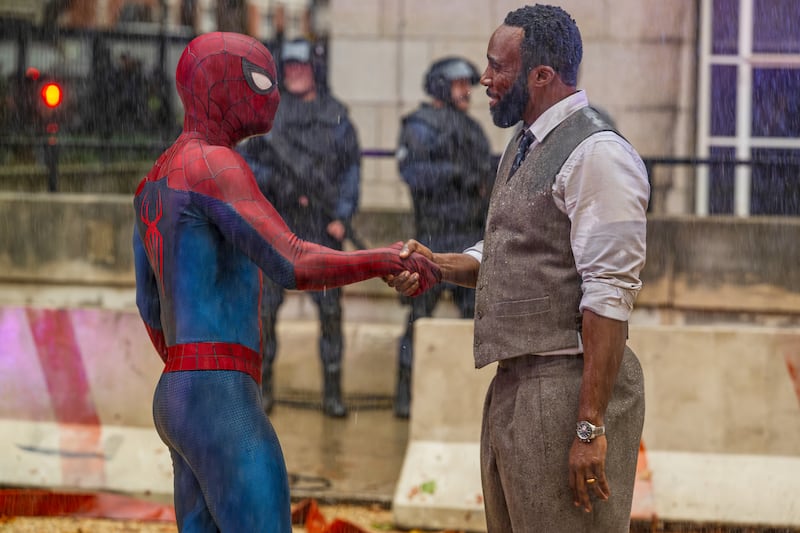
With his birthday coming up, he’s been excitedly planning an outing to see the new “Spider-Man: Brand New Day” with his friends — along with apparently every other young person in the known world ($1.67 billion worldwide in its first 10 days).
And lots of older people too. Like many fathers, I showed my kids Marvel Avenger movies way earlier than their mother would have preferred — with superhero lore a fun backdrop of their childhoods, from posters on the wall to Halloween costumes to Friday night with popcorn.
So, I didn’t think much about my son inviting his friends to go. But my wife Monique felt a little uncomfortable and wasn’t sure why. I’d only seen some cautions about “mild” or “moderate” language in the show and told her I’d look up some family reviews.
I was honestly a little surprised to find Plugged In, from Focus on the Family, reporting “15 s-words, a dozen uses of “h—,” six uses of “a—” and that “God’s name and Jesus’ name are both misused a total of 16 times.”
Hold on, I’d been told the language was pretty mild? After all:
- Common Sense Media cautioned about “some language” — apparently good enough for “11-year-olds” — including only “a few uses” of a variety of swear words.
- FilmiSnap characterized this as “mild profanity similar to previous MCU entries” — stating that “most conversations remain suitable for family audiences.”
- And most raters in the IMDb Parents Guide concluded this was “moderate” profanity, although they did acknowledge that one of the 4 variations of God’s name as a curse word was “the most in any Spider-Man movie.”
This Spider-Man movie is more foul-mouthed than previous installments. And this Tom Holland trilogy is significantly coarser than the Tobey Maguire and Andrew Garfield series that came before, according to Kids-in-Mind reviews dating back to the original 2002 movie.
Our friendly neighborhood Spider-Man isn’t quite so friendly anymore.
But the real question isn’t one Spider-Man can answer for us: Have we decided as a society that 40 obscenities in a movie focused on young people is “mild” and “suitable for family audiences?”
Movieguide, a Christian review organization, disagrees — stating more directly that the latest Spider-Man installment was “not for children, younger teens, or anyone who would rather not hear the name of Jesus Christ used as a curse.”
Even secular observers noted this movie’s surprising spike in usage of the “s” word.
But thankfully, it’s not any movie critic or review guide who gets to make decisions in our own homes. Monique and I, however, didn’t just want to tell my teenage son what to do. So, instead, we read him what we heard about the movie — and asked him what he thought.
“Well, I’m not going to that,” he said — clearly crestfallen. “It’s a dumb thing — all the swearing,” he told me. “I’ve been looking forward to seeing it for a while.”
This clearly isn’t an easy question for families, including our own. No parent wants their child to be “that kid” at school who hardly knows what their friends are talking about — and comes across clueless with major cultural references.
When I was growing up, there were constant references to “Friends” (1994-2004) and later, “Titanic” (1997). But my parents never felt comfortable with us watching either, and I’m grateful today they actually drew a line.
None of this is about judging anyone, though — including other parents. We’ve got dear friends raised in faiths and homes where using different language, including God’s name, was pretty normal.
Different family cultures prioritize different things. I grew up hearing about the story of a former leader of our faith being wheeled out of an operating room by an attendant who stumbled and in anger cursed using several of God’s names. Although “half-conscious” he reported, “I recoiled and implored: ‘Please! Please! That is my Lord whose names you revile.’”
In a subdued voice the man whispered, “I am sorry.”
Although Spencer W. Kimball went on to acknowledge that many will dismiss scriptural teaching about this as “given millennia ago to a faraway people” — he insisted the command still mattered:
“Thou shalt not take the name of the Lord thy God in vain,” Moses is told, “for the Lord will not hold him guiltless that taketh his name in vain.”
I want it to still matter in our home too. My boys used to react visibly when they heard profanity used in a show we were watching.
That is happening less as they are getting into high school — and hearing how frequently even kids are cursing now.
Yet none of this is new either. When we pulled up “Back to the Future” (1985) to show our kids, we were shocked at how much swearing there was (roughly 36 times). “Transformers” (2007) also had close to 30 words — along with provocative sexual references Michael Bay infused into a film he knew would be a magnet for teenage boys.
Of course, any such talk becomes just another punch line for some observers who find this a distraction at best and a puritanical scold at worst.
“Pearl-clutching at its finest,” wrote one Reddit commentator about parental concerns with the movie. Another poked fun at websites that catalog inappropriate content for parents “right down to counting every ‘bad’ word.”
But this isn’t a punch line. And it’s not a silly distraction.
Reverence for God’s name — and prohibitions against misusing or profaning it — is a teaching shared by Judaism, Christianity and Islam. And as my colleague Jennifer Graham has written about it thoughtfully over the years, coarse language also has broader implications in our public life and national affairs.
“We can have little hope of the blessing of heaven on our arms if we insult it by our impropriety and folly,” wrote George Washington in a 1776 letter after learning of what he called “the foolish and wicked practice of profane cursing and swearing” increasing in the American army.
Do we blink anymore when the cursing starts up, fellow adults-in-the-room? Because if not, let’s not be surprised if our children grow up not caring about this at all.