

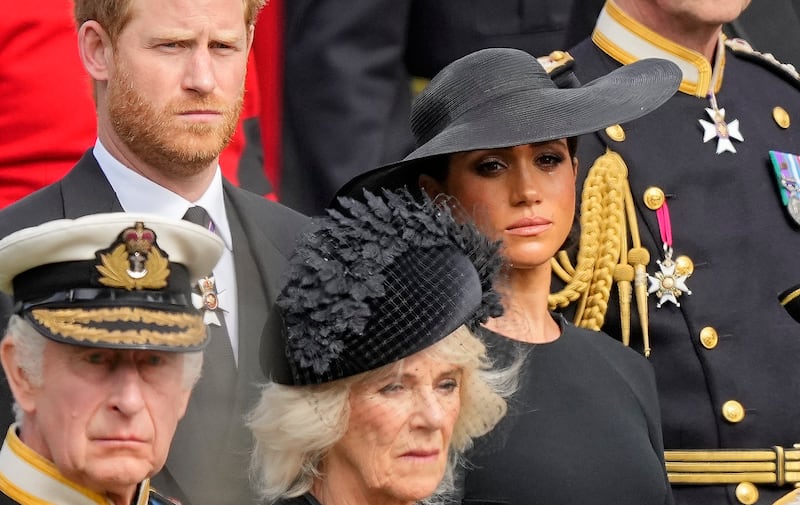

The differences between British royals and the rest of us are obvious enough that we’re most likely to just laugh about them. In the wake of Harry and Meghan’s announced return to the U.K. for unknown reasons, several of my colleagues jokingly speculated that “60 million doesn’t go as far as it used to” (the estimated combined net worth of the Duke and Duchess of Sussex).
The House of Windsor feels far removed from most of our realities. There are the nannies and security details, the palaces and multimillion-dollar homes, the relentless press attention and a social circle populated by celebrities. What could seem further from the jobs, mortgages, school pickups and grocery bills that fill most of our days?
Then again, the kinds of family tensions that have been on display between an aging father and his 41-year-old son hit home for many of us. Could that be another reason many of us have a hard time looking away from the continuing drama in the royal family?
The age of estrangement
We now live in an era where cutting off disappointing family or friends has become cast as virtuously “therapeutic” — more like detoxing from heavy metals or cutting out gluten.
Most of us know what it’s like to be estranged from someone we once loved dearly — maybe even denounced as well.

Prince Harry and his father, King Charles III, know this pain well — having experienced six years now of estrangement since Harry and Meghan’s decision to step back from royal duties in early 2020. That escalated considerably with the publication of Harry’s memoir three years later, “Spare,” which included lines such as this about his father Charles:
- “He had trouble communicating, trouble listening, trouble being intimate face-to-face.”
- “He’d sit on the edge of the bed. He’d never read to us. He was no good at that.”
Charles didn’t express love openly enough, verbally enough, Harry complains. How would you like your own limitations as a parent broadcast to record-breaking numbers around the world thanks to a lucrative publishing contract and an accompanying Netflix series?
In fairness, Harry also noted moments of sweet affection, like Charles stroking his young son’s face until he fell asleep — or answering the phone affectionately: “How are you, darling boy?”
What family story will we tell?
Much like the rest of our families, then, there are both hurtful mistakes and heartfelt gestures in this family’s saga. So, where will our focus be?
Prince Harry chose the grievance route, like so many children today educated in “woke” secular dogma affirming that the world only changes when such injustices are aired and confronted without hesitation, whatever the relational cost may be.

Harry and Meghan did just that. And then they watched their family relationships crumble — to the point that their young children, Prince Archie and Princess Lilibet, didn’t see their grandparents for four years until a reunion only one month ago.
Does any of this sound familiar to those of you who are grandparents? Just a few weeks ago, I heard yet another story of doting grandparents who haven’t been able to see a grandchild they adore.
Compared with an estrangement rate of 25% in a 2022 Deseret News poll, more recent surveys found 35% in 2024 reporting estrangement from an immediate family member in 2024 and 38% in 2025.
This might explain why the saga at Buckingham Palace remains so engrossing. Many of us can see ourselves in a son swimming in grievance and father who reportedly told his feuding sons at Prince Philip’s funeral in 2021, “Please boys, don’t make my final years a misery.”
“Strip away the tabloids and the royal titles and the tabloid drama, and this is actually a story about something deeply familiar,” says Deseret News reporter Margaret Darby. “A son whose father has cancer, and a chance to get his kids closer to their grandfather before it’s too late.”
‘Words that leave a scar’
The family has some work ahead of them. In Prince Harry’s memoir, he chose what Patti Davis calls “words that cut deep, that leave a scar”— for instance, calling William an “arch nemesis.”
The brothers remain “no contact” as of this summer, with not even texts of phone calls taking place, according to one report.
As The Atlantic writer Helen Lewis described the memoir, Harry’s anger “ooze(s) out of every page” — reflecting the “true quality of a family quarrel, reheating decades-old grievances.”
One British broadcaster Tom Bradby asked Harry “why he was revealing the most intense, most intimate moments of his life and laying so much of the blame at his family’s door.”
Harry pushed back: “None of anything that I’ve written is ever intended to hurt my family.” Rather, he insisted his aim was simply to “give a full picture of the situation.”
Denunciation as ‘truth telling’
There’s a long history of public denunciation even towards family members being framed as an act of noble truth telling. At its far extreme, memoirs such as Ji-li Jiang’s “Red Scarf Girl” detail how denunciation of family members was a building block of the brutal cultural revolution in China.
Closer to home, a cottage industry of podcasts and influencers amplifying denunciation has thrived in recent decades — including those on a mission to dress down a particular faith, an individual or a corporation, like Sea World.
Still today, these public denunciations are being portrayed as courageous truth-tellers standing up to pernicious injustice. Any resistance that arises is likewise framed as predictably corrupt. As Harry explains the pushback he’s received, “if you speak truth to power, that’s how they respond.”
Patti Davis, the daughter of President Ronald Reagan, followed a course similar to Harry years earlier when she “flung open the gates of our troubled family life” in her own tell-all autobiography — something for which she apologized to the former president right before he died.
Davis recounts her justification at the time: “I wanted to tell the truth, I wanted to set the record straight. Naïvely, I thought if I put my own feelings and my own truth out there for the world to read, my family might also come to understand me better.”
After acknowledging the obvious — that none of us respond well to being “embarrassed and exposed in public” — Davis realized that the full truth was more complicated than simply “her truth.”
Reconciliation on the horizon?
Even amid deep grievance, something else in life can wake us up. When the King announced his cancer diagnosis in 2024, Harry quickly flew from California to London for an in-person meeting.
“I love my family,” he said on Good Morning America weeks later — affirming that his father’s illness might have a “reunifying effect” on their family. “Yeah, I’m sure.”
A more permanent move home may also mark another step in eventual reconciliation.
Christina Buttons similarly recalls the effect of learning about her mother’s cancer diagnosis in her article entitled, “I Went No Contact with My Parents. I Regret It.” After five years of cutting her parents off without explanation, that revelation about her mother’s fragile health changed everything.
“All of a sudden, the reasons I used to justify staying away seemed horribly trivial,” she wrote in The Free Press.
After being asked what she would say to her younger self if she could, President Reagan’s daughter Davis recalled, “That’s easy. I’d have said, ‘Be quiet.’ ... Not forever. But until I could stand back and look at things through a wider lens.”
“Words have consequences, and they last a really long time,” she added. And “not everything needs to be shared.”
Wisdom to live by, for sure. Unless real abuse is taking place, it’s good to not give up on each other quite so quickly.
Maybe we care about this unfolding story in the royal family, Darby concludes, “because it’s asking a question that every family has faced: Can you actually go home again, and can broken relationships really be repaired?”