

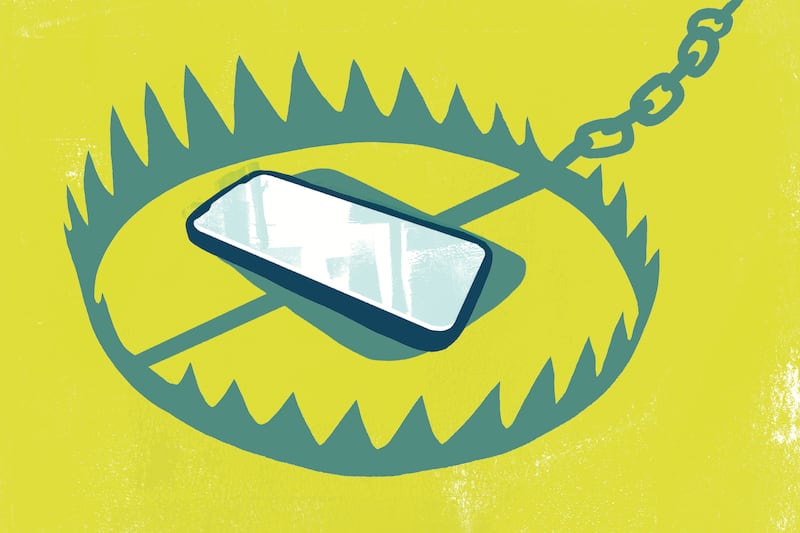

The scam text you just deleted is part of a $108 million problem in Utah.
Not long ago, I sat down at the White House with Vice President JD Vance, Federal Trade Commission Chair Andrew Ferguson, and about a dozen of my fellow attorneys general from across the country. It was the first meeting of the White House Task Force to Eliminate Fraud, and I didn’t go to observe. I went with specific proposals for closing the data-sharing gaps between states: the gaps that let cross-border fraud schemes operate with impunity.
I went because no issue reaches my desk — or my phone — more often than this one.
You know the pattern. Your phone rings on the way to work. You don’t recognize the number, so you let it go to voicemail. Moments later, a text lights up your screen from a different number: You have an “unpaid parking ticket,” so please just “click on this link to pay it.” By the end of the day, you’ve ignored half a dozen calls, texts and emails just like it. And that’s not an abnormal day. For most Utahns, myself included, it’s just another Tuesday.
Recently, a good friend called to say he’d been the victim of a real estate fraud scheme. I get these calls often, but this one was different.
My friend is a sophisticated real estate attorney who has practiced at some of the most prestigious firms in the country. He’s spent his career reading the fine print. He knew the exact scheme that got him, but in a brief moment of weakness, he wired the money without double-checking. That moment cost him several million dollars.
He reported it immediately. Because he did, our team recovered most of the funds. He was lucky; most victims aren’t. In these schemes, every minute between the fraud and the report is the difference between recovery and loss.
The lesson I’ve shared with audiences across Utah: If it can happen to a sophisticated lawyer, it can happen to anyone. Including you.
Every fraud you report helps us catch the people behind it before they reach your neighbor’s phone.
So, let me say something I wish Utahns understood: There is no shame in being scammed by sophisticated fraudsters.
I have learned, unfortunately, that many scam victims never even report these crimes out of embarrassment. Fraudsters don’t succeed by targeting careless people. They succeed by tapping into your most powerful emotions — fear, urgency or love for a grandchild who appears to be in trouble. Young or old, educated or working class, no one is immune.
The scale of this fraud is staggering. Last year, Utahns reported losing $108.4 million, according to Federal Trade Commission data, and that figure counts only what was actually reported.
My office is fighting back, and now we have new tools to do it. Thanks to the leadership of Utah Senate Majority Leader Kirk Cullimore, we have the resources to build a sophisticated platform where Utahns can report fraud without judgment. We will be able to track these schemes and operate a statewide fraud intelligence center that can connect dots that have been difficult to connect in the past.
And when we catch these criminals, we prosecute them.
James Miller promised three investors cryptocurrency returns and took more than $400,000 before my team stopped him. This year, a judge sentenced him to up to 15 years in prison. Dalton Slangerup was sentenced this year for theft and deception schemes that cost 13 victims nearly $247,000.
Both of these men made the same calculation: that they could defraud Utahns with impunity and that Utah would not come looking for him. Both were wrong.
Since I took office in 2025, courts have ordered more than $1.4 million in restitution for 46 victims in our cases. We also pursue the fraud you never see, the kind that drains the programs that we all pay into. Last fiscal year, our Cooperative Disability Investigations Unit ranked first in the nation, producing $9 million in savings for Social Security and more than $2.5 million for Medicaid and Medicare.
But here is the hard truth: Fraud is changing faster than our borders. The most aggressive schemes are built to cross state lines, even continents, and then disappear — money-laundering networks recruit local residents to receive stolen funds and convert them to cryptocurrency before investigators can follow the trail.
You have a role to play, and it is simpler than you might think. The next time your phone rings with a number you don’t recognize, or a text asks you to click a link and send money — don’t respond. You have no obligation to answer a stranger. If you are worried the call might be real, find the official number on the official website and check for yourself.
If you are ever victimized, report it immediately. As my friend’s story shows, speed is often what makes recovery possible. Every fraud you report helps us catch the people behind it before they reach your neighbor’s phone. That is how a $108 million problem starts getting smaller.