

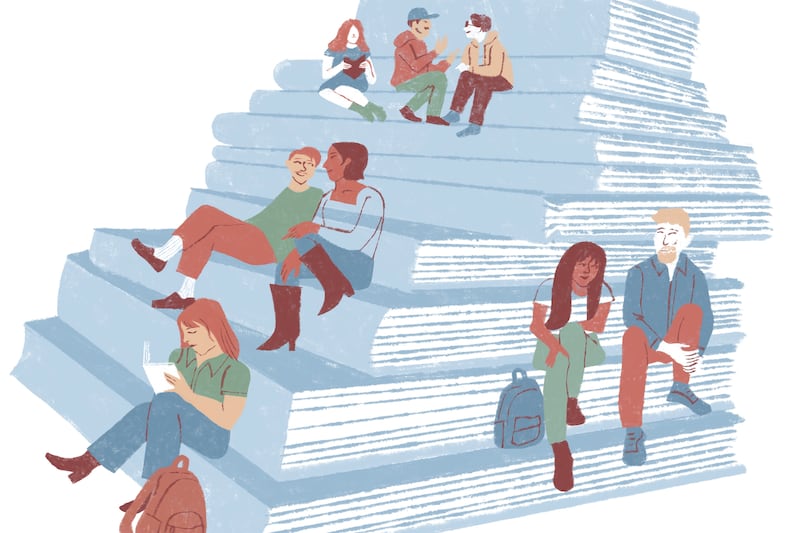

My daughter is getting ready to begin kindergarten this fall. She will be at a new school, with new classmates and many new teachers. She just turned 5 and her new backpack is almost as big as she is.
She’s excited and proud to be going to her new school. I may be more excited than she is, which says something about me as an academic. I think she may be nervous too, though she would deny it if I asked.
I’m both a parent and professor, so I have some advice that I want to share with her as she begins her journey and I figured it’s worth sharing here too: Pay attention to yourself, but don’t ignore the world outside either.
I offer this advice now because roughly two decades ago, therapeutic ideas and their vocabulary first became prominent in education. My students can easily share that they are anxious or struggling without much shame. There is virtue in this language because few talked openly about their mental health when I was an undergraduate; many remained quiet and suffered. I don’t want that back.
The trouble that I see today as a teacher is that the language of therapy has become the dominant vocabulary of students. Many students are fluent in describing what is going on inside them and that is helpful. But if you ask them questions about institutions, systems and the larger world — such as what an author is arguing or what their community needs — they often have trouble articulating their views and their responses are slow because those questions face outward.
Therapeutic ideas like “my truth” have value, but they should not set the tone for everything in life and limit one’s perspective on the world.
Be yourself, but also be kind and thoughtful of others. You may not know how someone else is feeling, and they may need a smile too.
A potent example is that most of my students have never heard of a community board. Anyone can go to their meetings and speak and one can have a local impact immediately. I remember sitting in one where we spent two hours debating a curb cut along a single block. These meetings are not glamorous, but they have impact.
Far too many students today do not understand that going to a local meeting, participating and then engaging by voicing something can be very valuable, and that it means looking outside of yourself. There are many ways to change a community. Protesting and shouting have their moments and make participants feel that they acted, sure, but there are other ways, and many students simply do not know about them.
Our students today are extraordinarily self-aware but they are also lonely and anxious. When students are conditioned to look inward so heavily, they have real difficulty building connections to institutions and others.
Carlos Carvalho, the president of the University of Austin, recently made this point in his convocation address, which was entitled “Forget Yourself.” Universities, he argued, too often hand students a self-affirming mirror when “what you need is a window.” Drawing on Alexis de Tocqueville, Carvalho worried that as ties of faith, place and community weaken, people retreat further into themselves. His advice was to look outward: Read books that do not care who you are and help someone when it is inconvenient.
Carvalho’s idea is worth amplifying and we should not ignore the individual. But the therapeutic language and looking inward cannot and should not be everything. When a problem needs to be addressed, we should not immediately look inward and say this is how I feel. Part of how we feel is about belonging, about being part of something outside of us and contributing to it. We have made the world lopsided, and therapeutic language has helped push us farther in that direction. It is not that there is anything wrong with thinking therapeutically in some contexts, but we are internal and external creatures, and we need to be able to look inward and outward.
UATX is starting with college freshmen, but looking both inward and outward is something we should be doing as early as kindergarten, when kids are asking wide-ranging questions and pushing boundaries. For my daughter and her new classmates, we want to consider her feelings. They should recognize that those feelings are real, and that they are also part of something bigger.
Kindergarten is about letters and numbers and being creative. But there is a social component as well — it is one of the earliest moments when a child can understand that she belongs to something she did not create and that there is something bigger than her. There is a teacher to listen to, rules and other children whose needs sometimes come before hers. There are songs everyone learns and traditions she did not invent that help set the tone and ideals of the school.
In some ways, my daughter already knows this through our faith. Judaism has been teaching her, in the small ways a 5-year-old can understand, that she is part of something older and larger than herself. There are prayers she did not write, traditions that began long before she did that we maintain regardless of her desire to follow them. She knows Shabbat feels different from Tuesday and I hope that she knows that some things are received rather than chosen.
Scouting taught me the same lesson about looking outside myself and had little to do with my faith. When I became a Scout, I made a commitment to my Scoutmaster and my troop and my patrol. We met on Monday nights and attending every Monday night was fun. I was tired, I had homework, there were social events I missed with my peers at school, and sometimes the Eagles were on Monday Night Football and I missed kickoff. Scout meetings would have been nice to skip, but I promised to commit to others.
Looking back 25 years later, what I gained was real friendships, mentorship and community because I followed through on my commitments. We are part of families, schools, friendships and traditions, and being an active part of them is not only an obligation, it can be a real pleasure.
Carvalho ends his message by urging his students toward “the durable joy of being absorbed in something greater than you.” I agree, and this is what I want for my daughter. Balance is what we need, and we can start establishing and anchoring these ideas as early as kindergarten.
So at my daughter’s school door at drop-off, I will crouch down and give her the kindergarten version along with a hug. I will tell her to have fun, listen to her teacher and help somebody who needs it. Be yourself, but also be kind and thoughtful of others. You may not know how someone else is feeling, and they may need a smile too.