

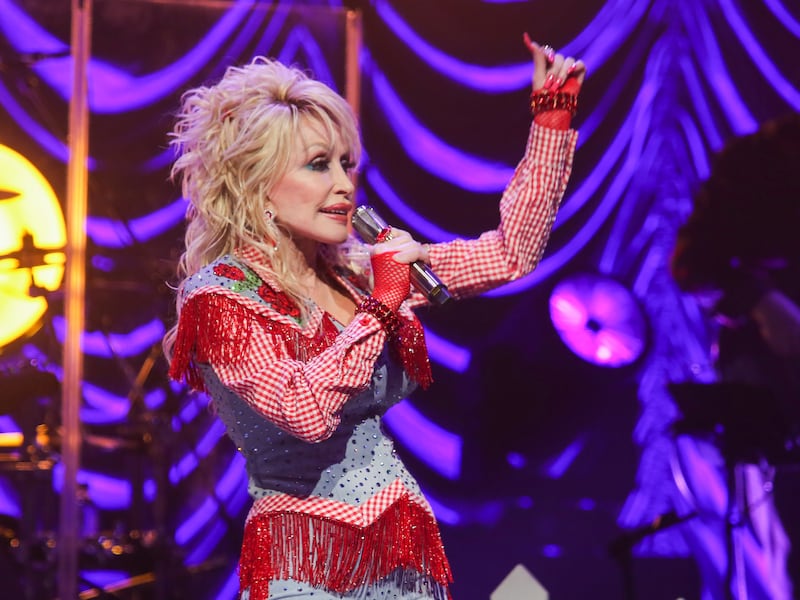
Like many of us, I’ve been listening to a lot of Dolly Parton’s music over the last two weeks. Since her passing, many articles have commented on Parton’s ability to bridge divides. Everybody loved her.
When Radiolab creator Jad Abumrad visited Weber State University three years ago, I had the chance to interview him. Among many topics, we discussed his 2019 podcast “Dolly Parton’s America,” which explored the ways in which Parton could speak to and about Americans from so many walks of life. I told Abumrad I felt cautiously hopeful listening to the podcast, and he talked about how Parton gave us a model for confronting differences.
She always approached individuals with empathy and never lost her sense of self in the process. Abumrad also discussed how her music helped him understand that Eastern Tennessee, where he grew up as the son of Lebanese immigrants, was as much his home as it was hers.
While not every performer can rock a rhinestone outfit the way Parton could, one of her legacies is to remind us how important the arts can be in bringing people together, even during difficult times. I have the good fortune of seeing this every day in the amazing work produced by Weber State faculty. Our artists, musicians and poets are creating awe-inspiring works and receiving accolades and recognitions at local, state and national levels.
While these achievements are significant on their own, what makes them truly remarkable is the way in which each artist uses their creations to strengthen communities and to remind us of the beauty that’s all around us.
Take Ogden’s newest Poet Laureate Sunni Wilkinson, who inspires communities through storytelling. Author of three poetry collections and an instructor of English at WSU, Wilkinson’s writing focuses on small moments and examines the significance of the ordinary. She often writes about the natural world and regularly takes her students on outdoor excursions to inspire their creative writing.
Last year Wilkinson co-taught a course with visual artist Kellie Bornhoft on art, poetry and the Great Salt Lake, bringing greater awareness to students of the fragility of our local environment and empowering them to create art that is timely and relevant.
Wilkinson writes that she is “continually trying to find new ways to engage her students and help them connect with the broader community and world,” an approach that is perfect for a poet laureate.
That course on the Great Salt Lake is one of the many ways Bornhoft connects art with environmental stewardship. A recent recipient of the Utah Artist Fellowship, Bornhoft creates immersive, place-based installations that facilitate connections between audience members and the natural world as she invites viewers to consider how empathy, responsibility and collective understanding can emerge through encounters with art. This practice is powerfully exemplified in her recent installation, “This Was Water,” created in partnership with composer and music faculty Carey Campbell, whose haunting musical composition was initially conceived as a requiem for the lake. Together, Campbell and Bornhoft fashioned an abstract piece of art that embeds beauty within a narrative of grief and urgency, asking audiences to understand our common goals.
For Jason Manley, public art is a vehicle to engage audiences through active participation. His art piece “Key Changes,” a giant sculpture designed in celebration of the Bachauer International Piano Competition’s 50th anniversary, was recently on display on the plaza outside Abravanel Hall.
Manley involved several WSU students in all aspects of the design, fabrication and installation of the 9-by-3-foot playable structure. The kinetic and interactive elements of the sculpture engage the public in the imaginative and joyful work of artistic creation.
While many WSU faculty focus on the bountiful resources and people of Utah, Tamara Goldbogen is extending Utah’s reach around the world. Goldbogen has been selected by the U.S. Department of State’s Bureau of Educational and Cultural Affairs and World Learning to join the prestigious Fulbright Specialist Roster for a three-year tenure, making her eligible for global project matches across 150 countries. She’s exploring international academic partnerships with the University of Sarajevo, located in Bosnia and Herzegovina, and Taiwan’s University of Tainan to develop workshops for educators and schoolchildren that use art and puppetry to explore climate resilience and youth participatory action research.
The artistic gifts shared by Weber State’s faculty are inspiring. They serve as role models for students and remind us of the importance of the arts in elevating our shared humanity and addressing the challenges we all face. I think Parton would be proud.