

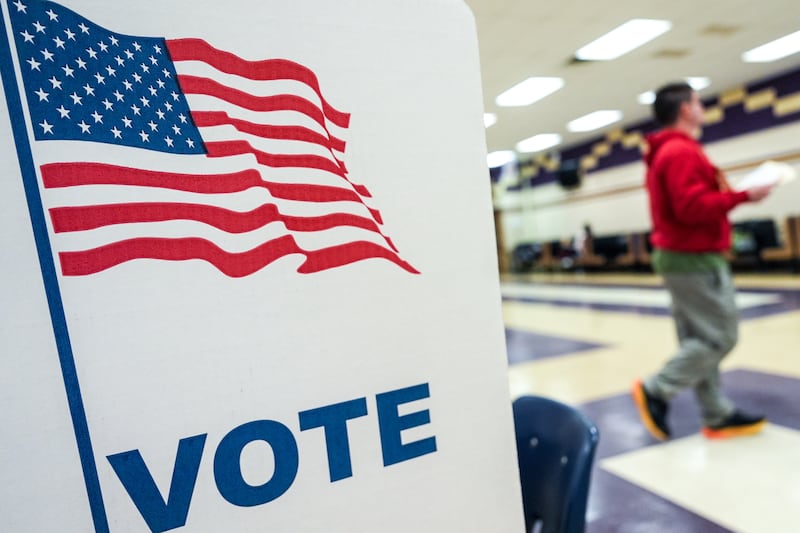

Virginians took to the voting booth on Tuesday as part of a special election, largely approving the redrawing of a congressional map that will heavily favor Democrats come November.
The state approved a plan that could possibly boost Democrats’ chances to win four additional House seats later this year, which could make the difference in regaining control of the lower chamber as the redistricting fight takes place across the country.
A constitutional amendment was backed by voters in Virginia making the heavily-gerrymandered map possible, marking a major setback for the Trump administration in Washington, which hoped to maintain majority control in Congress through the unusual method of mid-decade redistricting.
The special election was officially called just around 9:00 p.m. EDT, two hours after polls closed in Virginia. It could eliminate four of the state’s five Republican-held seats ahead of the 2026 midterms, giving the Democrats the advantage in 10 of the 11 congressional seats in the state.
However, the Democratic win Tuesday evens the playing field between the political parties. The gains for Democrats in this year’s redistricting fight largely match the gains the GOP has potentially made in the months before and leaves the House makeup fairly similar to where it currently stands. It’s unclear if other states will join the redistricting battle, but Florida is rumored to be looking at the option in the coming months.
Early voting ahead of Tuesday showed that 1.4 million Virginia voters cast ballots in the redistricting race, just shy of early voting in the November 2025 Virginia governor’s race, where Democrat Abigail Spanberger won, which was largely regarded as a barometer for where the country and swing states were after the 2024 general election.
Turnout for the special election Tuesday was high given that it was an April special election during a midterm year.
The redistricting battle that President Donald Trump started last year in Texas led Californians to overwhelmingly pass Proposition 50 last year, approving more Democratic seats in the House to counteract Texas’ action. Many other states followed with their own unique mid-decade redistricting votes, defying the typical map scrutiny that follows the census every 10 years.
In Virginia, Democrats finalized an agreement in February about how they should redraw the state’s congressional map, leading to eight safe Democratic districts, two that leaned Democratic and one safe Republican seat. As it currently stands, Virginia has six Democrats and five Republicans in the House.
Voters cast ballots ahead of Tuesday’s special election on a temporary amendment that would allow the state to revert to its standard redistricting process come 2030 if voters wanted.
In the lead-up to the special election Tuesday, there was an influx of spending and a huge get out the vote effort by both parties. There were a lot of questions around who was donating funds to either side of the referendum since state laws say nonprofit organizations don’t have to disclose their donors.
Even as the parties look to take control of the lower chamber during Trump’s last two years in the White House, it seems that the hundreds of millions of dollars poured into these battles across the country may not have been entirely useful in changing the makeup of the House.
Historically, the party that controls the White House tends to lose ground with voters in the midterm elections.
According to RealClearPolitics’ polling averages for a generic 2026 congressional ballot, Democrats have a more than 5 percentage point lead over the GOP. Still, the administration has several months in order to make its case to Americans.