

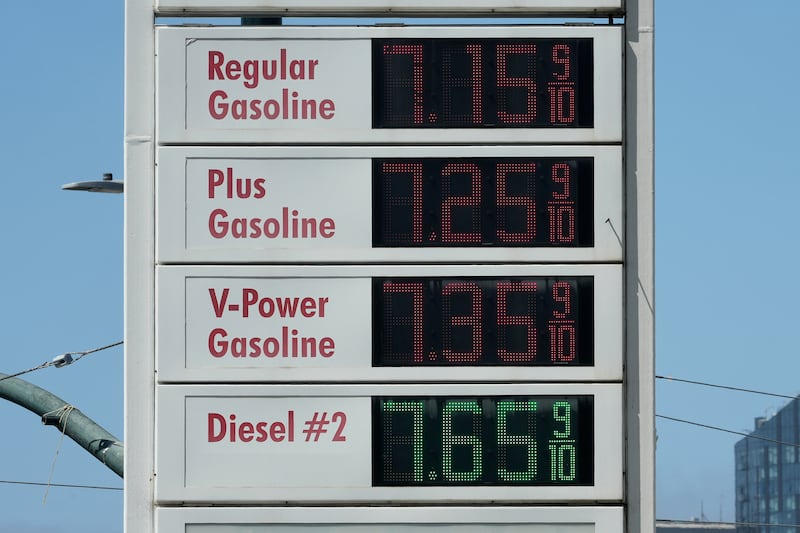

Utahns aren’t the only ones paying more for a gallon of gas — many states in the West are struggling with steeper prices.
At the top of the list is California, where the average rate for a gallon is $5.98, and Arizona, the neighboring state, is also experiencing a steep hike.
At an average of $4.23 per gallon, Utah’s gas prices have risen 12 cents per gallon since Monday and are up $1.01 compared to a year ago, per AAA data.
“Average gasoline prices rose in 39 states over the last week, with the national average moving higher, while diesel prices declined in most states, offering a brief divergence at the pump,” Patrick De Haan, head of petroleum analysis at GasBuddy, said in a statement from a Monday press release.
As the Deseret News reported, this worrying trend persists because the Strait of Hormuz, a critical shipping passage through which 20% of the world’s oil exports travel to global markets, remains closed, and negotiations to end the war in Iran are stalled amid a fragile ceasefire.
With the midterms just a few months away, politicians running for critical races in Arizona and California are addressing the problem of costly fuel rates.
Arizona works on getting a new pipeline from Texas
Before the war began, the price of gas in the Grand Canyon State hovered at $3.59.
On Wednesday, the average climbed to $4.632, according to AAA.
A spokesperson from the Copper State Victory, a campaign Democratic effort, held two of Arizona’s Republican representatives, both of whom are running for governor, responsible for this trend.
“With gas prices hitting all-time highs, there is no end in sight to Andy Biggs and David Schweikert’s cost-hiking agenda. Biggs and Schweikert have already failed Arizonans, and now they are sticking families with the bill,” said Nicholas Simões Machado.
There are no oil refineries in Arizona, and only two major pipelines, one from Texas and another from California. Last week, the Western Gateway Pipeline project announced it is adding another fuel source in the state. The proposed pipeline would stretch from the Texas Panhandle to Phoenix. The goal is to match the Arizona metro’s growing needs while also potentially bringing relief to drivers in the valley.
Of the latest project, Biggs said, “They doubled the size of the new people proposal that they got approval from the EPA.”
He revealed another proposal is in the works to transport fuel from New Mexico, adding, “That will help as well.”
“The problem with California, of course, is they’ve got exotic blends of gas that we get stuck paying for,” he said. “Also, California’s closing its refineries.”
The California Energy Commission is seeking a buyer for the Valero refinery in Benicia, California, which is expected to transition into an import hub for gasoline.
Biggs noted that state officials in Arizona file annually with the EPA to avoid California’s “boutique” fuel blends. “That keeps price down (by) 60 cents a gallon.”
But the Arizona representative added, “As long as we’re involved in the Middle East, I’m afraid that the world market price is going to be high.”
Candidates in California’s race reckon with high prices
The average price of gas per gallon in California is $5.98, compared to the $4.82 average in mid-February, before the war began.
California Gov. Gavin Newsom’s office shifted the blame to the White House in a post on X.
“Thanks to President Trump stumbling into a long war with no plan, Americans are now paying more at the pump — and that doesn’t appear to be stopping any time soon,” said Newsom.
During California’s gubernatorial debate, many candidates addressed how they would tackle the Golden State’s expensive fuel problem.
Billionaire business owner Tom Steyer blamed the state’s high gas prices on Trump as well as the ongoing war in Iran.
“That war has driven up prices for everybody in California … and the cost to the oil companies has not gone up a penny,” Steyer said during the live broadcast on CBS-owned stations.
He also defended his previous statements, in which he supported outsourcing California’s oil refining to other states or countries.
“What I said was that we should have the ability to outsource everything because we are under the thumb of the oil companies who are jacking up prices,” Steyer said, clarifying his stance.
The U.S. Oil & Gas Association rebuked the narratives from Democrats regarding gas prices.
“High gas prices in your district aren’t ‘Trump’s war’ — they’re Sacramento’s doing,” wrote USOGA President Tim Stewart in a post on X, responding to Rep. Ro Khanna.
“California drivers pay nearly double the national average in state taxes, plus cap-and-trade, Low Carbon Fuel Standard, unique reformulated gasoline, refinery limits, and geographic isolation that blocks cheap imports,” he added. “That adds $1.00–$1.78+ over the U.S. average.”
At the gubernatorial debate, former U.S. Health and Human Services Secretary Xavier Becerra noted that slashing the gas tax hurts people who cannot afford electric vehicles and deprives the state of necessary funds to fix roads. Meanwhile, San Jose Mayor Matt Mahan reiterated his promise to suspend California’s gas tax amid the skyrocketing prices.
“It is the most regressive tax in California,” Mahan said. “Working people, rural people are spending three times as much maintaining our roads as wealthy EV owners.”